Til laddu is a traditional Indian dessert prepared during Makar Sankranti. This sweet and nutty, sphere-shaped sweet is made with roasted sesame seeds and jaggery.

Makar Sankranti is celebrated with great fervor and devotion across various states in India. Til ladoo is traditionally made to celebrate the occasion and shared with friends and family.
My office colleagues would often share these laddus with us while saying the words ‘ tilgul ghyaa ani god god bola ‘ (which means take the til gul laddu and speak sweetly). Pretty great, isn’t it?
These laddus are also known by other names like tilache ladoo, til gul, tilgul ladoo, til gud ladooi in Marathu, tal na ladoo in Gujarati, tilkut in Bihari, til ke laddu in Hindi, ellu unde or ellu urandai in Kannada, and sesame seed and jaggery ladoo in English.
Til means sesame seeds and gul, gud, or gur is jaggery.
Each family has their own way of making this laddu. This is not something that was made in my household, but having lived in Mumbai, I’ve feasted on quite of few of them.
I’ve learned to make these laddus from my friend, Yogita. Last Makar Sankranti, we got together to make about 1 kg of these scrumptious laddus.
This year I simply had to share it on the blog and I really hope you will give it a go.
- Significance of Makar Sankranti festival
- Why should you make these laddus?
- Ingredients needed
- How to make til ke laddu – Step-by-step process
- Storage instructions
- Recipe Tips
- Frequently asked questions
- You may also enjoy these ladoo recipes
- Til Laddu | Sesame Laddu
Significance of Makar Sankranti festival
Makara or Makar Sankranti is a celebration of the harvest festival in India. It marks the arrival of spring and the transition of the Sun into the zodiac sign of Makara rashi (Zodiac sign of Capricorn).
This festival is mostly celebrated on the 14th of January, but sometimes it may be celebrated on the 13th or 15th of January.
It is also celebrated as Thai Pongal in South India, Bihu in East India, and Maghi or Lohri in North India.
Why should you make these laddus?
Sesame seeds are a good source of many nutrients and so is jaggery. The combination of these ingredients in the laddu offers numerous health benefits and makes it ideal to consume during the winter.
Sesame seeds and jaggery have heat-inducing properties and provide the body warmth needed during the winter.
Harsh winters can make many people feel lethargic and fatigued, and these calcium and iron-rich sesame laddus provide a much-needed boost of energy.
It also makes for a delicious snack, especially for growing children.
This protein-packed til laddu is perfect to satisfy those sweet cravings post meals or simply enjoy it as a snack sans the guilt. It is a healthier alternative to refined sugar-laden sweets.
The best part is that it is a pretty quick recipe! It all comes together in under 30 minutes.
Ingredients needed
To make til laddu, you need 4 simple ingredients, which are;
Sesame seeds: I’ve used white sesame seeds, but honestly any kind will work, hulled, unhulled, black sesame seeds, or a combination, whatever you have at hand. You need to roast the seeds as it removes the moisture and also enhances the nutty flavor and crunchy texture.
Jaggery: I’ve used the keshar chap jaggery for these ladoos, which is a darker variety. You can also use light-colored Kolhapuri jaggery.
Ghee: You need little ghee to make the jaggery syrup, it adds a subtle aroma. You will also need ghee to grease your palms while forming the laddus.
Cardamom: To flavor these laddus.
Raw peanuts (optional): I love the flavor and extra crunch these add, but feel free to skip them.
Coconut (optional): I’ve skipped adding it, but you can dry roast about 1/4 cup of unsweetened dry shredded coconut until golden brown and add it along with the roasted sesame seeds.

There are two ways this laddu is prepared;
- With jaggery syrup
- Without jaggery syrup
I’m sharing the first method. It is not a very beginner-friendly method, hence it would be great if you have some help around. I definitely hope to share the second method next time.
You will get better at this method with some practice, as the consistency of the jaggery syrup is important in determining the final texture of this til laddu.
I’ve shared a lot of tips below and I hope you find them handy along with the quick video tutorial for some visuals.
How to make til ke laddu – Step-by-step process
Step 1: Roast sesame seeds
Heat a heavy-bottomed pan on medium-low heat. Add 150 grams (1 cup) of white sesame seeds and dry roast on medium-low heat, until it starts to pop and the color changes to a light golden. ( Photos 1 to 3 )
Pro tip: Sometimes, the seeds do not pop, and that’s okay, pay attention to the change in color.
Transfer to a bowl and set aside. Add 2 tablespoons of roasted crushed peanuts along with 1/2 teaspoon of cardamom powder, and mix well. ( Photos 4 to 6 )

Step 2: Jaggery syrup
Heat the same pan on medium-low heat, add 1/2 tablespoon of ghee, 1 cup grated or chopped jaggery pieces, and 2 tablespoons of water. ( Photos 7 and 8 )
Cook on medium-low heat until it melts and foam begins to appear. ( Photo 9 )
Cook for 2- 3 minutes and test for the softball stage. Transfer a few drops of the melted jaggery into a bowl of cold water. ( Photo 10 )
If it is too soft, sticky, and cannot be shaped into a ball, continue cooking on low heat for another 1-2 minutes. ( Photos 11 and 12 )
Test again. If you can form a soft and stretchable ball, it is done. ( Photos 13 to 15 )

Step 3: Combine sesame seeds and peanuts with jaggery syrup
Add the sesame seed mixture, and mix well on low heat, until well incorporated with the jaggery syrup. ( Photos 16 and 17 )

Step 4: Make laddus
Pro tip: Switch off the heat and immediately divide the mixture into approximately equal-sized portions using a spatula. ( Photo 18 )
Allow the mixture to cool down for 1-2 minutes or until warm enough to handle.
Grease your hands with ghee or apply water, take a portion of the mixture, and shape them into smooth round balls as shown in the video. ( Photos 19 and 20 )
Set aside on a plate and repeat the same process with the remaining portions. ( Photo 21 )
Do not spend too much time perfecting the round shape as the mixture will begin to harden quickly.
Allow the laddus to cool completely before storing. These laddus stay soft even after cooling down. ( Photo 22 )

Storage instructions
Once the laddoos reach room temperature, store them in an airtight container for up to 1 month.
Recipe Tips
The ratio of jaggery and sesame seeds: You need a 1:1 ratio by weight to make til laddu. I suggest using a weighing scale for best results since cup measures can differ. Also, how you chop or grate the jaggery will affect the way it’s measured in volume. You pack more jaggery if it’s finely chopped or grated as opposed to the larger jaggery pieces.
Making this for the first time? I highly suggest sticking with these quantities as it is just right for a novice cook. Unless you have helping hands, I do not suggest doubling this recipe, since you need to work really quickly to make til gud ladoo.
Roast sesame seeds on medium-low heat: Be sure to roast on low to medium-low heat, or else they will burn and impart a bitter taste to the ladoo.
Grate or chop the jaggery into small pieces: This will allow the jaggery to melt uniformly and prevent it from getting overcooked.
Cook jaggery to the softball stage: Do not overcook the jaggery beyond the softball stage. That will make the ladoo hard like a brittle.
Do not switch off the heat while mixing sesame seeds with jaggery syrup: Doing so will reduce the temperature of the mixture and it will begin to cool down immediately. So, mix the sesame seeds with syrup on the lowest heat just until everything is well combined, we do not need to cook this mixture.
Troubleshooting cold and hard ladoo mixture: If it gets too hard, transfer it back to the pan and melt on low heat until jaggery melts.
Form ladoos while still fairly hot: Do not allow the mixture to cool down completely, or you will not be able to form the ladoos, as the mixture will stiffen and turn crumbly.

The mixture is too hot to make ladoos, what should I do?
Apply some water on your palms and try to form the laddu while still warm.
Halfway through if you feel that the mixture is solidifying, you can put it back on the heat until jaggery melts and continue making the laddu or you can make chikki/brittle using this same mixture.
To do that, simply transfer the mixture to a greased plate or a tray lined with parchment paper, and spread it evenly in a thin layer.
Cut into squares and allow to set.
Why is my laddu mixture not binding?
This can happen due to 2 reasons;
- The jaggery syrup did not reach the right consistency, most probably it is undercooked.
- The mixture has turned cold and stiff.
Put the mixture back on low heat, and cook until the jaggery melts. Drop a little mixture in cold water and check if you can form a soft ball. Do not overcook or they will turn hard!
Try to make the laddus while still warm.
Are these laddus hard or soft?
This recipe will yield soft til laddus, since the jaggery syrup is cooked to a softball stage.
If you prefer crisp, hard laddus like the chikki/brittle, cook the jaggery syrup further until it reaches a hard ball stage. When you drop it on a plate it should give out a sound. That’s the right consistency.
If you make the hard laddus, I suggest making smaller laddus since they are easier to eat.
Can I make this vegan?
Yes, of course, you can! Please swap the ghee with plant-based ghee or coconut oil.
How many calories in 1 til ladoo?
1 til laddu contains 110 calories, 12.7 grams of carbs, 2.2 grams of protein, 6.1 grams of fat, and 9.6 grams of sugar. For the complete nutrition information, please check the recipe card.
Please note that these are approximate values and they will differ according to the size of the ladoo.

You may also enjoy these ladoo recipes
Rava laddu
Coconut ladoo
I would love to hear from you! Please be sure to share your feedback and/or give this recipe a rating in the comment below. Your reviews help others know the recipe better too.
You can also FOLLOW me on Facebook , Pinterest, Instagram & Twitter

Til Laddu | Sesame Laddu
Ingredients1x2x3x
- 150 grams sesame seeds, 1 cup
- 20 grams crushed roasted and unsalted peanuts, 2 tablespoons
- 1/2 teaspoon cardamom powder or grated nutmeg
- 1/2 tablespoon ghee
- 150 grams grated or chopped jaggery, 1 cup
- 2 tablespoons water
Instructions
Roast sesame seeds
- Heat a heavy-bottomed pan on medium-low heat. Add sesame seeds and dry roast on medium-low heat, until it starts to pop and the color changes to a light golden.
- Pro tip: Sometimes, the seeds do not pop, and that’s okay, pay attention to the change in color.
- Transfer to a bowl and set aside.
- Add roasted crushed peanuts along with cardamom powder, and mix well.
Jaggery syrup
- Heat the same pan on medium-low heat, add ghee, jaggery and water.
- Cook on medium-low heat until it melts and foam begins to appear.
- Cook for 2- 3 minutes and test for the softball stage. Transfer a few drops of the melted jaggery to cold water.
- If it is too soft, sticky and cannot be shaped into a ball, continue cooking on low heat for another 1 2 minutes.
- Test again. If you can form a soft and stretchable ball, it is done.
Combine sesame seeds and peanuts with jaggery syrup
- Add the sesame seed mixture, and mix well on low heat, until well incorporated with the jaggery syrup.
Make laddus
- Pro tip: Switch off the heat and immediately divide the mixture into approximately equal-sized portions using a spatula.
- Allow the mixture to cool down for 1-2 minutes or until warm enough to handle.
- Grease your hands with ghee or apply water, take a portion of the mixture, and shape them into smooth round balls as shown in the video.
- Set aside on a plate and repeat the same process with the remaining portions.
- Do not spend too much time perfecting the round shape as the mixture will begin to harden quickly.
- Allow to cool completely before storing.
Video
Notes
Nutrition

Til Laddu | Sesame Laddu
Ingredients
- 150 grams sesame seeds, 1 cup
- 20 grams crushed roasted and unsalted peanuts, 2 tablespoons
- 1/2 teaspoon cardamom powder or grated nutmeg
- 1/2 tablespoon ghee
- 150 grams grated or chopped jaggery, 1 cup
- 2 tablespoons water
Instructions
Roast sesame seeds
- Heat a heavy-bottomed pan on medium-low heat. Add sesame seeds and dry roast on medium-low heat, until it starts to pop and the color changes to a light golden.
- Pro tip: Sometimes, the seeds do not pop, and that’s okay, pay attention to the change in color.
- Transfer to a bowl and set aside.
- Add roasted crushed peanuts along with cardamom powder, and mix well.
Jaggery syrup
- Heat the same pan on medium-low heat, add ghee, jaggery and water.
- Cook on medium-low heat until it melts and foam begins to appear.
- Cook for 2- 3 minutes and test for the softball stage. Transfer a few drops of the melted jaggery to cold water.
- If it is too soft, sticky and cannot be shaped into a ball, continue cooking on low heat for another 1 2 minutes.
- Test again. If you can form a soft and stretchable ball, it is done.
Combine sesame seeds and peanuts with jaggery syrup
- Add the sesame seed mixture, and mix well on low heat, until well incorporated with the jaggery syrup.
Make laddus
- Pro tip: Switch off the heat and immediately divide the mixture into approximately equal-sized portions using a spatula.
- Allow the mixture to cool down for 1-2 minutes or until warm enough to handle.
- Grease your hands with ghee or apply water, take a portion of the mixture, and shape them into smooth round balls as shown in the video.
- Set aside on a plate and repeat the same process with the remaining portions.
- Do not spend too much time perfecting the round shape as the mixture will begin to harden quickly.
- Allow to cool completely before storing.
Video
Notes
Nutrition
Prawn pulao (shrimp pulao) is a yummy, one-pot rice dish featuring tender prawns and fragrant basmati rice, flavored with aromatic herbs and spices.

Let me start by saying I just love seafood. Prawns have always been on top of my list, second only to crabs. I love the mildly sweet and meaty texture of the prawns. Secondly, they can be cooked in a jiffy which is why I always have some prawns stashed in my freezer for a quick meal.
This one-pot prawn pulav recipe is so easy to make and tastes absolutely delicious. Have it with some kachumber or salad for a simple yet hearty meal.
I usually resort to making pulao or biryani on Sundays, especially biryani, since it does involve some amount of prep work. But IMHO pulao makes for a great weekday meal when you are short on time! Besides, who doesn’t love one-pot meals?
Prawns are known as jhinga in Hindi, so it is also known as jhinga pulao. There are quite a number of ways of preparing prawn pulao.
Mom usually prepares it the Goan way which is quite mild. It relies on some whole spices, turmeric, bouillon, and coconut milk for flavor. I will be sure to share that with you some other time.
Today, I’m sharing a slightly different version of prawn pulao, kind of a masaledar version. The flavor leans more towards biryani since it is packed with spices and is uber delicious. The only difference is that it is not layered, but rather cooked in one pot!

- Why you will love this recipe?
- Ingredients needed
- How to make prawn pulao recipe –
- Serving suggestions
- Storage instructions
- Recipe tips
- Variations
- Frequently asked questions
- You may also enjoy these rice recipes
- Prawn Pulao | Shrimp Pulao
Why you will love this recipe?
This prawn pilaf;
☑ Is a flavorful one-pot dish
☑ Can be customized to suit your palate
☑ Is great to be served at parties, potlucks, or house gatherings
☑ Can be easily scaled
☑ Is gluten-free
Ingredients needed
Rice: I’ve used aged basmati rice. You may use long-grained or short-grained rice of your choice. But please be sure to use the correct ratio of water for the kind of rice you opt for.
Prawns: I’ve used medium-sized prawns here. You could use large, jumbo, colossal-size prawns, etc as well. You could also use sea, river, or farmed prawns. Do not opt for very small prawns as they will kind of get lost amongst the rice grains.
Aromatics: Onions, fresh ginger, and garlic. I’m not a fan of the store-bought ginger garlic paste as it pales in comparison to homemade paste. But, if that is all you have, feel free to use it.
Tomatoes: Add a subtle tangy flavor to the pulao.
Whole spices: You will need a mix of whole spices like shahi jeera, green cardamom, cloves, black peppercorns, cinnamon, star anise, mace, and bay leaves. The spices release a lovely aroma when tempered in ghee.
Powdered spices: Along with the whole spices, you will also need basic Indian spices from your masala dabba , like spicy red chili powder, cumin, coriander powder, turmeric, and garam masala, along with some salt.
Cooking fat: I’ve used ghee, but you can also use vegetable oil.
Lemon juice: A little amount of acid added to the water while cooking prevents the rice grains from sticking together and helps make them fluffier.

How to make prawn pulao recipe –
Step 1: Soak rice and marinate prawns
Rinse the rice 3 to 4 times with water until it runs clear to remove excess starch. Add 2 cups of water and soak the rice for 15 to 20 minutes. ( Photos 1 to 4 )
Marinate the prawns with ½ teaspoon salt, and ¼ teaspoon each of black pepper and turmeric. Set aside for 15 minutes. ( Photos 5 and 6 )
Prep your ingredients in the meanwhile.

Step 2: Cook onion-tomato masala and prawns
Heat 2 tablespoons of ghee in a heavy-bottomed pot on medium heat. Add ½ teaspoon shahi jeera, 2 bay leaves, 1-inch cinnamon, 1-star anise, 4 green cardamom, 2 cloves, and 3 to 4 black peppercorns, and saute for about 30 seconds. ( Photo 7 )
Add 1 cup thinly sliced onion, and saute until it turns golden brown. ( Photos 8 and 9 )
Next, add 1 tablespoon of coarsely crushed ginger-garlic paste and 2 to 3 green chilies, and saute until fragrant. ( Photos 10 to 12 )

Add 1 teaspoon of coriander powder, ½ teaspoon of cumin powder, ¼ teaspoon of red chili powder, ½ teaspoon of garam masala, and ½ teaspoon of turmeric. ( Photos 13 to 17 )
Saute for about 30 seconds. Add a few splashes of water if needed to prevent the spices from sticking to the bottom of the pot. ( Photo 18 )

Add ¾ cup chopped tomatoes and salt to taste. Mix well, and cook until the tomatoes turn mushy and fat separates from the sides. You can add a few tablespoons of water if needed to cook the tomatoes. ( Photos 19 and 20 )
Add the marinated prawns, and cook on medium-high heat just until it turns opaque (about 1 minute). ( Photos 21 and 22 )
Add 1 to 2 tablespoons of coriander leaves, and mix. ( Photos 23 and 24 )

Step 3: Add rice and water, and cook the prawn pulao
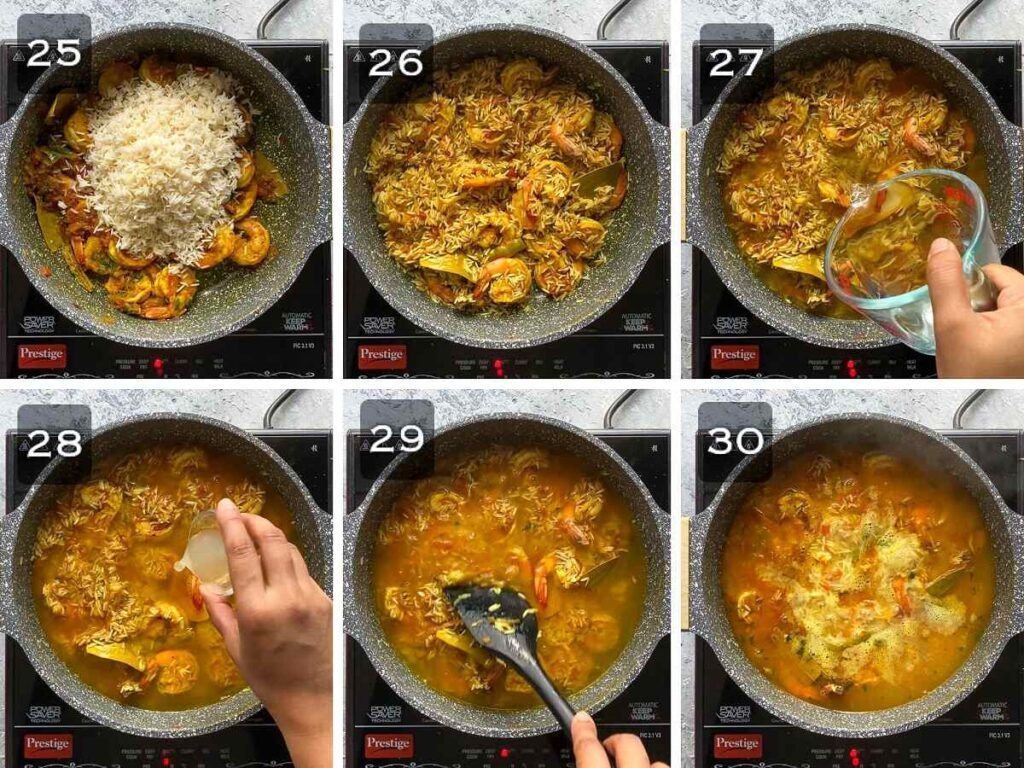
Add the drained basmati rice, and mix it well, so that the grains get coated evenly with the masala. ( Photos 25 and 26 )
Add 1¾ cups of water, and ½ tablespoon of lemon juice, and bring to a boil. ( Photos 27 and 30 )
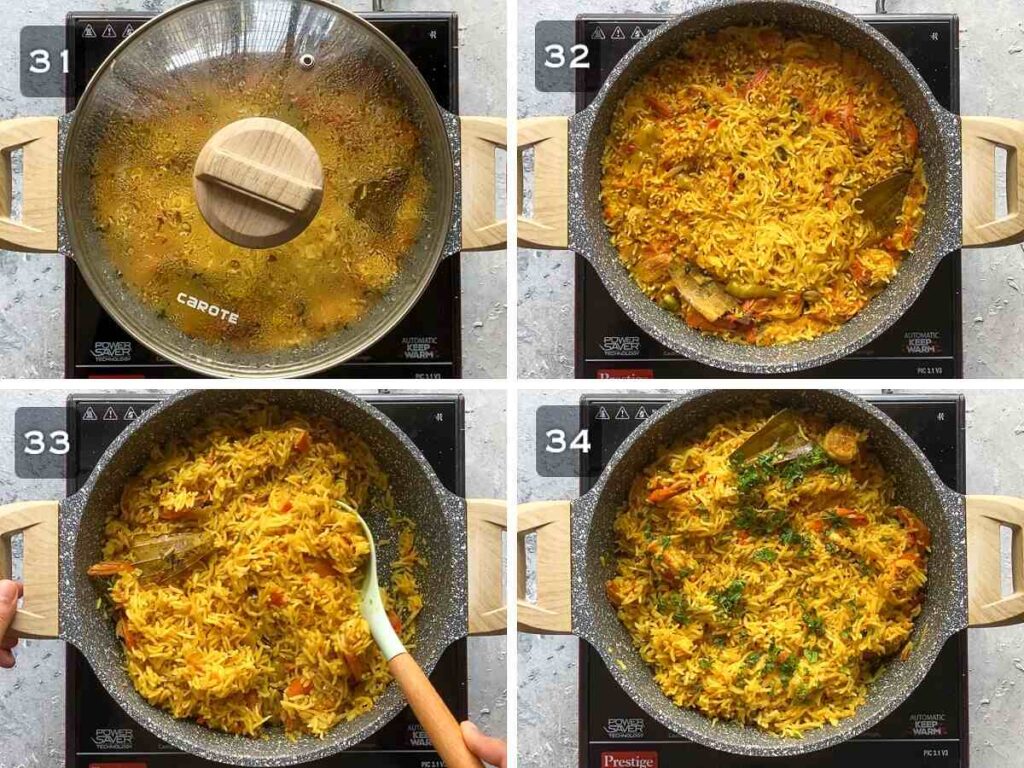
Cover and simmer on low heat until all the water is absorbed and the rice is fully cooked (about 15 minutes). ( Photo 31 )
Switch off the heat, and leave it undisturbed for another 15 minutes.( Photo 32 )
Fluff the rice gently, garnish with more coriander leaves and serve hot! ( Photos 33 and 34 )
Serving suggestions
This prawn pulao is a yummy standalone dish. It doesn’t need many sides.
A raita or salad is more than enough to serve as an accompaniment.
Sometimes, I serve it along with boiled eggs.
You can also serve it along with some papad and pickle.
Storage instructions
Leftovers: Allow the pulao to cool down completely. Store leftovers within 2 hours of cooking in an airtight container in the fridge for up to 2 days.
Freeze: Portion out individual servings in freezer-safe airtight containers or Ziptop bags and freeze for up to 1 month. Thaw overnight in the fridge.
Reheat: Transfer it in a skillet or pot, add about 2 to 3 tablespoons of water. Reheat on medium-low heat for about 5 to 10 minutes or until heated through. Stir frequently to prevent the rice grains from sticking to the bottom of the skillet.
Recipe tips
Use stock instead of water: You can use seafood stock or just prawn stock instead of plain water to amp up the flavor of this pulao. Feel free to add one small chicken or vegetable bouillon cube (Maggi stock cube) or 1 teaspoon of better than bouillon lobster base. Please skip or reduce the salt in the recipe accordingly.
Rice-to-water ratio: Most pulao recipes call for a 1:2 ratio of rice to water. But since the rice is soaked for about 30 minutes here, I highly suggest cutting back on the water for perfectly cooked rice grains that are fluffy and distinct. Follow the quantities mentioned in the recipe.
Prawns: You can use either fresh or frozen prawns. If using frozen, thaw and then use. If cleaning fresh prawns yourself, be sure to devein them. I like to leave the tails on as it gives them a nice appearance. Feel free to remove them if you like.
Do not overcook the prawns: You need to saute the prawns just until they turn opaque. Keep in mind that they will further cook with the rice for another 10 to 15 minutes. Cooking it too much initially will just make them hard and rubbery.
Spices: Feel free to play around with the amount of spices. If you prefer a brownish-colored pulao, skip the turmeric. You can also add pulao masala or biryani masala instead of garam masala.

Variations
Shrimp pulao: Substitute the prawns with shrimp if you like.
Add vegetables: You can add some diced carrots, potatoes, green beans, bell peppers, cauliflower, or green peas to this pulao.
Green prawn pulao: Skip adding ginger garlic paste after sauteing onion if you want to make this version. Instead make a paste of about 1 cup of coriander leaves, green chilies, 1-inch ginger, and 10 to 12 garlic cloves. You can also add about 1/4 to 1/2 cups of freshly grated coconut if you like. Add this paste after sauteeing the tomatoes and cook for a few minutes. Then add prawns and follow the rest of the recipe.
Mint leaves: You can also add a few mint leaves along with coriander leaves.
Coconut milk: Swap 3/4 cup of water with light coconut milk.
Spicy: This recipe is not very spicy. If you prefer spicy pulao, add the dark green variety of chilies or use serrano peppers, and add more red chili powder/cayenne pepper.
Make it with cooked rice: Follow the recipe as such, and add 3 cups of cold cooked rice (a day old preferably) instead of the drained raw rice. Toss gently until the rice is well combined with the masala.
Quinoa: Swap the rice with quinoa for a twist.
Saffron: For a royal touch, add about 2 tablespoons of saffron water (a pinch of saffron soaked in 2 tablespoons of hot water for 10 minutes).
Birista garnish: For a festive touch, sprinkle some crispy fried onions while serving.
Can I use brown basmati rice?
I don’t recommend using brown rice here. Brown rice takes a long time to cook, and the prawns will definitely overcook and turn rubbery!
If you must use brown rice, saute the prawns separately and add them to the pulao towards the end of cooking (after most of the liquid has been absorbed by the rice). Add the sauteed prawns, cover, and let it stand undisturbed for 10 minutes.
Can I make prawn pulao in the pressure cooker?
I personally do not prefer pressure cooking prawns since they do tend to overcook. You may saute the prawns in the pressure cooker first and set them aside on a plate.
Follow the same recipe as the stovetop method, but use 1.5 cups of liquid for 1 cup of basmati rice. Pressure cook the pulao for 2 whistles over medium heat, switch off the heat, and let it depressurize.
Then open the lid, add the sauteed prawns in one layer, close the lid and leave undisturbed for 10 minutes (gas should be switched off). Then fluff the rice gently.
How to make it in the Instant Pot
Follow the same process as the stovetop pressure cooker. Use 1 cup water (firm) to 1.25 cups water (softer) for 1 cup of rice, depending on your preferred rice consistency. Pressure cook on ‘HIGH’ for 5 minutes, followed by ‘NPR’ for 10 minutes.

You may also enjoy these rice recipes
Vegetable pulao
Mushroom pulao
Palak rice
Pudina rice
Tomato rice
Bagara rice
I would love to hear from you! Please be sure to share your feedback and/or give this recipe a rating in the comment below. Your reviews help others know the recipe better too.
You can also FOLLOW me on Facebook , Pinterest, Instagram & Twitter

Prawn Pulao | Shrimp Pulao
Ingredients1x2x3x
For the prawn marination
- 250 grams prawns, cleaned and deveined, about 20 medium-sized prawns
- 1/2 teaspoon salt
- ¼ teaspoon black pepper
- ¼ teaspoon turmeric
For the pulao
- 1 cup basmati rice 210 grams
- 2 tablespoons ghee
- ½ teaspoon shahi jeera
- 2 bay leaves,
- 1 inch cinnamon
- 1 star anise
- 4 green cardamom
- 2 cloves
- 3 to 4 black peppercorns
- 1 cup thinly sliced onion, 110 grams
- 1 tablespoon ginger garlic paste
- 2 green chilies slit lengthwise
- 1 teaspoon coriander powder
- ½ teaspoon cumin powder
- ¼ teaspoon red chili powder, you may add more for more heat
- ½ teaspoon garam masala
- ½ teaspoon turmeric
- 2 medium tomatoes, finely chopped, about ¾ cup, 120 grams
- 1 teaspoon table salt, or to taste
- 2 to 3 tablespoons chopped coriander leaves, divided
- ½ tablespoon lemon juice
Instructions
Soak rice and marinate prawns
- Rinse the rice 3 to 4 times with water until it runs clear to remove excess starch. Add 2 cups of water and soak the rice for 15 to 20 minutes.
- Marinate the prawns with salt, black pepper and turmeric. Set aside for 15 minutes.
- Prep your ingredients in the meanwhile.
Cook onion-tomato masala and prawns
- Heat ghee in a heavy-bottomed pot on medium heat.
- Add shahi jeera, bay leaves, cinnamon, star anise, green cardamom, cloves, and black peppercorns, and saute for about 30 seconds.
- Add sliced onion, and saute until it turns golden brown.
- Next, add coarsely crushed ginger-garlic paste and green chilies, and saute until fragrant.
- Add coriander powder, cumin powder, red chili powder, garam masala, and turmeric.
- Saute for about 30 seconds. Add a few splashes of water if needed to prevent the spices from sticking to the bottom of the pot.
- Add chopped tomatoes and salt to taste. Mix well, and cook until the tomatoes turn mushy and fat separates from the sides. You can add a few tablespoons of water if needed to cook the tomatoes.
- Add the marinated prawns, and cook on medium-high heat just until it turns opaque, about 1 minute.
- Add half of the chopped coriander leaves, and mix.
Add rice and water, and cook the prawn pulao
- Add the drained basmati rice, and mix it well, so that the grains get coated evenly with the masala.
- Add 1¾ cups of water, and lemon juice, and bring to a boil.
- Cover and simmer on low heat until all the water is absorbed and the rice is fully cooked, about 15 minutes.
- Switch off the heat, and leave it undisturbed for another 15 minutes.
- Fluff the rice gently, garnish with more coriander leaves and serve hot!
