Thandai is a popular and refreshing North Indian drink prepared during the festival of Holi and Mahashivratri! It is a dairy-based drink made by blending milk with a nutritious mix of nuts, seeds, and spices. Learn how to make this delicious thandai recipe with homemade thandai masala from scratch!
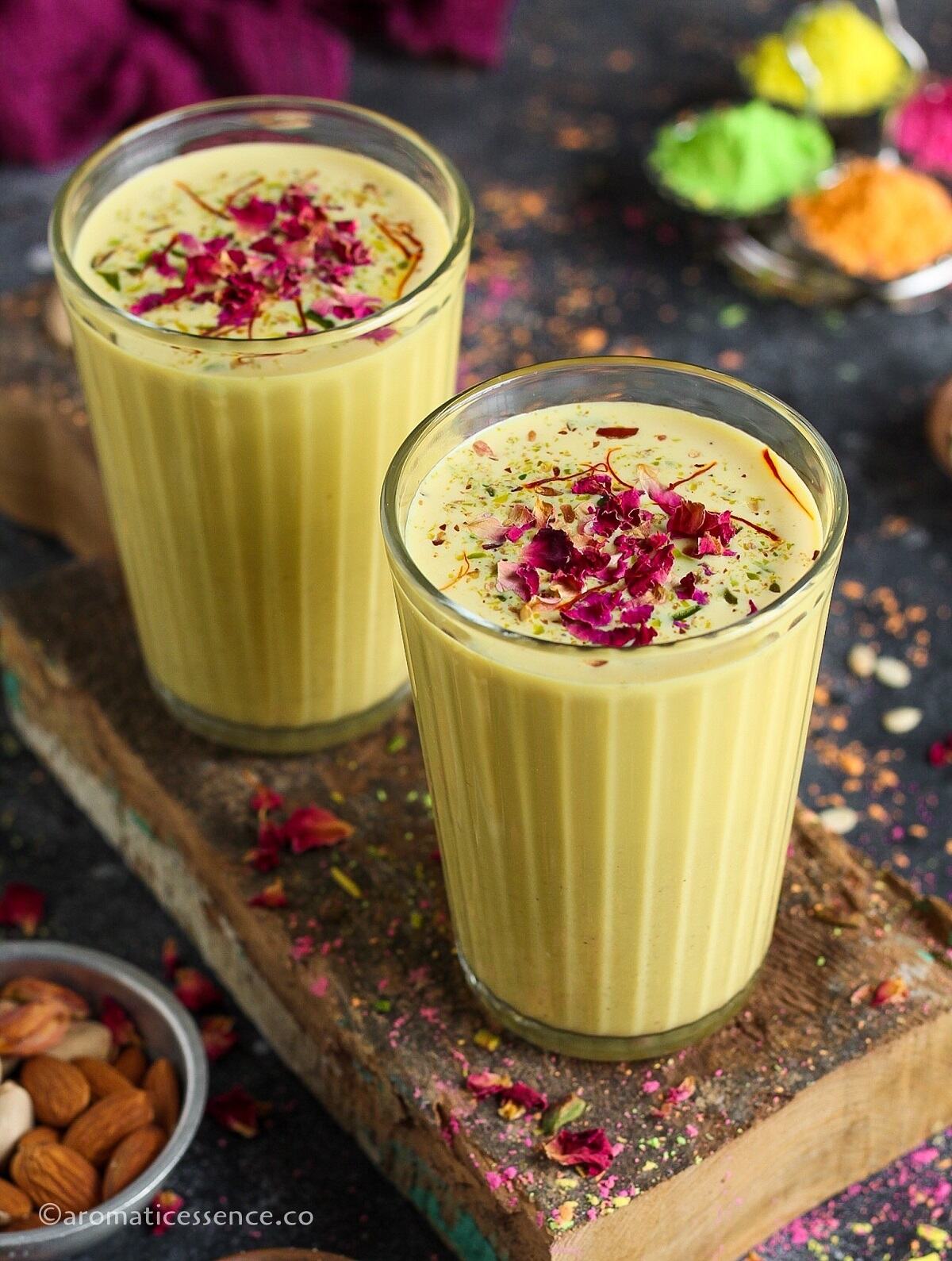
Holi is just a couple of days away! It is also known as the festival of colors, the festival of love, or the festival of spring! Holi signifies the victory of good over evil. It celebrates the arrival of spring and harvest season.
People all across India and the world celebrate Holi with vibrant colors and lots of sumptuous food! Holi celebration is incomplete without festive treats such as gujiya, malpua, dahi vadas, and especially Thandai! It is the quintessential Holi drink!

- What is thandai and what is it made of?
- Why you will love this kesar badam thandai recipe
- Ingredients needed
- How to make thandai at home – Step by step process
- Serving suggestions
- Storage suggestions
- Variations
- Tips to make the best thandai recipe
- Frequently asked questions (FAQs)
- You may also enjoy these refreshing summer beverages
- Thandai Recipe
What is thandai and what is it made of?
Thandai is derived from the word ‘thand’ or ‘thanda’ which translates to cold in Hindi. It is also known as sardai or shardai. The mix of ingredients that go into the making of this thandai drink is believed to have a cooling effect on the body, and ergo the name ‘thandai’! It is popular in the states of Uttar Pradesh and Rajasthan!
This aromatic beverage is creamy, soothing, and tastes slightly nutty and sweet, with a hint of spice from the black pepper.
Thandai masala can be made in two ways;
- By soaking the ingredients for a couple of hours and then grinding it to a smooth paste. Soaking is the more traditional approach.
- By blending all the ingredients to make a dry powder.
Today, I’m sharing the traditional method because I prefer it prepared this way. I think it makes for a more flavorful thandai drink. I will share a whole new post on thandai powder for another time since that comes in super handy to flavor various desserts!
Making thandai at home is not as complicated as you think. The traditional method just needs a little planning, since the nuts and spices need to be soaked for a while.
Sardai is not only delicious but is also an excellent drink to boost your energy whenever you feel worn out by the scorching summer heat! It will surely help you get rid of your tiredness instantly. Besides that, it also helps boost immunity and aid digestion, thanks to an array of spices and nuts used!

Why you will love this kesar badam thandai recipe
This thandai recipe;
☑ Is free from preservatives, artificial colors, and flavors
☑ Is very adaptable, you may skip if you don’t have certain nuts or spices
☑ Does not contain a lot of sugar
☑ Can be made ahead, in fact, it is best when made ahead
☑ Has many health benefits
☑ Is vegetarian and gluten-free
Ingredients needed
Homemade Thandai masala: This is a mix of almonds, cashew nuts, pistachios, melon seeds, poppy seeds, fennel seeds, green cardamom, nutmeg, black peppercorns, and dried rose petals.
Almonds and fennel seeds are the most important ingredient in this masala, so I wouldn’t recommend skipping them. You can play around with the rest of the ingredients to suit your palate.
Milk: I’ve used full-fat milk to make this thandai recipe.
Aromatics: I’ve added a little rose water and saffron-infused milk to enhance the flavor and color of the drink, though it tastes just as good without it.

How to make thandai at home – Step by step process
Step 1: Soak the nuts, seeds, spices, and dried rose petals
In a bowl, add 1/4 cup unsalted almonds and 2 tablespoons shelled and unsalted pistachios, soak in 1/2 cup of water for 4 to 6 hours or overnight. ( Photos 1 to 4 )

In a medium bowl, add 2 tablespoons of unsalted cashew nuts, 2 tablespoons of melon seeds, 1 tablespoon each of fennel seeds, and poppy seeds along with 1/2 tablespoon of black peppercorns, 1 teaspoon of green cardamom seeds, and 2 tablespoons of edible dried rose petals. ( Photos 5 to 11 )

Add about 3/4 cup of water, mix well, cover, and set aside for 4 to 6 hours or overnight. ( Photos 12 to 14 )

Step 2: Grind the soaked ingredients
This is what the nuts, seeds, and dried rose petals look like after soaking for 4 hours. ( Photo 15 )
Peel the almonds and pistachios and add them to a blender. ( Photo16 to 19 )

Transfer the remaining ingredients to a blender along with the water. Also, add 1/2 teaspoon of grated nutmeg and 1/3 cup of mishri dana (rock sugar). ( Photos 20 to 22 )
Blend to a smooth paste. Add more water if needed to achieve a smooth paste. ( Photos 23 and 24 )

Step 3: Boil milk
Boil 1 liter of milk in a pan over medium heat, stirring occasionally. ( Photos 25 and 26)
Add 2 tablespoons of hot milk to crushed saffron in a small bowl. Mix well and set aside. ( Photos 27 )
Switch off the heat and set aside the milk until it turns lukewarm. ( Photo28 )

Step 4: To make the thandai drink
Add the saffron-infused milk and thandai masala paste to the lukewarm milk, mix well. ( Photos 29 to 31 )
Taste and adjust with more sugar if needed.

Once the milk has cooled down completely, add 1 tablespoon of rose water (optional), mix well. Taste and adjust with another tablespoon of rose water if needed. Cover and refrigerate for a couple of hours or until chilled. ( Photos 32 and 33 )
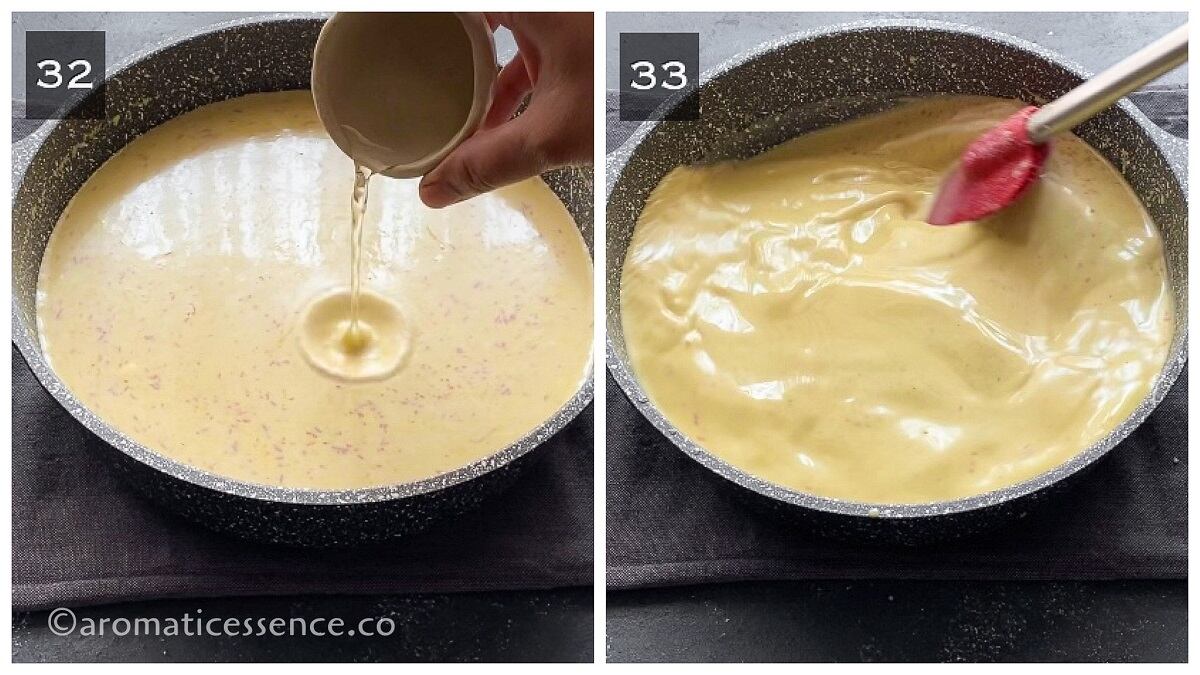
I transferred it into a glass bowl since I used nonstick cookware. If using a steel pot or pan, you could refrigerate it as such. ( Photos 34 and 35 )

When you are ready to serve strain the thandai using a muslin cloth (the traditional way) or a fine-mesh sieve over a pitcher. ( Photo 36 )
Press on the solids with the back of a spoon to extract maximum flavor. ( Photos 37 and 38 )

Serving suggestions
Serve it over ice cubes or crushed ice in a glass or clay kullad. Chilled thandai is just so refreshing! Especially after playing Holi in the sweltering heat, this drink sure gives a lot of respite!
For a festive look, garnish with slivered almonds and/or pistachios, dried rose petals, and some saffron if you wish.
Serve it along with other Holi special snacks like mawa gujiya, dahi vada, etc.
Storage suggestions
The paste will keep well for up to 1 week in an airtight container. If you use milk to grind it, use it within 1 to 2 days.
The drink itself can be made and refrigerated up to 2 days in advance.

Variations
Listing a few variations to make individual servings. If you’d like to make a big batch, scale up the quantity of the flavoring ingredients.
Base recipe: Blend 3 to 4 tablespoons of thandai paste with 1 to 2 tablespoons of sugar (or sweetener of choice), and 200 ml of chilled milk (previously boiled and cooled). You may strain this or enjoy it as such! If the milk has already been sweetened with sugar while boiling, skip adding it here. Taste and add if needed.
Rose: Add 2 tablespoons of rose syrup or gulkand to the base recipe.
Strawberries: Add 1/2 cup diced strawberries or 1/4 cup of strawberry compote to the base recipe.
Mango: Add 1/4 cup of mango pulp or ripe mango pieces to the base recipe. Taste and adjust with more mango pulp if needed.
Paan: Add 1 betel leaf, 1 tablespoon of gulkand, with 1/2 teaspoon fennel seeds to the base.
Vanilla: Add about 1/2 teaspoon of pure vanilla extract to the base recipe. You could also flavor the milk with vanilla pods.
Thandai with alcohol: For an alcoholic version, you can consider spiking the drink with 1 to 2 oz (30 to 60 ml) of gin, white rum, or vodka.
Tips to make the best thandai recipe
Quality ingredients: Make sure the nuts and seeds are fresh and not from an old batch. They might impart a weird taste if the oils in the nuts turn rancid.
A richer version: Mix in some malai and rabdi for a decadent version, the way they serve it in Varanasi!
Full-fat milk: Use full-fat milk for best results though nonfat milk will also work in a pinch. But I highly suggest using whole milk. For a thicker and creamier thandai, you can substitute half of the milk with evaporated milk or half-and-half (equal parts heavy cream and milk).
Sweetness: I’ve not added a lot of sugar while blending, but that sweetness is perfectly fine for us. We do not prefer it very sweet. You could also use honey, maple syrup, date syrup, or any other sweetener of your choice.
Allow the thandai masala to steep in the milk: Once the prepared thandai masala paste is mixed with the milk, let it steep for 4 to 5 hours or overnight in the refrigerator in order to extract maximum flavor from the thandai masala. Strain before serving and enjoy!
Adjust the spice: Black pepper gives a kick that hits you in the back of the throat. Add as much as you can tolerate. This quantity here was good enough for us. If you are unsure about the heat, start off with maybe 8 to10 black peppercorns.
For an individual serving: Blend 3 to 4 tablespoons of thandai masala with 200 ml of chilled milk. Taste the sweetness and adjust as needed. Enjoy it as is or strain and serve.

How can I make a vegan version?
Use your favorite plant-based milk to make a vegan version. Almond milk or oat milk would be my preferred choices.
Can I make thandai without poppy seeds?
Yes, you can! If poppy seeds are not accessible where you live, simply leave them out.
Why is black pepper added to this recipe?
Black pepper is a good source of antioxidants, helps in boosting immunity, and also aids in digestion. Besides this, it provides many health benefits making it an important ingredient in an authentic thandai recipe.
The addition of black pepper enhances the cooling effect of the ingredients used to make thandai. If you’ve ever had this drink, I’m sure you would understand better.
When should we drink thandai?
Thandai is normally served during Holi and Shivratri. But that doesn’t mean you need to restrict yourself to enjoying this cooling beverage on just these days. This drink is perfect for the summers when you need to keep your body temperature cool. It will definitely refresh you!
Is thandai healthy?
Not really! Even though it has ingredients like healthy nuts and seeds, they are quite high in calories. Additionally, sugar is used to sweeten the drink.
Having said that, yes this homemade thandai recipe is way healthier than the readymade thandai masala powder or syrup/concentrate that contains a truckload of sugar and preservatives.
Like everything else, this must be consumed in moderation as well. I strongly believe that one should eat a healthy diet and exercise regularly to stay fit.
Is there a difference between thandai and bhang?
Bhang is a preparation made from the leaves and flowers of the female cannabis or marijuana plant. It is made by soaking the leaves and flowers in water and then ground to a paste. In essence, this paste is referred to as bhang. This is then added to thandai to make a spiked beverage. I do not advocate the consumption of bhang. However, if you wish to add it to the thandai I would suggest you read this article .
Thandai is a non-alcholic drink that even kids can enjoy. You would want to go a little easy on the black pepper though so as to not make it too spicy for the little ones.
You may also enjoy these refreshing summer beverages
Mango mojito mocktail
Strawberry limeade
Lemon iced tea
You can also follow me on Facebook , Pinterest, Instagram & Twitter

Thandai Recipe
Ingredients1x2x3x
For the thandai masala
- 1/4 cup raw almonds 40 grams
- 10 unsalted cashew nuts 20 grams
- 20 to 25 unsalted pistachios. shelled 20 grams
- 2 tablespoons melon seeds 25 grams
- 1 tablespoon fennel seeds 10 grams
- 1 tablespoon poppy seeds 12 grams
- 1/2 tablespoon black peppercorn, adjust as per desired heat
- 12-15 green cardamom seeds, about 1 teaspoon
- 2 tablespoons edible dried rose petals
- 1/2 teaspoon grated nutmeg
- 1/3 to 1/2 cup mishri dana (rock sugar), you may substitute with regular granulated sugar, adjust as per desired sweetness
For the thandai drink
- 1 cup of prepared thandai paste
- 1 liter full-fat/whole milk
- 1/4 teaspoon saffron strands, crushed
- 1 to 2 tablespoons of rose water
Instructions
- In a bowl, add almonds and pistachios, soak in 1/2 cup of water for 4 to 6 hours or overnight in the fridge.
- In a medium bowl, add cashew nuts, melon seeds, fennel seeds, poppy seeds, black peppercorns, cardamom, and edible dried rose petals.
- Add about 3/4 cup of water, mix well, cover, and set aside for 4 to 6 hours or overnight.
- Peel the almonds and pistachios and add them to a blender.
- Transfer the remaining ingredients to a blender along with the water used for soaking. Also, add grated nutmeg and sugar.
- Blend to a smooth paste. Add more water if needed to achieve a smooth paste.
- Boil milk in a saucepan over medium heat, stirring occasionally.
- Add 2 tablespoons of hot milk to crushed saffron in a small bowl. Mix well and set aside.
- Switch off the heat and set aside the milk until it turns lukewarm.
- Add the saffron-infused milk and thandai masala paste to the lukewarm milk, mix well.
- Taste and adjust with more sugar if needed.
- Once the milk has cooled down completely, add 1 tablespoon of rose water (optional), mix well. Taste and adjust with another tablespoon of rose water if needed. Cover and refrigerate for a couple of hours or until chilled.
- When you are ready to serve strain the thandai using a muslin cloth (the traditional way) or a fine-mesh sieve over a pitcher, pressing back against the solids to extract maximum flavor.
- Add some ice cubes or crushed ice to a serving glass, pour the thandai. Garnish with slivered nuts, dried rose petals, and saffron strands. Enjoy!
Video
Notes

Thandai Recipe
Ingredients
For the thandai masala
- 1/4 cup raw almonds 40 grams
- 10 unsalted cashew nuts 20 grams
- 20 to 25 unsalted pistachios. shelled 20 grams
- 2 tablespoons melon seeds 25 grams
- 1 tablespoon fennel seeds 10 grams
- 1 tablespoon poppy seeds 12 grams
- 1/2 tablespoon black peppercorn, adjust as per desired heat
- 12-15 green cardamom seeds, about 1 teaspoon
- 2 tablespoons edible dried rose petals
- 1/2 teaspoon grated nutmeg
- 1/3 to 1/2 cup mishri dana (rock sugar), you may substitute with regular granulated sugar, adjust as per desired sweetness
For the thandai drink
- 1 cup of prepared thandai paste
- 1 liter full-fat/whole milk
- 1/4 teaspoon saffron strands, crushed
- 1 to 2 tablespoons of rose water
Instructions
- In a bowl, add almonds and pistachios, soak in 1/2 cup of water for 4 to 6 hours or overnight in the fridge.
- In a medium bowl, add cashew nuts, melon seeds, fennel seeds, poppy seeds, black peppercorns, cardamom, and edible dried rose petals.
- Add about 3/4 cup of water, mix well, cover, and set aside for 4 to 6 hours or overnight.
- Peel the almonds and pistachios and add them to a blender.
- Transfer the remaining ingredients to a blender along with the water used for soaking. Also, add grated nutmeg and sugar.
- Blend to a smooth paste. Add more water if needed to achieve a smooth paste.
- Boil milk in a saucepan over medium heat, stirring occasionally.
- Add 2 tablespoons of hot milk to crushed saffron in a small bowl. Mix well and set aside.
- Switch off the heat and set aside the milk until it turns lukewarm.
- Add the saffron-infused milk and thandai masala paste to the lukewarm milk, mix well.
- Taste and adjust with more sugar if needed.
- Once the milk has cooled down completely, add 1 tablespoon of rose water (optional), mix well. Taste and adjust with another tablespoon of rose water if needed. Cover and refrigerate for a couple of hours or until chilled.
- When you are ready to serve strain the thandai using a muslin cloth (the traditional way) or a fine-mesh sieve over a pitcher, pressing back against the solids to extract maximum flavor.
- Add some ice cubes or crushed ice to a serving glass, pour the thandai. Garnish with slivered nuts, dried rose petals, and saffron strands. Enjoy!
Video
Notes
Dragon chicken is a delicious Indo-Chinese appetizer. Crispy chicken strips and bell peppers are tossed in a spicy sauce with crunchy cashews. Here’s an easy, step-by-step recipe with a quick video tutorial that shows you how to make this restaurant-worthy dish at home!

There was this restaurant in my late grandma’s neighborhood from where we always ordered dragon chicken. Mom just happened to order it one day after randomly selecting it from their menu. It was a good find, something different from the regular sweet and sour or Manchurian or schezwan dishes.
Frankly, this dish has tasted different at the many places I’ve tried it. But the restaurant where we tried it first still has my heart. It was the best! So I’ve tried to replicate it at home trying to remember the flavors. And this version is as close to the one I’ve always enjoyed!
- What is dragon chicken?
- Why you will love this recipe?
- Ingredients needed
- How to make restaurant-style dragon chicken – Step by step process
- Serving suggestions
- Storage suggestions
- Recipe tips
- Variations
- You may also enjoy these Indo-Chinese recipes
- Dragon Chicken Recipe
What is dragon chicken?
Dragon chicken is a flavor-packed Indian Chinese dish. It has nothing to do with the dragon-legged chicken also known as dong tao, a rare breed of chicken found in Vietnam!
In this recipe, boneless chicken strips are coated in batter, deep-fried, and tossed in a fiery sauce with subtle undertones of sweetness. Though, I’ve also seen this dish being served as boneless chicken chunks and cubed bell pepper instead of strips. Each restaurant lends its own spin on this recipe!
Why is it called dragon chicken then you ask? Honestly, I don’t have an appropriate answer, but I feel it may have gotten its name due to the fiery red color and/or spicy taste of the dish. If you know anything about its origin, I’d love to hear it!

Why you will love this recipe?
You will love this dragon chicken recipe because;
☑ Not only does it look appetizing but it also tastes so delicious
☑ It is brimming with zesty and spicy flavors with a hint of sweetness
☑ It is a quick recipe making it ideal for busy weeknights
☑ Better than take-out!
☑ Does not contain MSG
Ingredients needed
Chicken: It is best to use boneless meat for dishes like these. I’ve used boneless chicken breasts. But feel free to use chicken thighs or tenders as well.
For the chicken marinade: You will need all-purpose flour, cornflour, light soy sauce, rice vinegar, Kashmiri chili powder (for color sans the heat), ginger garlic paste, salt, pepper powder, and one egg white. Use only the egg white as it creates a crispier coating and helps keep the chicken tender and moist.
Dragon sauce: The sauce is an amalgam of basic sauces such as soy sauce (I prefer to use light soy sauce), tomato ketchup, sambal oelek, and rice vinegar. You will also need some, salt, pepper, a tiny bit of sugar, and cornstarch slurry to thicken the sauce.
Aromatics: Freshly minced ginger, garlic, and sliced onions form the flavor base of this dish.
Vegetables: Sliced red and green bell peppers.
Cashew nuts: Cashew nuts are usually added to this recipe, and I love the crunch and a hint of sweet nutty flavor they impart to the dish. It just complements the chicken really well. You may skip it if you wish to.
Cooking fat: I’ve used vegetable oil.
Other ingredients: Besides the above, you will also need some dried red chilies (any kind), and spring (scallion) onion greens.

How to make restaurant-style dragon chicken – Step by step process
Step 1: Marinate the chicken
In a large bowl, add 300 grams of chicken pieces. Season with 1/4 teaspoon each salt, black pepper, 1teaspoon each of Kashmiri chili powder, vinegar, light soy sauce, and ginger-garlic paste. Mix well. ( Photos 1 to 7 )

Next, add one egg white and mix until all the chicken pieces are well coated. ( Photos 8 and 9 )
Add 2 tablespoons each of all-purpose flour and cornflour. Mix well, cover the bowl and set aside for 15-20 minutes or overnight in the fridge. ( Photos 10 to 13 )

Step 2: Fry the chicken pieces
Note: If you have marinated the chicken overnight, take it out from the fridge and bring it to room temperature before frying.
Heat about 1 cup of oil in a heavy-bottomed wok over medium heat.
Slide in the chicken pieces in batches, and leave undisturbed for a few seconds. Deep fry on medium heat, turning a couple of times with the help of a slotted spoon until they turn golden brown and crispy on both sides. Cook time will depend on the thickness of the chicken pieces. ( Photos 14 to 17 )
Set aside on an absorbent napkin. ( Photo 19 )

Step 3: Dragon chicken sauce
In a small bowl, combine 2 tablespoons of sambal oelek, 2 tablespoons of tomato ketchup, 1 tablespoon light soy sauce, 2 teaspoons of rice vinegar, and 1 teaspoon of sugar. Mix well and set aside. ( Photos 20 to 25 )

Heat 2 tablespoons oil in a wok or heavy-bottomed pot on medium-high heat, add 1/4 cup raw cashew nuts, saute until golden brown and set aside. ( Photos 26 to 29 )

Next, add 1 tablespoon each of minced ginger and garlic and 2 to 3 dried red chiles (broken in halves), sauté until ginger-garlic are fragrant. ( Photos 30 and 31 )
Add 1/2 cup of sliced onion, 1/4 cup each of red and green bell peppers, sauté for 2 to 3 minutes. ( Photos 32 and 33 )

Add 1/4 teaspoon each of salt and pepper to season the veggies. ( Photos 34 and 35 )

Add in the sauce mixture. Mix well, and cook for 1-2 minutes or until it begins to bubble. ( Photos 36 and 37 )
Now add the cornflour slurry (2 teaspoon cornflour mixed with 1/4 cup cold water). Give the slurry a good stir before pouring and continue mixing until it thickens up. ( Photos 38 to 40)

Step 4: Toss fried chicken with the sauce
Add in the fried chicken pieces along with the roasted cashew nuts, and toss to coat with the sauce. ( Photos 41 and 42 )
Add 2 to 3 tablespoons scallion greens, mix and switch off the heat. Serve immediately. ( Photos 43 and 44 )

Serving suggestions
Serve dragon chicken as a starter along with your favorite beverage to wash it down!
It also pairs well with this vegetable fried rice , Thai basil fried rice , or this chili garlic hakka noodles .
Storage suggestions
This spicy dragon chicken dish tastes best as soon as it is prepared. If kept for longer the chicken will get soggy. Also, the cashews will not be as crunchy. So enjoy it immediately after the chicken and cashews are tossed with the sauce!
Leftovers: Ideally leftovers must be refrigerated within 2 hours of their preparation for food safety as per the FDA. Allow leftovers to cool completely. Store in an airtight container in the fridge for up to 3 to 4 days.
Reheat: To reheat, transfer the chicken to a skillet or wok, and stir-fry on medium heat until piping hot. Add a splash of water if it looks too dry.

Recipe tips
Oil temperature: Make sure that the oil is not too hot, or the exterior will brown quickly and the chicken will remain raw on the inside. The ideal temperature for deep frying is between 350° to 375° F
Avoid overcrowding the wok: Deep fry the chicken in batches. Overcrowding the wok will reduce the temperature of the oil, and the chicken will absorb more oil and turn out greasy.
Spicy: This recipe is not super spicy, even my kids enjoy it! If you’d like to tone down the heat, then reduce the sambal oelek or any other chili sauce to 1 tablespoon. If you prefer it spicy, then increase the sambal oelek/red chili sauce to a couple more tablespoons. Less is the way to go if you are unsure about the heat tolerance of this recipe.
Sugar: You can replace the sugar with other sweeteners of your choice. If you prefer a sweeter sauce, you can most certainly increase the quantity of the sweetener.
Sodium content: I prefer using low sodium soy sauce. Also, it does not mar the vibrant red color of the dragon sauce as much as the dark soy sauce does. Add salt and pepper to taste!

Variations
Make it a main dish: Dragon chicken is usually served as a starter, but you could convert it into a main dish. To do that, add about 1.5 tablespoons of cornstarch/cornflour to 1 cup of water or chicken stock, add this cornstarch slurry to make a thick gravy.
Seafood: You can swap the chicken with prawns/shrimps or any firm white fish.
More vegetables: You can increase the quantity of bell peppers if you like. You can also add other veggies such as broccoli, carrots, green beans, asparagus, snow peas, snap peas, etc.
Other nuts: You can replace cashew nuts with almonds or even peanuts.
Baked version: For a healthier version, you can bake the chicken pieces instead of deep-frying. To do that, place the marinated chicken strips on a greased wire rack over a baking tray or sheet. Bake at 400° F or 200° C for 15 to 20 minutes (baking time will depend on the thickness of the chicken pieces, so keep an eye out). The internal temperature on an instant-read thermometer must be 165° F. You can refer to this baked chicken 65 post for a pictorial on the baking steps.
Shallow fry: If deep frying intimidates you, skip it and shallow fry instead. Works just as well.
Gluten-free: Swap the all-purpose flour with rice flour. Cornflour or cornstarch is gluten-free, but make sure to read the food labels to know about any allergen advisory statements. Swap the soy sauce with coconut aminos.
Corn-free diet: Swap the cornstarch or cornflour with potato starch or tapioca starch.
Sesame seeds: You could sprinkle some sesame seeds to garnish the dish.
You may also enjoy these Indo-Chinese recipes
Sweet and sour chicken
Schezwan noodles
Hot and sour vegetable soup
Sweet corn soup
You can also follow me on Facebook , Pinterest, Instagram & Twitter

Dragon Chicken Recipe
Ingredients1x2x3x
For the batter
- 300 grams chicken thighs/breast
- 1 teaspoon light soy sauce
- 1 teaspoon vinegar
- 1 teaspoon Kashmiri chili powder
- 1 teaspoon ginger garlic paste
- Salt to taste, I added 1/4 teaspoon
- 1/4 teaspoon ground black pepper
- 2 tablespoons cornflour
- 2 tablespoons all-purpose flour
- 1 large egg white
For the sauce
- 2 tablespoons oil plus more oil as needed for deep frying
- 1/4 cup cashew nuts
- 1 tbsp minced garlic
- 1 tbsp ginger
- 2 to 3 dry red chillies
- 1/2 cup sliced onion
- 1/4 cup red bell pepper strips
- 1/4 cup red bell pepper strips
- 2 tablespoons sambal oelek or any other chili sauce, refer notes
- 2 tablespoons tomato ketchup
- 1 tablespoon light soy sauce or 1 teaspoon dark soy sauce
- 2 teaspoons rice vinegar
- 1 teaspoon sugar
- Salt to taste, I added 1/4 teaspoon
- 1/4 teaspoon ground black pepper
- 2 teaspoons cornflour/cornstarch mixed with 1/4 cup cold water
- 2 to 3 tablespoons chopped scallion greens
Instructions
Marinate the chicken
- In a large bowl, add chicken pieces. Season with salt, black pepper, Kashmiri chili powder, vinegar, light soy sauce, and ginger garlic paste. Mix well.
- Next, add an egg white and mix until all the chicken pieces are well coated.
- Add all-purpose flour and cornflour. Mix well, cover the bowl and set aside for 15-20 minutes or overnight in the fridge.
Fry the chicken pieces
- Note: If you have marinated the chicken overnight, take it out from the fridge and bring it to room temperature before frying.
- Heat oil in a heavy-bottomed wok over medium heat.
- Slide in the chicken pieces in batches, and leave undisturbed for a few seconds. Deep fry on medium heat, turning a couple of times with the help of slotted spoon, until they turn golden brown and crispy on both sides. Cook time will depend on the thickness of the chicken pieces.
- Set aside on an absorbent napkin.
Dragon chicken sauce
- In a small bowl, combine sambal oelek, tomato ketchup, light soy sauce, rice vinegar, and sugar. Mix well and set aside.
- Heat oil in a wok or heavy-bottomed pot on medium-high heat, add cashew nuts, saute until golden brown and set aside.
- Next, add minced ginger-garlic and broken dried red chiles, sauté until ginger-garlic are fragrant.
- Add sliced onion, red and green bell peppers, sauté for 2 to 3 minutes.
- Add salt and pepper to season the veggies.
- Add in the sauce mixture. Mix well, cook for 1-2 minutes or until it begins to bubble.
- Now add the cornflour slurry. Give the slurry a good stir before pouring and continue mixing until it thickens up.
Toss fried chicken with the sauce
- Add in the fried chicken pieces along with the roasted cashew nuts, toss to coat with the sauce.
- Add in the scallion greens, mix and switch off the heat. Serve immediately.
