Paneer pakora | paneer pakoda recipe with step-by-step pictures. These paneer pakoras are crispy and crunchy on the outside, with a soft melt in the mouth paneer cheese in the inside. Enjoy these crispy munchies with your favorite dipping sauce or along with some simple green chutney and ketchup.

While it was nice and warm last week, the temperatures dropped again this week! And when it is this cold or rainy, the one and only snack that we love are pakoras. If you follow my blog, you know that I don’t frequently share deep-fried foods, that’s coz I hardly make any. As much as we love a variety of pakoras, I resist the urge to make them.
So this time when I made paneer pakora the traditional way, I just had to share it with you guys! Coz honestly, I know it’s going to be a while I make them next. Sometimes it is best to enjoy to your heart’s content and satiate those cravings, isn’t it ??
- SO ANYWAY, WHAT IS PANEER PAKORA?
- INGREDIENTS NEEDED TO MAKE CRISPY PANEER PAKORA
- PANEER PAKORA VARIATIONS
- MORE SNACK RECIPES
- STEP BY STEP INSTRUCTIONS TO MAKE PANEER PAKODA | COTTAGE CHEESE PAKORA
- HOW TO MAKE PANEER PAKORA?
- Paneer Pakora | Paneer Pakoda Recipe
SO ANYWAY, WHAT IS PANEER PAKORA?
A Punjabi pakora or pakoda is a sort of fritter made with gram flour (besan) and spices. Onion pakora happens to be the most popular kind, a common street snack all across India. You can make a pakora of any vegetable or even meat. In this case, we use paneer (Indian cottage cheese) which is coated with a spiced, thick gram flour batter, and deep-fried.
Pakora is ideally not a healthy food dish when it’s made by deep-frying, but hey, sometimes you just have to indulge!
INGREDIENTS NEEDED TO MAKE CRISPY PANEER PAKORA
You don’t actually need a recipe to make this paneer cheese pakora . The two main ingredients are paneer and gram flour here, and of course some salt to season.
Besides besan, adding rice flour is a good option if you like a really crispy paneer pakora . I love to add rice flour in these kinds of batter for some extra crispiness. The remaining ingredients that are spices can be varied as per your tastes.
Baking soda is another optional ingredient and not a necessity, but I like to add just a tad bit for a lighter batter. You may feel free to omit it.
Though I recommend adding some carom seeds, since it aids in better digestion of the gram flour. I’ve used some ginger garlic paste, chaat masala, turmeric, and red chilli powder. That’s about it.
If you like a spicy paneer pakora, add more chilli powder and some chopped green chillies to the batter. I avoid making it too spicy since the kids eat it too. At times, after I’m done frying a portion of the pakoras for the kids, I increase the heat levels in the remaining batter. So, you can consider doing that too.

PANEER PAKORA VARIATIONS
Bored of just the plain paneer pakoras? Then I’ve got some interesting variations to try.
- Stuffed paneer pakora/paneer pakora with filling : Sandwich 3 paneer pieces (like a club sandwich) with green chutney and sweet chutney or ketchup. Then dip it in the besan batter and deep dry.
- Paneer bread pakora : Take two slices of sandwich bread. Apply green chutney on one side, and sweet chutney on the other side. Place a paneer slice (the same size as the bread slice) on the bread slice with the green chutney. Cover with the other bread slice. Cut into diagonals. Dip the bread in the besan batter and deep fry until golden brown.
- Mozzarella cheese pakora : For a completely different twist, use mozzarella cheese sticks instead. Cut each mozzarella cheese stick into 2, dip in the batter and deep fry.

MORE SNACK RECIPES
Veg chilli cheese toast
Mayo Sandwich
Corn cheese toast
Air-fried Bread potato rolls
Cream cheese sandwich bites
Veg Manchurian rolls
STEP BY STEP INSTRUCTIONS TO MAKE PANEER PAKODA | COTTAGE CHEESE PAKORA
1.Cut the paneer into 1.5 x 1.5-inch square, about 1/4 inch thick. Set aside. Also, add oil in a wok and heat it on medium heat.

2.In a bowl, add all the ingredients (from besan to coriander leaves) for the batter. Mix well with a whisk. Add water, in increments until you have a thick batter. I used about 1/2 cup and 2 tbsp of water.

3.Check if the oil is ready for deep-frying. Check by dropping some batter in the oil, it should rise and float immediately, but the color should not change. Dip one paneer piece in the batter, transfer carefully in the hot oil, deep-fry on medium heat. Once it is golden brown on one side, flip and let the other side turn golden brown. Transfer to a plate lined with an absorbent kitchen napkin. Taste and adjust the seasoning if required before frying up all the other paneer pieces.


4.Repeat the same process with remaining paneer pieces. You may fry in batches depending on the size of your wok. If you do not wish to deep-fry you may also shallow fry them in an inch of oil in a flat skillet.
5.Transfer the deep-fried paneer pakoras to a plate lined with an absorbent kitchen napkin. Sprinkle chaat masala and serve immediately. This tastes best when it is fresh, as leftovers will get soggy. So fry only as much as you need.

NOTES
- You may marinate the paneer with spices like red chilli, turmeric, chaat masala, and garam masala for 5-10 minutes. Then proceed with the recipe.

HOW TO MAKE PANEER PAKORA?

Paneer Pakora | Paneer Pakoda Recipe
Ingredients1x2x3x
- 225 grams paneer (Indian cottage cheese)
- 1 cup besan (gram flour)
- 2 tbsp rice flour, optional
- Pinch of hing (asafoetida)
- 1/2 tbsp ginger garlic paste
- 1/2 tsp ajwain (carom seeds)
- 1/2 tsp red chilli powder
- 1/4 tsp turmeric powder
- Salt, to taste
- 1/4 tsp baking soda, optional
- 1/4 tsp chaat masala, plus for sprinkling on the fried pakoras
- 3 tbsp chopped cilantro/coriander leaves
- Water, as required to make a thick paste sort of batter
- Oil, as required for deep-frying
Instructions
- Cut the paneer into 1.5 x 1.5-inch square, about 1/4 inch thick. Set aside. Also, add oil in a wok and heat it on medium heat.
- In a bowl, add all the ingredients (from besan to coriander leaves) for the batter. Mix well with a whisk. Add water, in increments until you have a thick batter. I used about 1/2 cup and 2 tbsp of water.
- Check if the oil is ready for deep-frying. Check by dropping some batter in the oil, it should rise and float immediately, but the color should not change. Dip one paneer piece in the batter, transfer carefully in the hot oil, deep-fry on medium heat. Once it is golden brown on one side, flip and let the other side turn golden brown. Transfer to a plate lined with an absorbent kitchen napkin. Taste and adjust the seasoning if required before frying up all the other paneer pieces.
- Repeat the same process with remaining paneer pieces. You may fry in batches depending on the size of your wok. If you do not wish to deep-fry you may also shallow fry them in an inch of oil in a flat skillet.
- Transfer the deep-fried paneer pakoras to a plate lined with an absorbent kitchen napkin. Sprinkle chaat masala and serve immediately. This tastes best when it is fresh, as leftovers will get soggy. So fry only as much as you need.
Notes
- You may marinate the paneer with spices like red chilli, turmeric, chaat masala, and garam masala for 5-10 minutes. Then proceed with the recipe.
- Measuring cup used, 1 cup = 250 ml, 1 tsp = 5 ml
You can also follow me on :
Regards,
Freda

Paneer Pakora | Paneer Pakoda Recipe
Ingredients
- 225 grams paneer (Indian cottage cheese)
- 1 cup besan (gram flour)
- 2 tbsp rice flour, optional
- Pinch of hing (asafoetida)
- 1/2 tbsp ginger garlic paste
- 1/2 tsp ajwain (carom seeds)
- 1/2 tsp red chilli powder
- 1/4 tsp turmeric powder
- Salt, to taste
- 1/4 tsp baking soda, optional
- 1/4 tsp chaat masala, plus for sprinkling on the fried pakoras
- 3 tbsp chopped cilantro/coriander leaves
- Water, as required to make a thick paste sort of batter
- Oil, as required for deep-frying
Instructions
- Cut the paneer into 1.5 x 1.5-inch square, about 1/4 inch thick. Set aside. Also, add oil in a wok and heat it on medium heat.
- In a bowl, add all the ingredients (from besan to coriander leaves) for the batter. Mix well with a whisk. Add water, in increments until you have a thick batter. I used about 1/2 cup and 2 tbsp of water.
- Check if the oil is ready for deep-frying. Check by dropping some batter in the oil, it should rise and float immediately, but the color should not change. Dip one paneer piece in the batter, transfer carefully in the hot oil, deep-fry on medium heat. Once it is golden brown on one side, flip and let the other side turn golden brown. Transfer to a plate lined with an absorbent kitchen napkin. Taste and adjust the seasoning if required before frying up all the other paneer pieces.
- Repeat the same process with remaining paneer pieces. You may fry in batches depending on the size of your wok. If you do not wish to deep-fry you may also shallow fry them in an inch of oil in a flat skillet.
- Transfer the deep-fried paneer pakoras to a plate lined with an absorbent kitchen napkin. Sprinkle chaat masala and serve immediately. This tastes best when it is fresh, as leftovers will get soggy. So fry only as much as you need.
Notes
- You may marinate the paneer with spices like red chilli, turmeric, chaat masala, and garam masala for 5-10 minutes. Then proceed with the recipe.
- Measuring cup used, 1 cup = 250 ml, 1 tsp = 5 ml
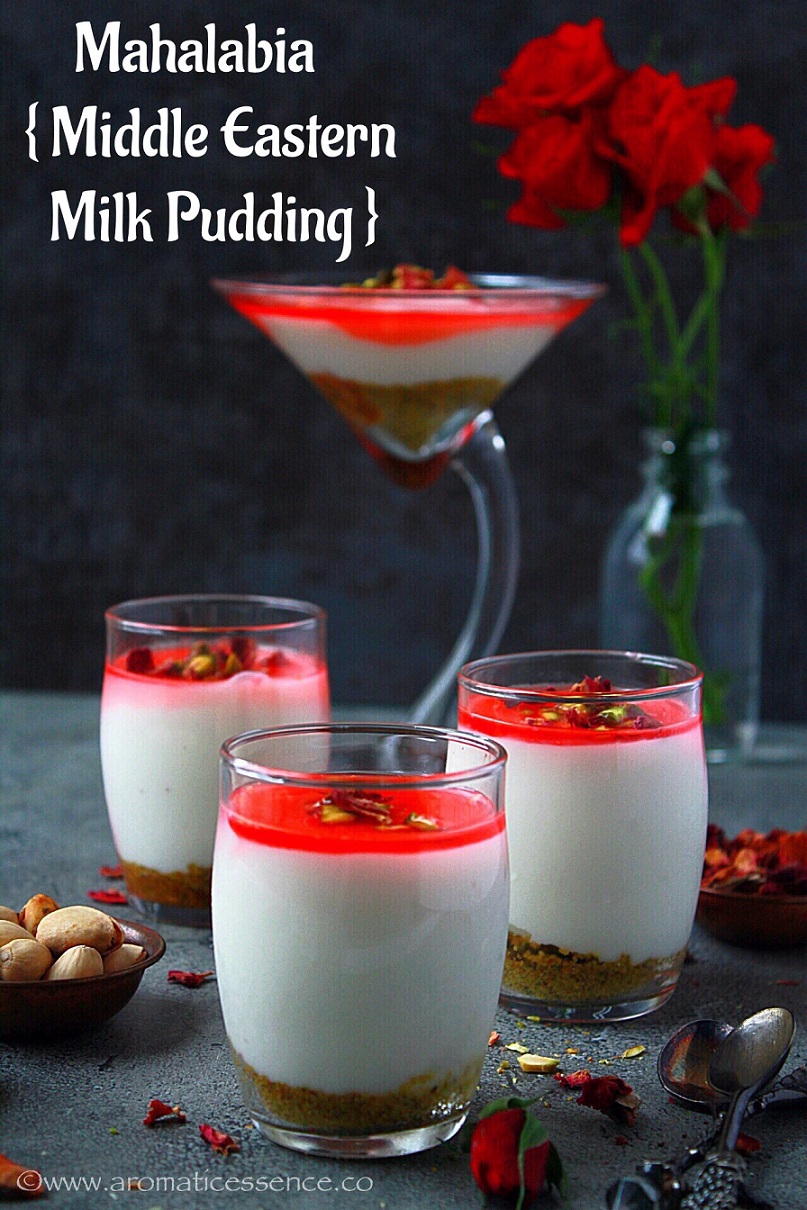
Mahalabia, also known as Muhallebi, Muhalabia, Mahalebi, Mohallabiah, or Muhallabiyeh is a traditional Middle Eastern pudding made with milk, rice flour, sugar, and flavored with rose or orange blossom water. Looking for different dessert ideas? Then you will definitely enjoy this easy pudding recipe! Let’s learn how to make mahalabia.
But before we move on with the recipe for mahalabia, I wanted to share with you guys the reason I made this dessert! I completed 4 years of blogging on the 17th of March.
So to celebrate that little milestone, I prepared this sweet treat! I didn’t have time for an elaborate dessert and yet wanted to share something quick, easy and delicious, and this mahalabia ticked off all the boxes!
Sometimes, I’m unsure if I should continue to blog and yet here I am celebrating 4 years of this blogging journey. There are ups and downs, and a thousand moments of self-doubt, but no matter what, I don’t think I can ever stop blogging after coming this far. Unless some life-changing event occurs, that is!
Thanks to my blogging journey, I’ve learned and made things that I don’t think I would have otherwise, like macarons , for instance. I will never forget the day I baked a batch of macarons successfully in my first attempt.
Or perhaps, I would have never tried making a fusion cake, such as the popular Rasmalai cake , and the many others that I made for my kid’s birthdays! And don’t even get me started on my numerous futile attempts at making soft and fluffy idlis ! I would have given up had it not been for this blog!

Let’s talk about Muhallebi or Mahalabia, Muhalabia, Mahalebi, whatever you want to call it! What’s in a name after all, right?
This fancy-sounding dessert is so easy, that you ought to head to your kitchen and make some right away! It is actually quite popular during Ramadan, but I think it is a great dessert to be enjoyed all year round!

- Ingredients needed
- How to serve mahalabia?
- You should try this recipe because
- You may also enjoy these easy eggless desserts
- How to make mahalabia (muhallebi) pudding – Step by step instructions
- Mahalabia Recipe | Muhallebi {Middle Eastern Milk Pudding}
Ingredients needed
Muhallebi or mahalabia is pretty much like a middle eastern version of the American vanilla pudding sans the eggs. The ingredients are similar for this mahalabia dessert recipe, let’s have a detailed look.
Milk
Since this is a milk-based pudding, this is an important ingredient. You can also use a mix of dairy and evaporated, half and half or heavy cream for a richer taste. But you don’t have to stick to dairy milk, you can use plant-based milk for a vegan muhallebi.
Thickener
Rice flour is traditionally used a thickener in this recipe. Rice flour has the same property as cornstarch of thickening the pudding. I use rice flour quite often to make quick dosa’s (crepes), so more often than not, I always have some in my pantry. It is not an ingredient I need to go out and get to make this pudding. But, I understand not many of you may have this ingredient, so I’ve chosen to use cornstarch in this recipe. If you have rice flour, use that instead.
Sugar
Sugar is added to sweeten the muhallebi. You can add some sweetened condensed milk instead and skip the sugar.
Flavorings
Rose water or orange blossom water, along with cardamom are traditionally used to flavor up the mahalabia. Basically, instead of vanilla, you would use these to make this delicious Middle Eastern dessert. I absolutely adore rose based dessert, I love its flavor!
Rose flavoring is a pretty common in Indian desserts as well, which is why I always have some rose extract, rose water, and rose syrup in my pantry. Rose and pistachio are one of the most exotic combinations you will try, trust me! Check out this rose and pistachio icebox cake , that turned out really well!
Speaking of rose syrup, you must check of this rose falooda recipe made with milk, rose syrup, and basil seeds. Such a cooling and refreshing beverage to beat the Summer heat!
You will find rose syrup easily in any Indian or Lebanese grocery store. If you don’t want to buy an extra ingredient that you are unsure of using in the future, use orange zest or vanilla extract or pure vanilla bean paste to flavor the pudding.
Garnishes
Traditional muhallebi is garnished with coarsely crushed nuts. I like to add some dried rose petals for a visual appeal, though they do nothing in terms of flavor. And, I like to add a thin layer of diluted rose syrup over the pudding after it has set. Rose syrup is really sweet, so diluting it down helps. Doesn’t the contrasting white and pinkish-red color look gorgeous?
How to serve mahalabia?
There are many ways you could serve it. For instance,
1.Pour the mahalabia milk pudding in glasses or bowl, and refrigerate it. After it has set, drizzle rose syrup (diluted with some water), and sprinkle pistachio powder or slivered/chopped pistachios or almonds.
2.Add ground pistachios at the bottom of the serving glass (like I did) and pour the mahalabia mixture. Drizzle diluted rose syrup and garnish with nuts.
3.Garnish with fresh fruits like strawberries, blueberries apple, mango, etc.
4.For another variation try, chocolate mahalabia: Add some melted chocolate in place of rose syrup after the pudding has set.

You should try this recipe because
- It is eggless, perfect if you don’t consume eggs
- Does not require gelatin or agar-agar
- Quick and Easy
- So delicious!
I want to take a minute here and thank all you wonderful readers for sticking around, visiting the site, trying out my recipes, and sharing your lovely feedback with me! I truly appreciate all the support!
Don’t wait for an occasion to make this easy eggless mahalabia dessert, I hope you try it soon!
You may also enjoy these easy eggless desserts
- Fruit Custard With Jelly
- Serradura (Portuguese sawdust pudding)
- Mango cream
- Mango Parfait
- Strawberry Fool
- Banana Pudding Parfait
How to make mahalabia (muhallebi) pudding – Step by step instructions
1.Remove the seeds from the cardamom pods, transfer to a mortar and pestle. Pound them to a fine powder and set aside.

2.Add milk in a heavy-bottomed pan, add cream, followed with cornstarch, and sugar. Using a wire whisk, whisk the mixture very well. Make sure the cornstarch is not settled at the bottom of the pot {You may mix the cornstarch with about 1/2 cup of milk and then add the cornstarch slurry to the milk mixture too, but it doesn’t make much of a difference if you use a wire whisk to mix up everything}. Then, switch on the flame to medium heat.

3.Cook the mahalabia pudding mix on medium heat, while continuously whisking the milk mixture until it begins to thicken, like a custard. This will take around 8-10 minutes. Do not stop whisking , or else the cornstarch will settle at the bottom and burn, or the mixture may turn clumpy. Continuous whisking until thickened is the only important step you need to follow while making this pudding.
As you continue whisking, you will see the mixture thickening up. Reduce the heat to low, and continue whisking. When it coats the back of a spoon, it is done.

4.Remove the pot off the heat, add the flavorings like rose or orange blossom water and freshly crushed ground cardamom (if using). Set aside to cool down for about 5 minutes.

5.Pour the mahalabia mixture into desired serving glasses or bowls, or one big bowl. I added some ground pistachios at the bottom of each glass, which is totally optional. Cover the glasses with a cling wrap or aluminum foil, chill in the refrigerator for 5-6 hours or overnight for best results. Garnish this delicious Middle Eastern milk pudding with rose syrup and chopped pistachios.

Notes
- You may skip the heavy cream and add milk instead. I recommend adding the cream, because the dessert sets beautifully, almost like a pannacotta, and the taste is nice and creamy. If you set it in small round bowls or molds, you can easily invert it and serve it like a jelly sort of dessert!
- Mahalabia with condensed milk: Replace the cream with condensed milk and omit the sugar.
- If you can’t find rose syrup or orange blossom water, you may flavor mahalabia with 2 tsp orange zest or vanilla extract. You can also play around with other warm spices like cinnamon or nutmeg.

You can also follow me on Facebook , Pinterest, Instagram & Twitter

Mahalabia Recipe | Muhallebi {Middle Eastern Milk Pudding}
Ingredients1x2x3x
- 3 cups whole milk
- 1 cup heavy cream
- 6 tbsp cornstarch/cornflour or rice flour
- 1/2 cup granulated sugar, adjust as per desired sweetness
- 1 tsp rose water/orange blossom water, or 1/4 tsp rose extract
- 3 green cardamom pods
For garnishing
- 2 tbsp coarsely chopped pistachios
- 3 tbsp rose syrup, diluted with 2 tbsp water
- dried rose petals, optional
Instructions
- Remove the seeds from the cardamom pods, transfer to a mortar and pestle. Pound them to a fine powder and set aside.
- Add milk in a heavy-bottomed pan, add cream, followed with cornstarch, and sugar. Using a wire whisk, whisk the mixture very well. Make sure the cornstarch is not settled at the bottom of the pot {You may mix the cornstarch with about 1/2 cup of milk and then add the cornstarch slurry to the milk mixture too, but it doesn’t make much of a difference if you use a wire whisk to mix up everything}. Then, switch on the flame to medium heat.
- Cook the mahalabia pudding mix on medium heat, while continuously whisking the milk mixture until it begins to thicken, like a custard. This will take around 8-10 minutes. Do not stop whisking, or else the cornstarch will settle at the bottom and burn, or the mixture may turn clumpy. Continuous whisking until thickened is the only important step you need to follow while making this pudding.
- As you continue whisking, you will see the mixture thickening up. Reduce the heat to low, and continue whisking. When it coats the back of a spoon, it is done.
- Remove the pot off the heat, add the flavorings like rose or orange blossom water and freshly crushed ground cardamom (if using). Set aside to cool down for about 5 minutes.
- Pour the mahalabia mixture into desired serving glasses or bowls, or one big bowl. I added some ground pistachios at the bottom of each glass, which is totally optional. Cover the glasses with a cling wrap or aluminum foil, chill in the refrigerator for 5-6 hours or overnight for best results. Garnish this delicious Middle Eastern milk pudding with rose syrup and chopped pistachios.
Notes

