Slurp up a tall glass of this refreshing, creamy, and luscious mango shake made with fresh, ripe, seasonal mangoes, milk, sugar, and a touch of cardamom. This is a pretty simple and basic recipe for a mango shake with milk. Be sure to check out more delicious variations listed in the post below!

One of the best things about summers in India are mangoes. The sweet, golden, juicy mangoes are the only thing I look forward to during Indian summers.
Sweet and ripe mangoes can be enjoyed on their own or can be incorporated in many recipes from beverages, salads to desserts.
Although mangoes are a bit heavy on the wallet at the moment, I still went ahead and bought a dozen Alphonso mangoes, just coz we couldn’t wait to savor this fruit.
I love making the most of this fruit in the form of a simple milkshake. It is insanely easy and loved by everyone in the house.
Moreover, mango season lasts for a very short time, so we like to enjoy it to the fullest.

- Why should you try this recipe
- Ingredients needed
- How to make mango shake with ice cream – Step by step process
- Variations of this recipe
- Frequently asked questions
- You may also enjoy these mango recipes
- Mango Shake | How To Make Mango Milkshake
Why should you try this recipe
✔ It’s mango season and that is reason enough to whip up this recipe!
✔ This mango shake without ice cream is simple and needs very few ingredients.
✔ Always a hit with toddlers, kids, or adults alike.
✔ Tastes heavenly!
✔ Great for breakfast as it keeps you full for longer.
✔ Also makes for a refreshing beverage to beat the heat.
✔ Most of all, so easy to make! Make it at home using clean and fresh ingredients!

Ingredients needed
For this homemade mango shake, you need four ingredients;
Mangoes: I’ve used Alphonso mangoes here, simply because it makes the best mango shake. You can use any mangoes, just be sure to use the ones that are ripe, sweet, and less fibrous. If using fibrous varieties, its best to strain the mango pulp and then blend it with the milk.
Milk: I’ve used full-fat dairy milk. You can use any kind of milk, toned, skim, fat-free, 1%, etc, they all work well. If using fresh milk, boil, cool, and then use it in the recipe. You can also veganize this recipe by using your favorite plant-based milk such as soy milk, oat milk, almond milk, cashew nut milk, light coconut milk, etc
Sugar: Just a touch to add more sweetness. You can skip it if the mangoes are really sweet. You can also sweeten it with honey, agave nectar, or stevia, or condensed milk for a decadent treat.
Cardamom: This is a totally optional ingredient, but I love adding a pinch of cardamom powder to give it that Indian touch. Besides, mango and cardamom pair really well, don’t you agree? It’s the most common spice used to flavor up Indian desserts, and it does a great job flavoring up this fresh mango shake as well.
Optional ingredients: Whipped cream and slivered pistachios for garnishing.

How to make mango shake with ice cream – Step by step process
Step 1: Blend all the ingredients
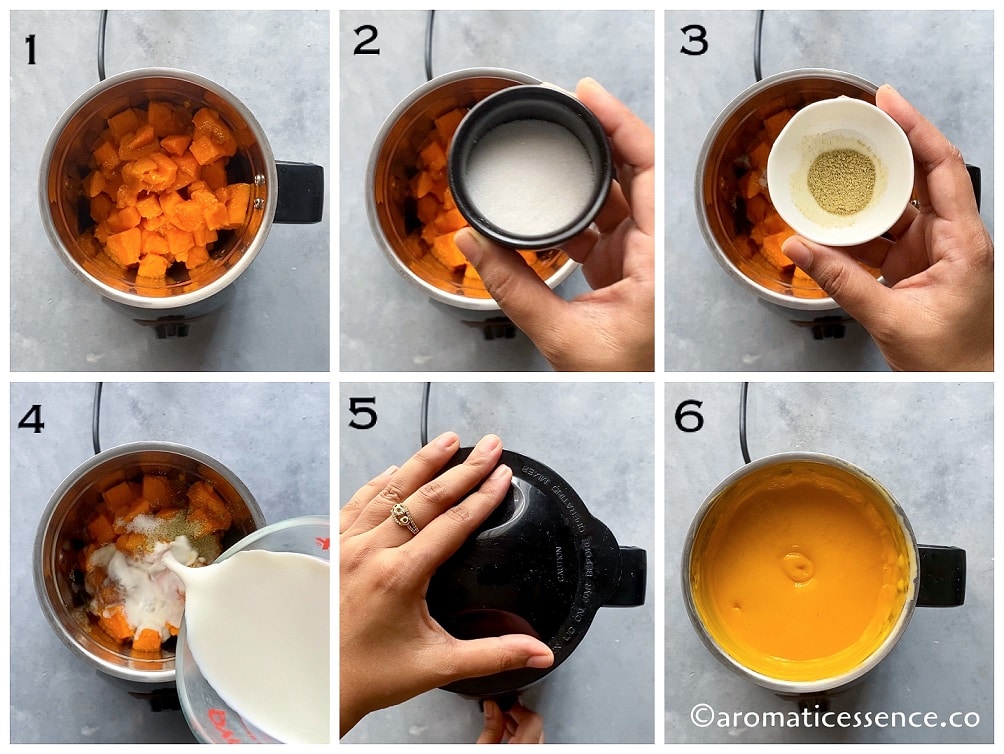
Add 2 cups diced mangoes, 1 tablespoon of sugar, 1/8 to 1/4 teaspoon ground cardamom, and 3/4 cup chilled milk in a blender. (Photos 1 to 4)
Blend until smooth and creamy. If it is too thick, add the remaining 1/4 cup milk and blend again. (Photos 5 and 6)
Step 2: Serve
Transfer the mango milkshake to serving glass, top with whipped cream, and slivered pistachios! (Photos 7 and 8)

Variations of this recipe
Store-bought mango pulp: If you live abroad, it’s best to make this mango milkshake with canned mango pulp or frozen mango pulp that you are most likely to find at Indian stores. Opt for Alphonso or Kesari mango pulp. Keep in mind, that most of these canned mango pulps already contain sugar. Read the labels, and adjust or eliminate sugar in this recipe.
Cream: For a richer and creamier milkshake, you can throw in a few tablespoons of fresh cream (malai) or heavy cream. I prefer to top the milkshake with whipped cream as that’s how my kids prefer it. I think it also looks top-notch restaurant-quality!
Rooh afza: Drizzle 1-2 teaspoons of rooh afza syrup, and swirl the glass to create a random pattern. Pour the milkshake, and enjoy another simple variation.
Vanilla flavored: If you don’t like cardamom, add some vanilla extract instead or about 2 scoops of vanilla ice cream.
Other flavors: Mango also pairs well with other warm spices such as cinnamon and nutmeg. A tablespoon of saffron-infused milk would add a royal touch!
Finely chopped nuts: After blending the ingredients, add 1 to 2 tablespoons of chopped assorted nuts such as almonds, pistachios, and cashew nuts. Mix with a spoon, and serve. This will add another layer of texture in contrast to the smooth and creamy mango shake.
Other fruits: I also love to swap half of the mangoes with banana or strawberry for some variation in flavor. Banana also makes the shake thicker.
Mango milkshake popsicles: For a yummy frozen treat, pour the milkshake in popsicle molds, and freeze.
Consistency of the milkshake : Feel free to increase the mangoes for a thicker shake with more mango flavor, or increase the milk if you don’t prefer as much of a mango flavor and also want a thinner consistency. You can also throw in some ice cubes to thin it out.

How to cut a mango?

I’d shared an easy pictorial to cut mango on my mango salsa post. Adding it here once again.
Can I mix mango with milk?
As per Ayurveda, it is not advisable to mix fruit with milk as it can cause digestive issues. However, I like to take this theory with a pinch of salt. Most Indians have had mango milkshake made with dairy milk for years now. Plant-based milk was not available so easily as it is today in big cities in India.
It is fine to mix mango and milk, but just make sure you use a ripe and sweet mango. Never mix semi-sweet, sour, or raw mango with milk as they can cause the milk to curdle.
Everybody is different. What agrees with me may not agree with you. So you are the best judge to decide how you’d like to make this recipe.
If this is your first time making this milkshake and you aren’t sure if using milk is a good idea, then simply use your favorite vegan milk. It will hardly affect the overall taste.
Which is the best mango for mango shake?
Undoubtedly, Alphonso mangoes are the best kinds to be used in the recipe. The taste, texture, and color are unparalleled with any other variety of mango.
They are called the King of mangoes for a reason here in India, after all! Kesari and Badami mangoes also are good alternatives.
It is really hard to get hold of Alphonso mangoes outside India. I’ve survived 5 years without these mangoes while I was in the US and missed them so much during the summers.
Ataulfo and Champagne mangoes were decent substitutes, but unfortunately, they are nowhere close to the Alphonso variety.
Can I make this mango milkshake without sugar?
Yes, absolutely! You can sweeten the milkshake with your favorite sweetener. You may not even need a sweetener if your mangoes are really sweet.
How to make this milkshake thicker?
Choose either of the methods to make a really thick milkshake;
- With ice cream: Check out this mango mastani post which is nothing but a thick mango milkshake made with the addition of ice cream. Simply follow that recipe if you’d like to include ice cream. You can also make this mango milkshake with mango ice cream, it tastes super delicious!
- Frozen milk cubes: Freeze the milk in an ice cube tray. Blend the frozen milk cubes and chopped mangoes for a really thick milkshake. If required, add some milk to adjust the consistency.
- Frozen mango chunks or pulp: Instead of milk, dice and freeze mango chunks. To do that, dice up mangoes, place them on a baking tray lined with parchment paper. Cover the tray with cling wrap. Freeze for 4 to 5 hours or until firm, then transfer to a zip lock back, label, and freeze for up to 10 to 12 months. You can also make mango pulp and freeze it in individual serving portions.

You may also enjoy these mango recipes
Mango lassi
Mango shrikhand
Eggless mango loaf cake
Eggless mango semolina cupcake
You can also follow me on Facebook , Pinterest, Instagram & Twitter

Mango Shake | How To Make Mango Milkshake
Ingredients1x2x3x
- 350 grams diced mangoes, about 2 cups
- 1 to 2 tablespoons castor sugar, depending on the sweetness of the mangoes
- 1/8 to 1/4 teaspoon ground cardamom
- 3/4 to 1 cup milk
- 1/2 cup Whipped cream, for garnishing. optional
- 1 teaspoon slivered pistachios
Instructions
- Add diced mangoes, sugar, ground cardamom, and 3/4 cup chilled milk in a blender.
- Blend until smooth and creamy. If it is too thick, add the remaining 1/4 cup milk and blend again.
- Transfer the mango milkshake to serving glass, top with whipped cream, and slivered pistachios!
Video
Notes
Nutrition

Mango Shake | How To Make Mango Milkshake
Ingredients
- 350 grams diced mangoes, about 2 cups
- 1 to 2 tablespoons castor sugar, depending on the sweetness of the mangoes
- 1/8 to 1/4 teaspoon ground cardamom
- 3/4 to 1 cup milk
- 1/2 cup Whipped cream, for garnishing. optional
- 1 teaspoon slivered pistachios
Instructions
- Add diced mangoes, sugar, ground cardamom, and 3/4 cup chilled milk in a blender.
- Blend until smooth and creamy. If it is too thick, add the remaining 1/4 cup milk and blend again.
- Transfer the mango milkshake to serving glass, top with whipped cream, and slivered pistachios!
Video
Notes
Nutrition
Pudina rice (mint rice) is an easy rice dish to put together. It is aromatic, packed with refreshing flavors, and perfect to be whipped up during busy weekdays. Serve it along with some raita, papad, and pickle for a quick and delicious meal!

This pudina rice or pudina pulao/mint pulao is so easy to make and packed with zesty flavors. The rice is cooked with a simple mint paste made with lots and lots of fresh mint leaves, coriander leaves, ginger, garlic, green chilies, and freshly grated coconut.
When I’m pressed for time, I prefer to cook up a simple yet delicious rice dish, that doesn’t need a lot of sides to be served with. This coconut mint rice is easy, really tasty and I’m sure you will add this rice recipe to your repertoire.
Mint is known as pudina in Hindi. As you know, this culinary herb is known for its aroma, refreshing flavors, and numerous health benefits. I love this herb so much, that I have a small mint plant in my kitchen garden. I’m sure going to be using it up in a lot of my summer coolers this season.
Pudina rice is quite popular in the Southern states of India. It is known as pudina sadam or pudina bath and is made slightly differently.Sadam translates to rice in Tamil and bath translates to rice in Kannada language respectively. Be sure to check out the South Indian version in variations below.
It’s great to whip up pudina sadam if you have some leftover rice. Well, you can make this recipe with leftover rice too, but I prefer making it with uncooked rice so that every grain of rice is infused with the flavorful mint paste.

- Why you will love this recipe
- Ingredients
- Instructions
- Serving suggestions
- Variations
- Storage
- Top tips
- FAQ
- Related
- Pudina Rice | Mint Rice
Why you will love this recipe
- A quick and easy rice dish, which is equally flavorful and needs simple ingredients
- Does not have an overpowering mint flavor, even if you don’t like mint as much, you will still enjoy this rice
- It has a beautiful green color, that is all-natural and makes it look appetizing
- The addition of vegetables makes it wholesome
- Does not need a lot of sides, it is substantial enough to be served with plain yogurt or raita of your choice
- Great to be packed in a lunch box
- Perfect for busy weekday meals
- Naturally gluten-free and can be made vegan by swapping the ghee with oil
Ingredients

To make this recipe, first, you will need to prepare the mint paste. For that, you will need the following;
- Mint leaves: Use only the leaves and not the stems.
- Coriander leaves: Optional, but I love the flavor it adds.
- Ginger and garlic: Enhances the overall flavor of the dish.
- Green chillies: To add some heat, skip or use the mild variety of chillies, if making for kids.
- Freshly grated coconut: You can also use desiccated coconut or small pieces of coconut.
To make the pulao, you will need;
- Rice: I’ve used basmati, but feel free to use any kind of rice. Even leftover rice is great.
- Cooking fat: Ghee is my choice of cooking fat when it comes to making pulao.
- Whole spices: I’ve used green cardamom, cloves, cinnamon, peppercorns, star anise, and cumin seeds. When sauteed in ghee, these spices release a wonderful aroma.
- Vegetables: I’ve used frozen diced veggies as it is super convenient. You can use finely diced fresh vegetables too.
- Ground spices: You don’t need a ton of spices for this recipe. I’ve used ground turmeric, and garam masala along with salt.
- Onions: Thinly sliced!
- Tomatoes: Adds some tang to the pulao.
- Cashew nuts: This is optional. I’ve used it mainly for garnishing, though I love the additional texture it adds. If you don’t have any nut allergies, definitely include this ingredient.
- Lemon juice: Again, an optional ingredient. But, I love the pop of freshness that it adds.
Instructions
Stovetop method
Rinse 1.5 cups of basmati rice until the water runs clear, soak it in 2-3 cups of water for 30 minutes. ( Photos 1 and 2 )
In the meanwhile, prep your ingredients.

Add 1 cup tightly packed mint leaves, 1/3 cup coriander leaves, 4 tablespoons grated coconut, 1/2- inch ginger, 4 garlic cloves, and 1-2 green chillies in a blender. Add 2-3 tablespoons of water and blend to a smooth paste. Set aside. ( Photos 3 to 8 )

Heat 2 tablespoons of ghee in a heavy-bottomed pot over medium heat. ( Photo 9 )

Add 8 to 10 cashew nuts, broken into halves, roast until golden brown, set aside. ( Photos 10 and 11 )

Add whole spices (3 each of green cardamom, cloves, 1 bay leaf, 3-4 peppercorns, 1-star anise, 1-inch cinnamon) 1/2 teaspoon cumin seeds), saute for a few seconds until the spices are fragrant. ( Photos 12 and 13 )

Add 1 cup of sliced onions, saute until the onions turn golden brown. ( Photos 14 and 15 )

Add 1/2 cup diced tomatoes, and cook until they soften. ( Photos 16 and 17 )

Next, add 1 to 1.5 cups of mixed vegetables, mix well, and cook for another 2-3 minutes. ( Photos 18 and 19 )

Add the mint paste and 1/4 teaspoon turmeric, and saute for a few more minutes until most of the moisture is lost. ( Photos 20 and 21 )

Next, add salt (to taste) and 1/2 teaspoon garam masala and mix well. ( Photos 22 to 24 )

Add the drained rice, and saute gently until the rice is coated with the paste. ( Photos 25 and 26 )
Rinse the blender with 1 cup of water to extract any remaining mint paste and add it to the pot. Add the remaining 1.75 cups of water, mix well, and bring to a boil.
Check for seasoning, the water should taste salty. Add more salt if needed.
Reduce the heat, cover the pot, and simmer for 10 minutes or until all the water is absorbed and the rice is done. ( Photos 27 to 29 )

Switch off the heat and let the rice stand undisturbed, with the lid on, for 10 minutes.
Open the lid, sprinkle 1/2 tablespoon of lemon juice (optional), and roasted cashew nuts (reserve a few for garnishing), and fluff the rice with a fork. ( Photos 30 to 33 )

Instant Pot method
Press the ‘SAUTE’ button, and set it to ‘NORMAL’. Once it displays, ‘HOT’, then add 2 tablespoons of oil or ghee, and let it heat up a bit, Add 8 to 10 cashew nuts, broken into halves, roast until golden brown, and set aside. ( Photos 34 and 35 )

Add whole spices (3 each of green cardamom, cloves, 1 bay leaf, 3-4 peppercorns, 1-star anise, 1-inch cinnamon) 1/2 teaspoon cumin seeds), and saute for a few seconds until the spices are fragrant. ( Photo 36 )

Add 1 cup of sliced onions, and saute until the onions turn golden brown. ( Photos 37 and 38 )

Add 1/2 cup diced tomatoes, and cook until they soften. ( Photos 39 and 40 )

Next, add 1 to 1.5 cups of mixed vegetables, mix well, and cook for another 2-3 minutes. ( Photo 41 )

Add the mint paste and 1/4 teaspoon turmeric, and saute for a few more minutes until most of the moisture is lost. ( Photos 42 to 44 )

Next, add salt (to taste) and 1/2 teaspoon garam masala and mix well. ( Photos 45 and 46 )

If you have browned bits stuck at the bottom of the pot, deglaze it with about 2 tablespoons of water to avoid a potential ‘BURN’ error.
Add the drained rice, and saute gently until the rice is coated with the paste.
Rinse the blender with 1/2 cup of water to extract any remaining mint paste and add it to the pot. Add the remaining 1 cup of water, and mix well. Make sure the rice is submerged in the liquid. ( Photos 47 to 49 )

Check for seasoning, the water should taste salty. Add more salt if needed.
Press ‘CANCEL’ to switch off the “SAUTE’ mode. Close the lid of the Instant Pot. Set the valve to ‘SEALING’. Pressure cook on high for 4 minutes. It will take some time for the pressure to build up (about 9 minutes), after which the timer will begin. ( Photo 50 )

Once the cooking cycle is complete, let the pot depressurize for 10 minutes. Then do a quick release of the leftover pressure as per the manufacturer’s instructions. Press ‘CANCEL’ and switch off the IP. Once the silver pin drops, turn the knob to ‘VENTING’ and open the lid away from you.
Sprinkle 1/2 tablespoon of lemon juice (optional), and roasted cashew nuts (reserve a few for garnishing), Fluff mint coriander rice with a fork. (Photos 51 to 55)

Serving suggestions
This mint pulao is packed with a lot of flavors and hence does not need a curry or gravy as an accompaniment. However, you can serve it with any vegetarian or meat-based curries of your choice.
I prefer to keep it simple and serve it with raita or plain yogurt, pickle, and some papad.
Roasted vegetables or grilled meats such as kebabs, etc. would make for a great side dish for this pudina rice.

Variations
South Indian style: Follow these steps;
- Heat 2 tablespoons oil, add 1 teaspoon each of mustard seeds.
- Once it starts crackling, add 1 teaspoon each of chana dal and urad dal.
- Add about 2 tablespoons of raw peanuts. Cook until the dals and peanuts turn a golden brown color.
- Add a sprig of curry leaves and 1 cup of sliced onions, and saute until golden brown.
- Next, add the mint paste, and 1/4 teaspoon of turmeric powder, and cook until the moisture is lost.
- Add 2 to 3 cups of cooked rice, sprinkle 1 tablespoon or so of lemon juice, and mix well. Dish out and serve!
Add proteins: You can also add cooked chickpeas, rajma, sprouts, paneer, or tofu to this tomato pudina rice.
Palak (spinach): You can add some blanched spinach leaves and blend them along with the other ingredients to make a palak pudina paste.
Use chicken or veg stock: Flavor up this pudina coriander rice even more by swapping the water with stock or broth. Remember to adjust the salt accordingly if the stock has added salt.
No onion/garlic: For a Jain version, feel free to make this rice without onion or garlic.
Chicken or prawns: Follow these steps;
- Dice up about 1 boneless chicken breast or 2 chicken thighs into 1-inch chunks or use prawns.
- Marinate with ginger garlic paste, yogurt, lemon juice salt, and pepper.
- Add it to the pot after sauteing the onions and tomatoes.
- Saute on medium-high heat until the chicken/prawn turns opaque.
- Then follow the rest of the recipe as stated above.
- You can also add fried/grilled chicken or prawns to this mint coriander rice after it’s done cooking, and mix it gently.
Storage
Refrigerator: Refrigerate leftovers (within 2 hours of cooking) in an airtight container for up to 1-2 days.
Reheat: Transfer the rice to a pan, sprinkle some water, cover, and reheat on low heat, stirring occasionally until heated through. You may also reheat it in the microwave.
Top tips
Mint leaves: Use fresh mint leaves for this recipe, as it is the key ingredient used for flavoring the rice. Never use the stems, as they can add a bitter taste to the dish.
Spice: I do not add a lot of green chilies because of my kids. Feel free to add more chilies as per your desired heat. You can also add 1/2 teaspoon of black peppercorns to the chutney to amp up the spice levels.
Vegetables: You can add any vegetables of your choice. I added a cup of mixed frozen vegetables (peas, corn, carrots, cauliflower, and green beans) to make my life easier. If adding vegetables like aloo (potatoes), then dice them small so that they cook through, especially if you make this recipe on the stovetop. If you dice bigger chunks, then be sure to let them cook at least until they are cooked halfway through.
Check for salt: Always check for salt, after the water comes to a boil. If the water does not taste salty, adjust with more salt at this stage, or else the rice will taste bland.
Quantity of water: I prefer to soak my rice, and hence reduce the water required to cook the pulao, or else it becomes too soft for our liking. If you choose to skip soaking the rice, then follow the 1:2 ratio (stovetop) and 1: 1.25 ratio (for Instant Pot) of rice to water for cooking the pulao. I do recommend rinsing your rice though, so don’t skip that step.
Let the rice rest: Leave the rice undisturbed for at least 10-15 minutes after it’s done cooking. Avoid fluffing the rice, as it continues to absorb moisture even after cooking.
If you skip tomatoes: Squeeze extra lemon juice, in the end, to add some tang and peppy flavor to the dish.

How to make this mint rice in a stovetop pressure cooker?
Follow the same steps as above. Reduce the water to 2 & 1/4 to 2 & 1/2 cups, depending on the quality of the rice. Cook on high for 2 whistles, then let the pressure release naturally. Open the lid and fluff the rice with a fork.
Can I make this pudina rice with cooked rice or leftover rice?
You can make fried rice-style pudina rice if you have cooked or leftover rice. Add about 2 to 3 cups of cooked and cooled rice instead of the drained rice in this recipe. Mix gently to avoid breaking the rice grains. Cover the pan, and cook on low heat for 2 minutes. Then fluff the rice and serve hot.
Can I skip coconut in the mint paste?
Yes, you can skip the coconut. The paste will not be as thick, but it will still be good. You can use cashew nuts instead of coconut for the paste. You can substitute some of the water used for cooking the rice with coconut milk instead, i.e. about 2 cups water and 3/4 cup light coconut milk.
Do I have to make this recipe with basmati rice?
Not really! Feel free to use any rice of your choice. The main ingredient here is the mint paste which will flavor up any variety of rice equally well. Adjust the water quantities as per the rice you choose to use.
Related
- Vegetable pulao
- Moong sprouts and paneer pulao
- Palak rice
- Cauliflower dum biryani
- Mushroom pulao
- Bagara rice

Pudina Rice | Mint Rice
Equipment
- Instant Pot DUO60 6 Qt 7-in-1
Ingredients1x2x3x
For the mint coconut chutney
- 1 cup tightly packed mint leaves, 25 grams
- 1/3 cup coriander leaves along with tender stems, tightly packed, 10 grams
- 4 tablespoons grated coconut, 25 grams
- 1/2 inch ginger root, peeled
- 4 to 5 garlic cloves
- 1-2 green chillies, I used the less spicy Indian variety that’s light green in color
For the pudina rice
- 1.5 cups of basmati rice 285 grams
- 2 tablespoons ghee or oil,
- 8-10 cashew nuts broken in halves
- Whole spices 3 each of green cardamom, cloves, 1 bay leaf, 3-4 peppercorns, 1-star anise, 1-inch cinnamon 1/2 teaspoon cumin seeds
- 1 cup sliced onions
- 1/2 cup diced tomatoes,
- 1 to 1.5 cups mixed vegetables
- table salt, to taste (I added about 1.25 teaspoons)
- 1/4 teaspoon turmeric
- 1/2 teaspoon garam masala
- 2.75 cups water, 1.5 cups water for the Instant Pot
- 1/2 tablespoon lemon juice, optional
Instructions
- Rinse basmati rice until the water runs clear, soak it in 2-3 cups of water for 30 minutes. In the meanwhile, prep your ingredients.
Mint coconut chutney
- Add mint leaves, coriander leaves, grated coconut, ginger, garlic, and green chillies in a blender. Add water and blend to a smooth paste. Set aside.
Stovetop Method
- Heat ghee in a heavy-bottomed pot over medium heat.
- Add cashew nuts, roast until golden brown, set aside.
- Add whole spices, saute for a few seconds until the spices are fragrant.
- Add sliced onions, saute until the onions turn golden brown.
- Add diced tomatoes, cook until they soften.
- Next, add the vegetables, mix well and cook for another 2-3 minutes.
- Add the mint paste and ground turmeric, saute for few more minutes until most of the moisture is lost.
- Next, add salt and garam masala, mix well.
- Add the drained rice, saute gently until the rice is coated with the paste.
- Rinse the blender with 1 cup of water to extract any remaining mint paste and add it to the pot. Add the remaining 1.75 cups of water, mix well, and bring to a boil.
- Check for seasoning, the water should taste salty. Add more salt if needed.
- Reduce the heat, cover the pot and simmer for 10 minutes or until all the water is absorbed and the rice is done.
- Switch off the heat and let the rice stand undisturbed, with the lid on, for 10 minutes.
- Open the lid, sprinkle lemon juice, and roasted cashew nuts (reserve a few for garnishing), fluff the rice with a fork.
Instant Pot Method
- Press the ‘SAUTE’ button, and set it to ‘NORMAL’. Once it displays, ‘HOT’, then add 2 tablespoons of oil or ghee, let it heat up a bit, Add cashew nuts, roast until golden brown, set aside.
- Add whole spices, saute for a few seconds until the spices are fragrant.
- Add sliced onions, saute until the onions turn golden brown.
- Add diced tomatoes, cook until they soften.
- Next, add the vegetables, mix well and cook for another 2-3 minutes.
- Add the mint paste and turmeric, saute for few more minutes until most of the moisture is lost.
- Next, add salt and garam masala and mix well
- If you have browned bits stuck at the bottom of the pot, deglaze it with about 2 tablespoons of water to avoid a potential ‘BURN’ error.
- Add the drained rice, saute gently until the rice is coated with the paste.
- Rinse the blender with 1/2 cup of water to extract any remaining mint paste and add it to the pot. Add the remaining 1 cup of water, mix well. Make sure the rice is submerged under the liquid.
- Check for seasoning, the water should taste salty. Add more salt if needed.
- Press ‘CANCEL’ to switch off the “SAUTE’ mode. Close the lid of the Instant Pot. Set the valve to ‘SEALING’. Pressure cook on high for 4 minutes. It will take some time for the pressure to build up (about 9 minutes), after which the timer will begin.
- Once the cooking cycle is complete, let the pot depressurize for 10 minutes. Then do a quick release of the leftover pressure as per the manufacturer’s instructions. Press ‘CANCEL’ and switch off the IP. Once the silver pin drops, turn the knob to ‘VENTING’ and open the lid away from you.
- Sprinkle lemon juice, and roasted cashew nuts (reserve a few for garnishing), Fluff mint coriander rice with a fork.
