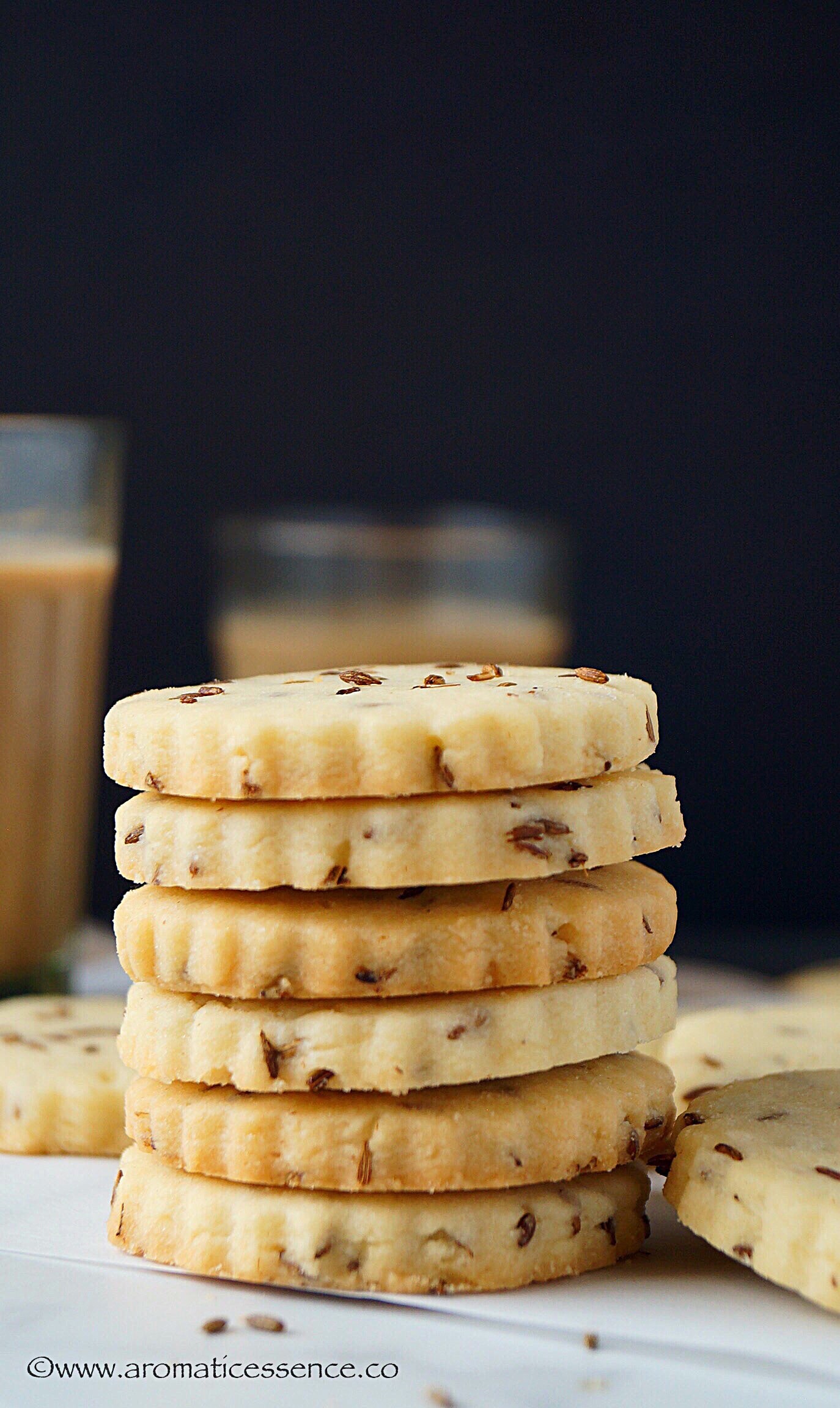
Jeera Biscuits ( cumin cookies) are sweet, salty, crispy, crunchy and crumbly Indian bakery style eggless cookies, flavored with roasted cumin seeds.

Jeera or zeera is the Hindi name for cumin seeds. Zeera biscuits are an amazing mix of savory and sweet and a welcome break from the overloaded sweet cookies. These namkeen biscuits (savory cookies) will satisfy your sweet and salty craving all in one go. They are buttery, crispy and so addictive.
If you have enjoyed some of the eggless cookies that I’ve shared earlier, you are definitely going to enjoy this savory Indian biscuit recipe too. They are also known as salt biscuits .
These sweet and salty biscuits are packed with the fragrant earthy aroma of roasted cumin. So good!

The base of these jeera butter biscuits is adapted from one of my favorite types of biscuits, Karachi bakery style fruit biscuits . Except, we don’t slice and bake here rather chill the dough until it’s workable, roll it and use a cookie cutter to form desired shapes. And of course, the amount of sugar is reduced by half, as this is more of a savory cookie.
We love to enjoy these salted jeera biscuits with our evening cuppa over some chit-chat or frankly I can have them anytime. Khari biscuits and rusks are also some of my favorite Indian tea-time snacks.
I enjoyed these snacks as a kid and it makes me happy to see my son enjoy it too. Of course, anything cooked/baked by me and is well received by him is always a bonus 😀

- How do you make these namkeen zeera biscuits?
- If you enjoyed this easy, sweet and savory salt biscuits, you may also like these eggless biscuit recipes
- How to make jeera biscuits (cumin cookies) – Step by step instructions
- Jeera Biscuits | Indian Cumin Cookies
How do you make these namkeen zeera biscuits?
You need pantry basics for this eggless jeera biscuit recipe i.e flour, butter, powder, powdered sugar, salt, and of course the star ingredient, cumin seeds.
- You will start off by creaming butter and sugar until light and creamy.
- Add in the dry ingredients.
- Shape the dough as disc and refrigerate for some time.
- Roll out the dough, sprinkle some more cumin seeds, cut out desired shapes.
- Bake until a nice golden brown.
You can also make ajwain cookies with this same recipe. Swap the cumin seeds with ajwain (carom seeds).
- Karachi fruit biscuits
- Badam pista biscuits
- Whole wheat and oats digestive cookies
- Nankhatai (Indian shortbread cookies)
- Coconut cookies
So let’s get on to the recipe and make some tasty tea time munchies!

How to make jeera biscuits (cumin cookies) – Step by step instructions
Step 1: Roast cumin seeds
Place the butter on your countertop until it reaches room temperature and is softened. You do not want it to be too soft. It should have some resistance when you push a finger through it.
Dry roast 1 tablespoon of cumin seeds on a skillet until fragrant. Transfer to a plate to cool completely. Then transfer to your work surface and crush it lightly with the help of a rolling pin.

Step 2: Dry ingredients
Sift 1 cup + 2 tablespoons of all-purpose flour in a mixing bowl. Add 3/4 of the crushed cumin seeds, along with 3/4 teaspoon of salt.

Step 3: Cream butter and sugar
Place 1/2 cup of softened butter in the bowl of your stand mixer (you can use your hand mixer or a whisk too), sift in 1/4 cup of powdered sugar, beat on low heat initially, until the powdered sugar is mixed with the butter, then increase the speed to medium and beat till light and creamy.

Step 4: Add dry ingredients to the creamed butter-sugar mixture
Now switch to the lowest speed and add the flour in 3 parts. Gently bring the dough together. Do not knead. If at all the dough is dry, sprinkle few teaspoons of milk at a time, do not add too much.

Step 5: Refrigerate the cookie dough
Shape the dough in a disc and wrap in a cling film. Refrigerate it for 15-30 minutes to make it workable.

Step 6: Roll and cut out
Preheat the oven to 180 degrees C/350 degrees F. Line a baking sheet with parchment paper or Silpat. Remove the disc from the refrigerator, place between 2 parchment papers, and roll it to 1/4 inch thickness.
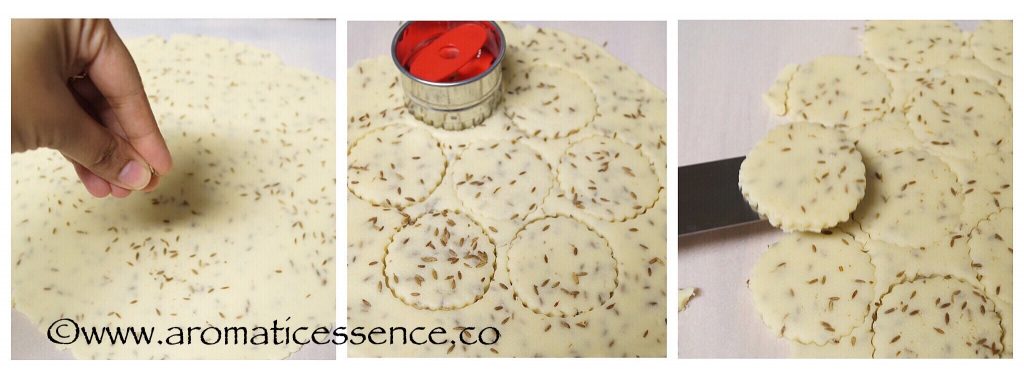
Sprinkle the remaining cumin seeds, and gently press int the dough. Cut out desired shapes using a cookie cutter. Collect the scraps, form a disc, and repeat the same procedure or make small balls from the scraps and flatten them between your palms.
Step 7: Bake
Transfer the cookies with the help of an offset spatula on the baking sheet at least 2 inches apart.

Bake for 12 -15 minutes or 15-18 minutes for crispier cookies. When the bottom of the cookies begins to brown, they are done. They will be soft in the middle but will firm upon cooling. Cool in the baking tray for five minutes and then transfer to the wire rack to cool completely. Jeera biscuits will last for about two weeks in an airtight container.

Notes
- If you don’t prefer salty cookies, use only 1/4 tsp salt or up to 1 tsp of salt if you prefer saltier cookies. I’ve used 3/4 tsp of salt.
- You can use whole wheat flour in place of all-purpose flour for whole wheat jeera biscuits. Simply adjust the consistency of the dough with milk by adding 1 tbsp milk at a time. With all-purpose flour, I didn’t need to add any milk.
- You can roll out the dough a little thicker if you like chunkier cookies. Baking time will increase, so keep an eye.

You can also follow me on Facebook , Pinterest, Instagram & Twitter

Jeera Biscuits | Indian Cumin Cookies
Ingredients1x2x3x
- 1 cup +2 tablespoons allpurpose flour/maida, (spooned and leveled), 160 grams
- 1/2 cup softened unsalted butter, 113 grams
- 1/4 cup powdered sugar/confectioner’s sugar, 35 grams
- 1 tbsp cumin seeds
- 1/4 to 3/4 tsp salt
- 1-2 tbsp milk, if required
Instructions
- Place the butter on your countertop until it reaches room temperature and is softened. You do not want it to be too soft. It should have some resistance when you push a finger through it. Dry roast the cumin seeds on a skillet until fragrant. Transfer to a plate to cool completely. Then transfer to your work surface and crush it lightly with the help of a rolling pin.
- Sift the flour in a mixing bowl. Add 3/4 of the crushed cumin seeds, along with the salt.
- Place butter in the bowl of your stand mixer (you can use your hand mixer or a whisk too), sift in powdered sugar, beat on low heat initially, until the powdered sugar is mixed with the butter, then increase the speed to medium and beat till light and creamy.
- Now switch to the lowest speed and add the flour in 3 parts. Gently bring the dough together. Do not knead. If at all the dough is dry, sprinkle few teaspoons of milk at a time, do not add too much.
- Shape the dough in a disc and wrap in a cling film. Refrigerate it for 15-30 minutes to make it workable.
- Preheat the oven to 180 degrees C/350 degrees F. Line a baking sheet with parchment paper or Silpat. Remove the disc from the refrigerator, place between 2 parchment papers and roll it to 1/4 inch thickness. Sprinkle the remaining cumin seeds, and gently press int the dough. Cut out desired shapes using a cookie cutter. Collect the scraps, form a disc, and repeat the same procedure or make small balls from the scraps and flatten them between your palms.
- Transfer the cookies with the help of an offset spatula on the baking sheet at least 2 inches apart.
- Bake for 12 -15 minutes or 15-18 minutes for crispier cookies. When the bottom of the cookies begins to brown, they are done. They will be soft in the middle but will firm upon cooling. Cool in the baking tray for five minutes and then transfer to the wire rack to cool completely. Jeera biscuits will last for about two weeks in an airtight container.
Notes
- If you don’t prefer salty cookies, use only 1/4 tsp salt or up to 1 tsp of salt if you prefer saltier cookies. I’ve used 3/4 tsp of salt.
- You can use whole wheat flour in place of all-purpose flour for whole wheat jeera biscuits. Simply adjust the consistency of the dough with milk by adding 1 tbsp milk at a time. With all-purpose flour, I didn’t need to add any milk.
- You can roll out the dough a little thicker if you like chunkier cookies. Baking time will increase, so keep an eye.
- Nutrition Disclaimer: Nutrition facts are approximate values calculated using an online nutrition calculator. If you rely on them for your diet, please use your preferred nutrition calculator.
- Measuring cup used, 1 Cup = 250 ml, 1 tsp = 5 ml
Nutrition


Jeera Biscuits | Indian Cumin Cookies
Ingredients
- 1 cup +2 tablespoons allpurpose flour/maida, (spooned and leveled), 160 grams
- 1/2 cup softened unsalted butter, 113 grams
- 1/4 cup powdered sugar/confectioner’s sugar, 35 grams
- 1 tbsp cumin seeds
- 1/4 to 3/4 tsp salt
- 1-2 tbsp milk, if required
Instructions
- Place the butter on your countertop until it reaches room temperature and is softened. You do not want it to be too soft. It should have some resistance when you push a finger through it. Dry roast the cumin seeds on a skillet until fragrant. Transfer to a plate to cool completely. Then transfer to your work surface and crush it lightly with the help of a rolling pin.
- Sift the flour in a mixing bowl. Add 3/4 of the crushed cumin seeds, along with the salt.
- Place butter in the bowl of your stand mixer (you can use your hand mixer or a whisk too), sift in powdered sugar, beat on low heat initially, until the powdered sugar is mixed with the butter, then increase the speed to medium and beat till light and creamy.
- Now switch to the lowest speed and add the flour in 3 parts. Gently bring the dough together. Do not knead. If at all the dough is dry, sprinkle few teaspoons of milk at a time, do not add too much.
- Shape the dough in a disc and wrap in a cling film. Refrigerate it for 15-30 minutes to make it workable.
- Preheat the oven to 180 degrees C/350 degrees F. Line a baking sheet with parchment paper or Silpat. Remove the disc from the refrigerator, place between 2 parchment papers and roll it to 1/4 inch thickness. Sprinkle the remaining cumin seeds, and gently press int the dough. Cut out desired shapes using a cookie cutter. Collect the scraps, form a disc, and repeat the same procedure or make small balls from the scraps and flatten them between your palms.
- Transfer the cookies with the help of an offset spatula on the baking sheet at least 2 inches apart.
- Bake for 12 -15 minutes or 15-18 minutes for crispier cookies. When the bottom of the cookies begins to brown, they are done. They will be soft in the middle but will firm upon cooling. Cool in the baking tray for five minutes and then transfer to the wire rack to cool completely. Jeera biscuits will last for about two weeks in an airtight container.
Notes
- If you don’t prefer salty cookies, use only 1/4 tsp salt or up to 1 tsp of salt if you prefer saltier cookies. I’ve used 3/4 tsp of salt.
- You can use whole wheat flour in place of all-purpose flour for whole wheat jeera biscuits. Simply adjust the consistency of the dough with milk by adding 1 tbsp milk at a time. With all-purpose flour, I didn’t need to add any milk.
- You can roll out the dough a little thicker if you like chunkier cookies. Baking time will increase, so keep an eye.
- Nutrition Disclaimer: Nutrition facts are approximate values calculated using an online nutrition calculator. If you rely on them for your diet, please use your preferred nutrition calculator.
- Measuring cup used, 1 Cup = 250 ml, 1 tsp = 5 ml
Nutrition
Kaju Katli recipe | Kaju Katari | Kaju barfi recipe with step-by-step pictures. Kaju Katli is one of the most popular and loved exotic Indian sweets. Here’s an easy, fuss-free, no-cook recipe to help you make your very own homemade Kaju katli!

Kaju katli is that one Indian mithai (sweet) that is gifted to friends and family on most joyous occasions and festivals. Sometimes it is just a box of this sweet, or else a mix of a variety of burfis, pedas, dry fruits etc.
The festival of lights- Diwali is approaching pretty soon which makes me miss Mumbai even more, especially during these festivities. I’m sure you are busy preparing for Diwali, with all the housework and of course planning about the various snacks and sweets that need to be prepared.

- What is kaju katli?
- Ingredients needed
- How is this sweet prepared traditionally?
- Kaju katli vs kaju barfi
- How to make Kaju katli – Step by step process
- Storage instructions
- Try a variation
- You may also like these Indian desserts
- Kaju Katli Recipe | Kaju Barfi (Easy, No-Cook Recipe)
What is kaju katli?
Kaju is the Hindi name for cashew nut and katli means a thin slice. Kaju katli is a diamond-shaped Indian sweet, sort of an Indian cashew candy or cashew fudge.
It is one of my favorite Indian sweets. If you ask me to pick one favorite Indian sweet, I’d really have a tough time choosing. I love all these Indian desserts, and if I have a kaju katli box in front of me, I can tell you for sure that it is not going to last another day 😀 It is really addictive!

Ingredients needed
For this easy homemade kaju katli recipe , you will require 3 ingredients and zero cooking .
- Cashew nut powder.
- Powdered or confectioner’s sugar.
- Rosewater, rose essence, or cardamom, for flavoring which is completely optional.
Wondering how to make cashew powder ? It is super easy, simply transfer some cashew nuts into a blender or food processor and grind it into a fine powder. The only important thing you have to remember is-
- Grind it in batches.
- This is done so that you do not over grind it, which will result in a paste rather than powder. The longer you grind the cashew nuts, it will ooze out the natural oils present in it, which in turn will make the entire thing pasty.

How is this sweet prepared traditionally?
So traditionally, cashew katli recipe is made by making a thick sugar syrup, to which the powdered cashews are added. The mixture is cooked to a stage where it forms a dough. It is then kneaded while it is still warm, rolled out, and cut into diamond shapes.
Quite a tedious task, no? Plus for a beginner, there is no guarantee that you will nail it in the first go. I mean it seems easy, 3 ingredients, but the method is pretty tricky as it depends on the consistency of the sugar syrup, if the syrup is too thick, the fudge will turn hard. And a good kaju katli is supposed to be soft, melt-in-the-mouth, and yet hold that shape. Tricky, eh?
The recipe that I’m sharing is completely different, as it is a no-cook one. It is basically my Mom’s marzipan recipe . We used to make marzipan using the cooking method, quite similar to the traditional kaju katli. Dealing with that hot cashew dough was a nightmare, as we needed to work quickly on the marzipan shapes, or else the dough would turn hard. But once my Mom got this no-cook recipe from her friend, we never looked back on that old method.
In this no-cook recipe, you simply make a dough of the cashew nut powder and powdered sugar with the help of some water or sugar solution, then roll it out between two parchment paper or on a greased board. Decorate with edible silver leaf paper. Cut it into diamond shapes.
How easy was that right? No headache of any sugar syrup consistency, nor any cooking, nor any fear of burning your fingers while dealing with that hot dough.
The recipe is pretty easy to memorize too, remember it is 1:1 :: cashew nuts: powdered sugar by weight and not volume.

Kaju katli vs kaju barfi
Kaju katli is sometimes also known as kaju barfi. A barfi is usually quite a thick piece, around 1-2 inches thick, katli, on the other hand, is thin, like a quarter of an inch thick.
Indian sweet barfi is also made with mawa or khoya and sugar, katli on the hand is almost vegan, except for the little ghee that may be used for greasing to help roll out the dough.
Other than these two minor differences, they are practically the same. And who cares really? Simply enjoy the soft, melt-in-the-mouth cashew goodness.

This Diwali, don’t buy kaju katli, rather make it at home along with your other regular goodies. This pure, unadulterated, and delicious, sweet cashew fudge will surely impress your friends and family 🙂
How to make Kaju katli – Step by step process
Grind the cashews to a fine powder, in batches. I ground 1 cup of cashew nuts in 4 batches, by pulsing it 8-10 times. Sieve it using a sifter by pressing the powder with the back of a spoon. If you are left with larger cashew nut pieces, collect them all, and grind again further to a fine powder. {Do no skip sifting the powder, as it is essential for that smooth finish}.


Now mix the powdered sugar with the ground cashew nut powder along with few drops of rose essence and make a dough using water, adding little at a time. I used a total of 2 tablespoons. It is ok if you see some oil releasing whilst kneading the dough. It depends on the quality of cashew nuts. The katlis will be air-dried later.

Transfer the dough between two parchment papers or on a greased board, roll out to a thickness of about 1/4-inch.

Place the silver varak if using over the rolled out dough, then cut into diagonal shapes.

Transfer to a tray, let it air dry for 6-8 hours. Once it has dried up completely, transfer to an airtight container.

Notes
- If you don’t have rose essence, you can use a mix of rose water + regular water to knead the dough.
- Or you don’t like the rose flavor in kaju katli, add about 1/8 tsp of cardamom powder in step 2.
- If you do not like any flavor in your kaju katlis, simply skip adding any.
Storage instructions
This particular recipe for kaju katli has a pretty good shelf life, as there is no milk nor ghee used here. Store kaju ki katli in an airtight container. It will last for about 2 weeks at room temperature and up to a month or even two months in the refrigerator. Only if it lasts that long 😀 If it is too hot and humid where you live, store it in the refrigerator after 3-4 days, if you have leftovers.
Try a variation
Chocolate kaju katli recipe – Add some cocoa powder, along with the sifted powdered sugar and follow the same recipe.
Kesar kaju katli – Dry roast some saffron (kesar) strands, then powder it in the mortar pestle, and add to the cashew nut powder and sugar mixture, proceed with the recipe as mentioned below.
Kaju badam katli recipe – Use half of cashew nut powder and blanched almond powder.
Badam katli – Swap the cashew powder entirely with blanched almond powder.
Kaju pista roll – Prepare the cashew dough, and use the same procedure to make a pistachio dough, shape it into a thin cylindrical roll. Roll out the cashew dough to a rectangular shape, similar to the way shown in the instructions below, but slightly thinner. Pace this cylindrical pista roll on one end, then start rolling the cashew dough, until you reached the other end. Cut out about 1 inch thick slices.
Instant shahi rabri
Kalakand
Instant Mango Shrikhand
Kesar peda
Chocolate peda
Badam pista barfi
Gulab jamun
Rasmalai
Rava laddu
Mango burfi
You can also follow me on Facebook , Pinterest, Instagram & Twitter

Kaju Katli Recipe | Kaju Barfi (Easy, No-Cook Recipe)
Ingredients1x2x3x
Measuring cup used, 1 Cup = 250 ml, 1 tsp = 5 ml
- 1 cup / 5.3 oz / 150 grams cashew nuts, roasted and unsalted
- 1 & 1/4 cup / 5.3 oz / 150 grams powdered/confectioner’s/icing sugar, you may reduce it to 1 cup, or adjust as per desired sweetness
- 4-5 drops rose essence or 1/8 tsp cardamom powder, optional
- 2 tbsp warrm water (approx)
- 1 sheet edible silver leaf (varak), optional
Instructions
- Grind the cashews to a fine powder, in batches. I ground 1 cup of cashew nuts in 4 batches, by pulsing it 8-10 times. Sieve it using a sifter by pressing the powder with the back of a spoon. If you are left with larger cashew nut pieces, collect them all, and grind again further to a fine powder. {Do no skip sifting the powder, as it is essential for that smooth finish}.
- Now mix the powdered sugar with the ground cashew nut powder along with few drops of rose essence and make a dough using water, adding little at a time. I used a total of 2 tablespoons. It is ok if you see some oil releasing whilst kneading the dough. It depends on the quality of cashew nuts. The katlis will be air-dried later.
- Transfer the dough between two parchment papers or on a greased board, roll out to a thickness of about 1/4-inch.
- Place the silver varak if using over the rolled out dough, then cut into diagonal shapes.
- Transfer to a tray, let it air dry for 6-8 hours. Once it has dried up completely, transfer to an airtight container.
Notes
- If you don’t have rose essence, you can use a mix of rose water + regular water to knead the dough.
- Or you don’t like the rose flavor in kaju katli, add about 1/8 tsp of cardamom powder in step 2.
- If you do not like any flavor in your kaju katlis, simply skip adding any.

