This Instant Pot green enchilada chicken soup is bursting with Mexican flavors! It is packed with tender, juicy shredded chicken, cheese, corn, and beans!
All the flavors of green chile enchiladas in a simple one-pot soup recipe! It is creamy, cozy, comforting, and just the soup you need to try if you are looking for something different!

There’s nothing more comforting than a bowl of hot soup on a damp, gloomy, and rainy day or a chilly night! It’s been raining incessantly this past week and a hot bowl of soup was just the perfect comfort food for our family to enjoy.
If you are bored with your regular chicken soup recipes, then you must try this easy, creamy green chile enchilada chicken soup. Preparing it in the Instant Pot is a breeze and it comes together in under an hour!
- Ingredients needed
- Why should you try this recipe?
- How to make Instant Pot Green Enchilada Chicken Soup – Step-by-step process
- Serving suggestions
- Storage Instructions
- Recipe Tips
- Variations
- Frequently asked questions (FAQs)
- Here are some of our favorite Instant Pot chicken soup recipes
- Green Enchilada Chicken Soup (Instant Pot)
Ingredients needed
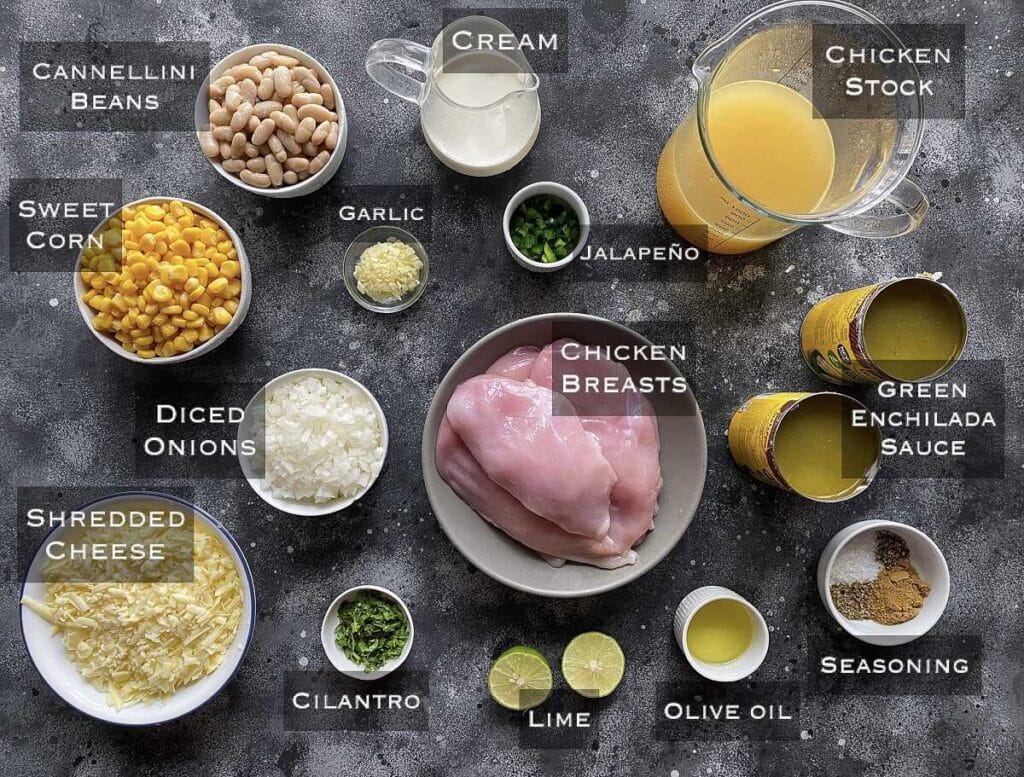
Once you have gathered all your ingredients, this soup comes together pretty quickly. Here’s the list of ingredients you will need for this Instant Pot green enchilada chicken soup;
Cooking fat: I’ve used olive oil, feel free to use your preferred oil.
Aromatics: I’ve used white onions and freshly minced garlic.
Jalapeno: Deseeded and diced. If you prefer the heat, leave the membrane and some of the seeds.
Seasoning mix: Just some ground cumin, Mexican oregano, kosher salt, and freshly cracked pepper!
Chicken stock: I’ve used water and better than bouillon chicken stock base.
Green enchilada sauce: I’ve used 2-(10 oz) cans of Old El Paso’s brand. Feel free to use your favorite brand of sauce.
Chicken: I’ve used skinless, boneless chicken breasts, but feel to use whatever you have at hand. Bone-in chicken breasts or thighs are also great and will add tons of flavor to the soup.
Cheese: I’ve used freshly grated Monterey Jack cheese.
Heavy cream: Adds creaminess and richness to the soup.
Other ingredients: To make the soup wholesome, hearty, and satisfying I’ve also thrown in some cannellini beans and sweet corn.
Chopped cilantro: Adds a fresh flavor to the soup. Skip it if you ain’t a fan!
Lemon juice: Adds some acidity and balances the rich and creamy flavors of the soup.
Why should you try this recipe?
This Instant Pot green enchilada chicken soup;
☑ Is an easy, effortless, and flavorsome recipe
☑ Can be adapted to make it low-carb or keto-friendly
☑ Has all the flavors of green chicken enchiladas in a yummy soup
☑ Is perfect for busy weeknight dinners
☑ Is kid-friendly
How to make Instant Pot Green Enchilada Chicken Soup – Step-by-step process
Step 1: Saute the aromatics and herbs
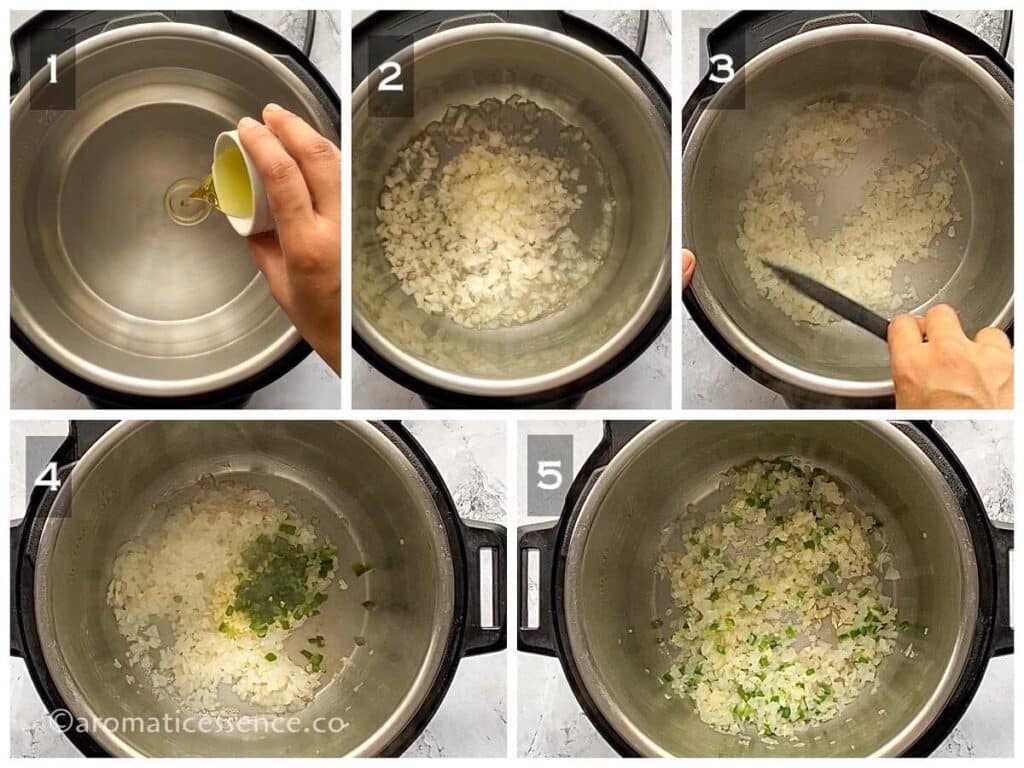
Press the ‘SAUTE’ button, and set it to ‘NORMAL’. Once it displays ‘HOT’, add 2 tablespoons of olive oil to the inner steel insert and let it heat up. ( Photo 1 )
Add 1 cup of diced onions and saute until the onions turn translucent. ( Phot os 2 and 3 )
Next, add 1 tablespoon of minced garlic, and 1 jalapeno, seeded and diced. Saute until garlic is fragrant. ( Phot os 4 and 5)
Make sure you scrape off all the browned bits stuck at the bottom of the pot, to avoid getting a ‘BURN’ error.
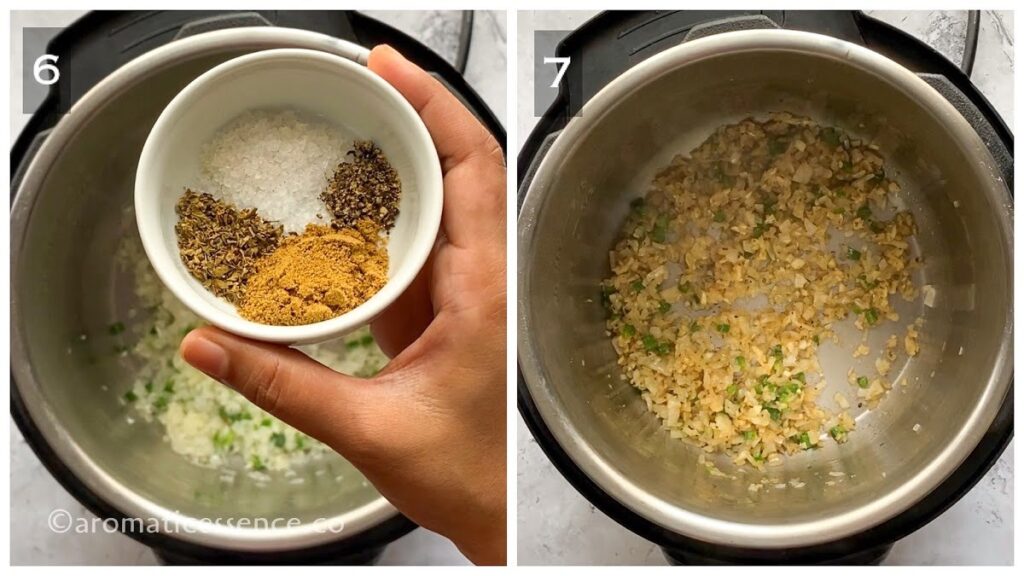
Add 2 teaspoons ground cumin, 1/2 teaspoon Mexican oregano, 1/2 teaspoon each of kosher salt, and freshly cracked pepper, mix well, and saute for another 30 seconds. ( Photos 6 and 7 )
Step 2: Add stock, green enchilada sauce, chicken, and pressure cook
Pour in 2 cups of chicken stock and 2-(10 oz) cans of green enchilada sauce. Give everything a good mix. ( Photos 8 to 10 )
Place 1.5 pounds of boneless, skinless chicken in the broth. ( Photo 11 )
Press ‘CANCEL’ and close the lid of the Instant Pot with the valve on the sealing position. ( Photo 12 )
Press the ‘MANUAL’or ‘PRESSURE COOK’ button and pressure cook on high for 10 minutes, about 15 minutes for thicker pieces. ( Photo 13 )
It will take some time for the pressure to build up (about 15 minutes), after which the timer will start.

Step 3: Natural pressure release (NPR) for 10 minutes
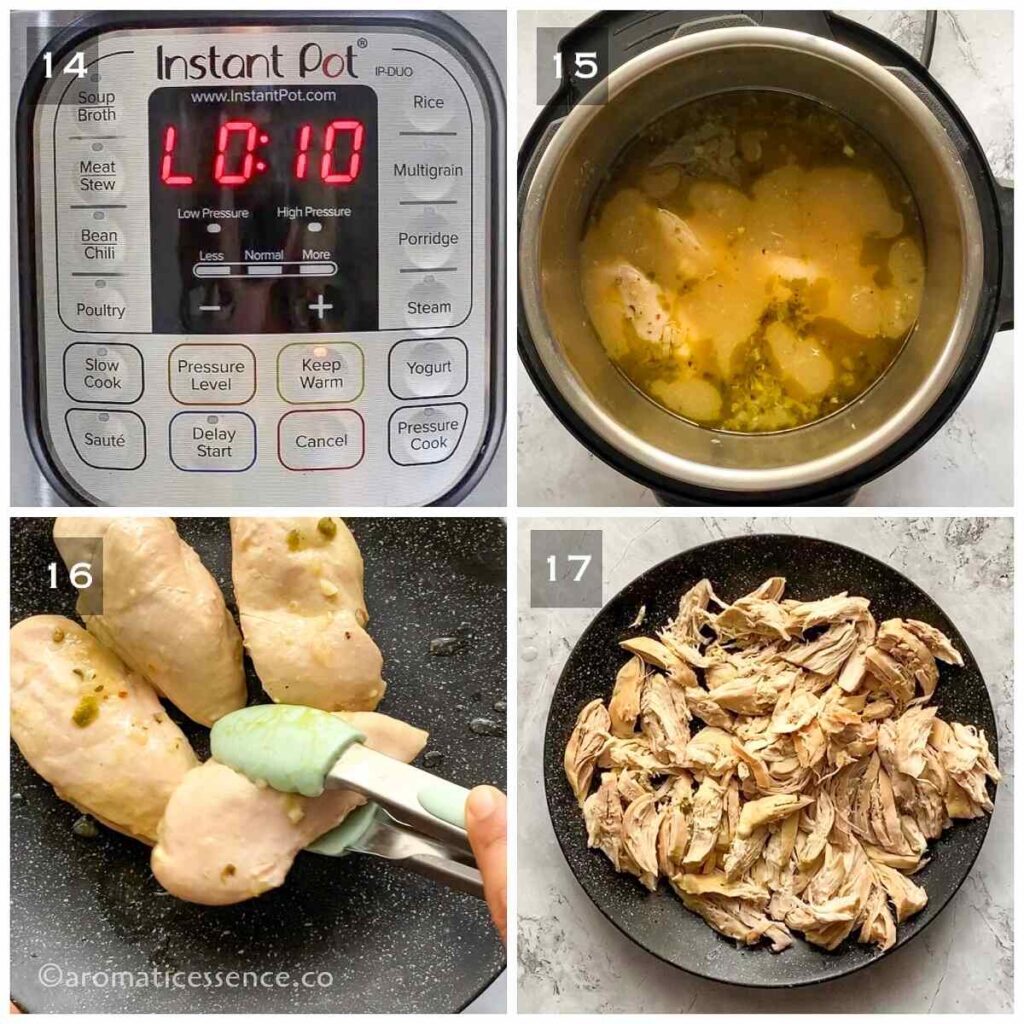
Once the cooking cycle is complete, let it depressurize for at least 10 minutes, then do a quick release of leftover pressure following the manufacturer’s instructions. Once the float valve (silver pin) drops, open the lid. ( Photos 14 and 15 )
Remove the chicken using tongs and shred using two forks. ( Photos 16 and 17 )
Step 4: Add the remaining ingredients
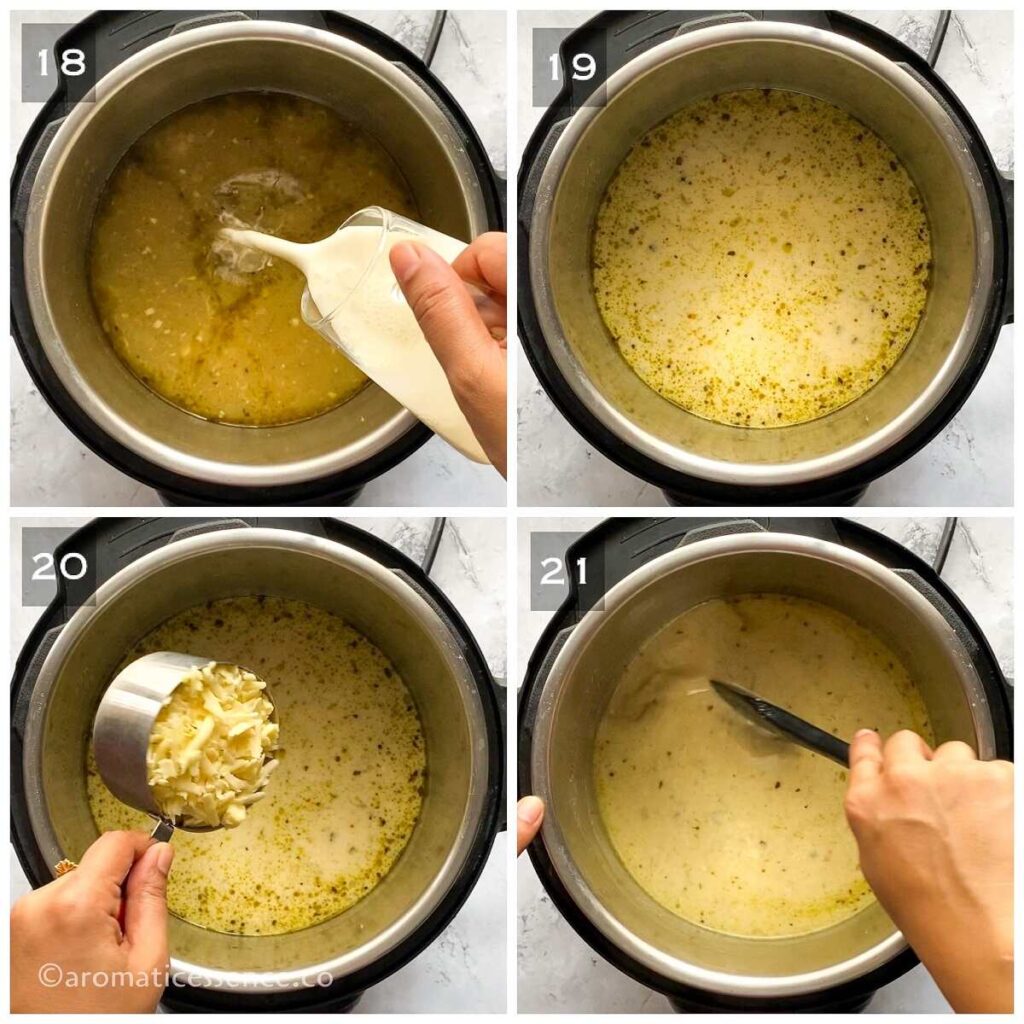
Warm 1 cup of cream in a saucepan or in the microwave for about 30 seconds.
Press the ‘SAUTE’ button and set it to ‘LOW’.
Add the cream or half and half, mix well and simmer for a minute. ( Photos 18 and 19)
Add 2 cups freshly grated Monterey Jack cheese in batches, stir continuously until it has melted, and blended well into the soup. Press ‘CANCEL’ to turn off the Instant Pot. ( Photos 20 and 2 1)
Return the shredded chicken back into the Instant Pot. Also, add 1 cup of sweet corn, and 1-(15 oz) can of drained and rinsed cannellini beans. Mix well. ( Photos 22 to 25 )
Add 1 tablespoon lime juice and freshly chopped cilantro leaves, mix well, and check for seasonings. Adjust with more salt, pepper, or lime juice as needed. ( Photos 26 to 28 )
Cover and let it sit for 10 minutes before serving.

Serving suggestions
The toppings are one of the best parts of the recipe as you can always mix and match different combinations. Here are some suggestions;
- Baked tortilla chips or strips
- A dollop of sour cream
- Diced avocadoes
- Guacamole
- Tomato salsa or pico de gallo
- Diced green onions
- Shredded cheese, queso fresco, or cotija cheese
- Red or green hot sauce
- Cilantro

Storage Instructions
Leftovers: Refrigerate leftovers in an airtight container for up to 3 days.
Freeze: Since this soup has cream and cheese, it will not freeze well. The dairy will separate. If you intend to freeze this soup, skip adding the cream and cheese.
Reheat: Reheat the soup in a pot over the stovetop until heated thoroughly. If you did not add the cream and cheese earlier, you can add them now.
Recipe Tips
Cream: Do not add cold cream or half and half to the hot soup, it may curdle. Either heat the cream in a pan over the stovetop or in the microwave just until it is warm to the touch. You can also temper the cream by adding hot broth into the cold cream, a few tablespoons at a time while stirring constantly. Add the cream mixture to the pot of soup.
Make it a dump-and-go recipe: Skip the olive oil, onion, and minced garlic and simply add 1 teaspoon each of onion powder and garlic powder.
Cheese: It is best to shred your own cheese instead of the pre-packaged stuff. It is often coated with potato starch or cellulose meant to prevent the cheese shreds from clumping. This prevents the cheese from melting well in the soup.
Prefer a thicker soup? Bring the soup to a boil, and add a cornstarch slurry ( 3 tablespoons cornstarch mixed with 3 tablespoons water). Stir continuously until it thickens. Set ‘SAUTE’ to ‘LOW’ and add the cream and the rest of the ingredients.
Like it spicier? Add jalapenos or serranos with seeds and membranes on. Add a dash of cayenne pepper along with the ground spices.
Season to taste: I’ve not included an amount of salt for this recipe like I normally do. The brand of sauce, chicken stock, or cheese you use may have different amounts of salt, so please taste the soup and adjust as needed.
Variations
Add body to the soup: You can add 1/2 cup of white rice to give the soup more texture and to make it thicker. You may adjust the consistency of the soup by adding more stock if it gets too thick.
Add vegetables: You can add also add more body to the soup by adding veggies like diced potatoes, zucchini, squash, bell peppers, carrots, mushrooms, cauliflower rice, etc. I’d add the cauliflower rice along with the corn and beans and cook it for 2 minutes or until tender.
Different beans: Instead of cannellini beans, you could also add kidney beans, black beans, great northern beans, navy beans, lima beans, etc, or whatever you have at hand. Feel free to double the quantity of the beans.
Seasoning: You can add other spices like smoked paprika, chili powder, poultry seasoning, taco seasoning, etc. Feel free to experiment!
Cheese: You can also swap the Monterey jack cheese with other cheeses like Colby Jack, mild or sharp cheddar, cream cheese, etc. If you use cream cheese, blend the cream cheese with some of the broth. If you add cold cream cheese directly to the soup, it may clump up. You can also soften the cream cheese in the microwave and then add it to the soup to avoid the clumps.
Salsa verde: You can substitute one can of green enchilada sauce with salsa verde, either mild, medium, or hot. Here’s my homemade roasted salsa verde recipe if you’d like to try it.
Jalapenos: You can swap the jalapenos with a 4 oz or 7 oz can of chopped green chiles (mild, hot, fire-roasted) instead.
Gluten-free: Be sure to read the labels of the brand of sauce, chicken stock, seasonings, etc you use to ensure it is gluten-free.
Red enchilada sauce: You can swap the green sauce with red enchilada sauce for another delicious variation.

How to make this soup on the stovetop?
Follow the same steps as directed above in a large stockpot. After you add the chicken, simmer, uncovered on medium-low heat for 20-25 minutes or until the chicken is cooked through. Follow the same steps thereafter.
Is there a difference between salsa verde and green enchilada sauce?
Verde means green in Spanish and so essentially it translates to green salsa. Salsa verde is made with tomatillos as the base. It is uncooked but at times also made by roasting the tomatillos.
Green enchilada sauce is made with green chile peppers, onion, garlic, and seasonings. Some brands will also include tomatillos.
Either way, if you are looking to substitute one for another, feel free to do so! It will taste great either way.
Can I use rotisserie chicken for this recipe?
You can! Reduce the pressure cook time to 2 minutes followed by 5 minutes NPR. Follow the recipe from step 4 as instructed above.
If adding vegetables like potatoes, and carrots, cook for 4 to 5 minutes on high pressure, depending on the thickness of the veggies.
Here are some of our favorite Instant Pot chicken soup recipes
Chicken noodle soup
Chicken gnocchi soup
Chicken wild rice soup
Have you made this recipe?
I would love to hear from you! Please be sure to share your feedback and/or give this recipe a rating in the comment below. Your reviews help others know the recipe better too.
You can also FOLLOW me on Facebook , Pinterest, Instagram & Twitter

Green Enchilada Chicken Soup (Instant Pot)
Equipment
- Instant Pot DUO60 6 Qt 7-in-1
Ingredients1x2x3x
- 1.5 tablespoons olive oil
- 1 cup diced white onion, 140 grams
- 1 tablespoon minced garlic, 12 grams
- 1 small jalapeno, seeded and diced, 20 grams
- 2 teaspoons ground cumin
- 1/2 teaspoon Mexican oregano
- Kosher salt, to taste, I added 1/2 teaspoon
- 1/2 teaspoon freshly cracked black pepper
- 2 cups chicken stock, 500 ml
- 2-(10) oz can of green enchilada sauce
- 1.5 lbs skinless, boneless, chicken breasts or thighs
- 1 cup heavy cream or half and half, 250 ml
- 8 oz shredded Monterey jack cheese, 225 grams
- 1 cup frozen sweet corn, thawed and drained
- 1-(15) oz can of cannellini beans, rinsed and drained
- 2 tablespoons chopped cilantro
- 1 tablespoon lime juice
Garnishes
- Crispy tortilla strips
- Sour cream
- Sliced radishes
- Sliced jalapenos
Instructions
- Press the ‘SAUTE’ button, and set it to ‘NORMAL’. Once it displays ‘HOT’, add olive oil to the inner steel insert and let it heat up.
- Add diced onions and saute until the onions turn translucent.
- Next, add minced garlic, and 1 jalapeno, seeded and diced. Saute until garlic is fragrant.
- Make sure you scrape off all the browned bits stuck at the bottom of the pot, to avoid getting a ‘BURN’ error.
- Add ground cumin, Mexican oregano, kosher salt, and freshly cracked pepper, mix well, and saute for another 30 seconds)
- Pour in the chicken stock and green enchilada sauce. Give everything a good mix.
- Place the chicken breasts in the broth.
- Press ‘CANCEL’ and close the lid of the Instant Pot with the valve on the sealing position.
- Press the ‘MANUAL’or ‘PRESSURE COOK’ button and pressure cook on high for 10 minutes, about 15 minutes for thicker pieces.
- It will take some time for the pressure to build up after which the timer will start.
- Once the cooking cycle is complete, let it depressurize for at least 10 minutes, then do a quick release of leftover pressure following the manufacturer’s instructions. Once the float valve (silver pin) drops, open the lid.
- Remove the chicken using tongs and shred using two forks.
- Warm the heavy cream in a saucepan or in the microwave for about 30 seconds.
- Press the ‘SAUTE’ button and set it to ‘LOW’.
- Add the cream or half and half, mix well and simmer for a minute.
- Add shredded cheese in batches, stir continuously until it has melted, and blended well into the soup. Press ‘CANCEL’ to turn off the Instant Pot.
- Return the shredded chicken back into the Instant Pot. Aso, add the sweet corn and cannellini beans. Mix well .
- Add lime juice and freshly chopped cilantro, mix well, and check for seasonings. Adjust with more salt, pepper, or lime juice as needed. (Photos 26 to 28)
- Cover and let it sit for 10 minutes before serving.
Video
Notes
Nutrition

Green Enchilada Chicken Soup (Instant Pot)
Equipment
- Instant Pot DUO60 6 Qt 7-in-1
Ingredients
- 1.5 tablespoons olive oil
- 1 cup diced white onion, 140 grams
- 1 tablespoon minced garlic, 12 grams
- 1 small jalapeno, seeded and diced, 20 grams
- 2 teaspoons ground cumin
- 1/2 teaspoon Mexican oregano
- Kosher salt, to taste, I added 1/2 teaspoon
- 1/2 teaspoon freshly cracked black pepper
- 2 cups chicken stock, 500 ml
- 2-(10) oz can of green enchilada sauce
- 1.5 lbs skinless, boneless, chicken breasts or thighs
- 1 cup heavy cream or half and half, 250 ml
- 8 oz shredded Monterey jack cheese, 225 grams
- 1 cup frozen sweet corn, thawed and drained
- 1-(15) oz can of cannellini beans, rinsed and drained
- 2 tablespoons chopped cilantro
- 1 tablespoon lime juice
Garnishes
- Crispy tortilla strips
- Sour cream
- Sliced radishes
- Sliced jalapenos
Instructions
- Press the ‘SAUTE’ button, and set it to ‘NORMAL’. Once it displays ‘HOT’, add olive oil to the inner steel insert and let it heat up.
- Add diced onions and saute until the onions turn translucent.
- Next, add minced garlic, and 1 jalapeno, seeded and diced. Saute until garlic is fragrant.
- Make sure you scrape off all the browned bits stuck at the bottom of the pot, to avoid getting a ‘BURN’ error.
- Add ground cumin, Mexican oregano, kosher salt, and freshly cracked pepper, mix well, and saute for another 30 seconds)
- Pour in the chicken stock and green enchilada sauce. Give everything a good mix.
- Place the chicken breasts in the broth.
- Press ‘CANCEL’ and close the lid of the Instant Pot with the valve on the sealing position.
- Press the ‘MANUAL’or ‘PRESSURE COOK’ button and pressure cook on high for 10 minutes, about 15 minutes for thicker pieces.
- It will take some time for the pressure to build up after which the timer will start.
- Once the cooking cycle is complete, let it depressurize for at least 10 minutes, then do a quick release of leftover pressure following the manufacturer’s instructions. Once the float valve (silver pin) drops, open the lid.
- Remove the chicken using tongs and shred using two forks.
- Warm the heavy cream in a saucepan or in the microwave for about 30 seconds.
- Press the ‘SAUTE’ button and set it to ‘LOW’.
- Add the cream or half and half, mix well and simmer for a minute.
- Add shredded cheese in batches, stir continuously until it has melted, and blended well into the soup. Press ‘CANCEL’ to turn off the Instant Pot.
- Return the shredded chicken back into the Instant Pot. Aso, add the sweet corn and cannellini beans. Mix well .
- Add lime juice and freshly chopped cilantro, mix well, and check for seasonings. Adjust with more salt, pepper, or lime juice as needed. (Photos 26 to 28)
- Cover and let it sit for 10 minutes before serving.
Video
Notes
Nutrition
Ukadiche modak is a traditional Maharashtrian steamed rice dumpling stuffed with a sweet mixture of grated coconut and jaggery.
If you are on the lookout for the perfect modak recipe, then look no further! I’ve got you covered with all the tips and tricks along with a handy video tutorial to help you make the perfect, soft, and melt-in-the-mouth ukadiche modak!

Ukadiche modak is a popular Maharashtrian delicacy and is believed to be Lord Ganesha’s favorite sweet and hence he is also called modakpriya.
Ganesh Chaturthi also known as Vinayak chaturthi, celebrates the birth of Lord Ganesha. Even though it is observed in other states across India, people in Maharashtra celebrate it with greater fervor and excitement.
I have eaten a lot of modaks! But I never really attempted to make one, that was until last year.
It so happened that all my friends from the building got together to organize things for the Ganesha festival last year. That’s when we decided we’d all make modaks as an offering!
I literally learned to make these ukdiche modak recipe firsthand from my friend Yogita! And I realized it wasn’t so hard after all.
The pleating and the shaping did need practice and trust me it took me 4-5 batches to get it close to perfection and I’m still not there with the perfect shape yet!
I apologize for the long post but I’d really love to pass on all the tips and tricks that I’ve learned from my experience to help you make the best modak recipe.
These tips will surely come in handy if you are a beginner. If I can do it, then you can as well! Find instructions to make modak with and without a mould!

- What is modak?
- What is ukadiche modak?
- Ingredients needed
- How to make modak recipe – Step-by-step process
- Serving suggestions
- Storage instructions
- Recipe tips for homemade steamed modak
- Variations
- Frequently asked questions (FAQs)
- You may also enjoy these Indian sweets
- Ukadiche Modak Recipe
What is modak?
Modak is a sweet dumpling made as an offering to Lord Ganesha during the 10 day Ganesh Chaturthi celebrations.
It has an outer shell made of steamed rice flour dough and is stuffed with a mixture of freshly grated coconut and jaggery flavored with cardamom and/or nutmeg.
There are two types of modaks prepared traditionaly;
- Ukadiche modak (steamed modak) in which the outer shell is made with rice flour
- Talchine modak (fried modak) in which the outer shell is made with wheat or refined flour
You will find many varieties of modaks like mawa, dry fruit, chocolate, kaju modak, etc sold in almost every mithai shop during the festive season of Ganesh Chaturthi.
But my favorite of them all has to be ukadiche modak!
What is ukadiche modak?
Ukadiche is a Marathi word and it means ‘steamed’. So it literally translates to steamed modak! It is also known by other regional names such as modaka or kadubu in Kannada, modakam or kudumu in Telugu language, and kozhukhattai or kolukattai in Tamil.
Most recipes use similar ingredients, the only difference is in the shape. Modaks are meticulously shaped whereas the others can be shaped as a sphere, half moon, etc.
To make this easy ukadiche modak recipe, you need to prepare two components;
- Rice flour dough
- Coconut-jaggery filling also known as saran in Marathi
A lime-sized ball of the rice dough is flattened, stuffed with the coconut mixture, the edges are pleated and shaped to make a dumpling aka modak, and finally they go in the steamer!
As you see doing it manually is a tedious affair. If you are making a large batch, you could definitely use some help. Else, the mould comes in super handy! It will help cut back on your prep work to a great extent.
Ingredients needed
For this ukadiche modak recipe, you will need;
Jaggery: I grated a block of kesar chap dark brown Kolhapuri jaggery. It has a rich flavor and is not as sweet as the golden yellow version. Feel free to use any kind of jaggery.
Ghee: Imparts a wonderful aroma to the modak. You also need some ghee for the rice dough and to grease the molds and your palms while shaping the modak.
Flavoring: I’ve used some cardamom and saffron to flavor the modaks. You may skip the saffron, but please do not skip the cardamom.
Salt: I’ve used table salt.

How to make modak recipe – Step-by-step process
Step 1: Prepare the coconut-jaggery stuffing
Heat 1 teaspoon ghee in a kadai on medium-low heat. ( Photo 1 )
Add 1.5 cups of grated coconut and roast it for a few seconds. ( Photos 2 and 3 )
Add 3/4 cup of grated jaggery, mix well and cook on medium-low heat. ( Photo 4)
The jaggery will melt, cook, stirring continuously until most of the moisture evaporates from the mixture. The mixture should be thick and slightly moist. ( Photos 5 and 6 )
Switch off the heat and add 1/2 teaspoon cardamom powder and mix well. ( Photos 7 and 8)
Transfer the mixture to a plate or bowl and set aside to cool down completely. ( Photo 9)

Step 2: Rice flour dough
Add 1 cup water, 1/2 tablespoon ghee, and 1/4 teaspoon salt to a heavy-bottomed pan on medium-high heat. Bring to a rolling boil. ( Photos 10 to 13 )
Add rice flour and stir continuously until all the rice flour has absorbed all the water. ( Photos 14 and 15 )
Switch off the heat, cover the pan with a lid and set it aside for 5 minutes. ( Photo 16)

Transfer the dough to a parat or bowl. You may apply some water to your palms to knead the dough since the dough will be slightly hot. ( Photos 17 and 18 )
You can also use the base of a small flat bowl to knead the dough until it is warm enough to handle.
Knead until the dough comes together. If it looks too dry, sprinkle some warm water and knead. ( Photo 19 )
Once the dough comes together, add 1 teaspoon of ghee and continue kneading until the dough is soft, smooth, and pliable, about 5 to 6 minutes. ( Photos 20 and 21 )
Pinch a portion of the dough and try to form a ball, if it is smooth and crack-free, the dough is the right consistency. ( Photo 22 )

Knead the dough for another minute. ( Photo 23 )
Pinch a portion of the dough and roll between your palm until smooth. Divide the dough into 11 to 12 portions. Cover the dough balls with a clean damp cloth. ( Photos 24 and 25 )
Grease a plate with some ghee and set aside. ( Photo 26 )

Step 3: Shaping
With mould
Open the mould, grease the insides with little ghee, and close it. ( Photo 27 )
Take a portion of the dough, make a slightly oblong shape by rolling between your palms. ( Photo 2 8)
Place it inside the mould. Grease your index finger with ghee if required, spread and press the dough against the sides of the mould to shape the modak leaving a dent in the middle for the stuffing. ( Photo 29 )
The excess dough will come out of the mould which will be used to seal later. If you use less dough, then simply pinch more dough to seal the bottom.
Spoon in about 1 to 2 teaspoons of the filling. Seal the ends with the excess rice dough. ( Photos 30 to 32 )
Open the mould and unmould the modak gently. ( Photos 33 and 34 )
Place it on the greased plate and cover loosely with a damp cloth.
Grease the mould each time before making the next modak.

Without mould
I’m sharing two methods;
- Method 1: Make the pleats and then add the stuffing
- Method 2: You can add the stuffing and then make the pleats
Shaping the dough into a shallow bowl is a common step for either of the methods.
Grease your palms with some ghee. Take a ball of dough, roll it between your palms to make it smooth and press it between your palms to flatten it slightly. ( Photo 35)
Using both your thumb and index fingers, press and flatten the outer edges leaving the center intact as you see in the pics below. ( Photo 36)
Press the center with your thumb to make an impression, and keep pressing the dough while rotating it simultaneously to shape it in the form of a shallow bowl. ( Photos 37 to 39 )
(I prefer using my left thumb to press the dough in the center to make it thin and my right thumb to rotate the dough. You may do it vice versa, whatever is comfortable for you).

Method 1
Pinch and press the edges of the dough to make the pleats (5 pleats are good for a beginner) with the help of your thumb and index finger. ( Photos 40 and 41 )
Spoon in about 2 teaspoons of the filling. ( Photos 42 )
Bring the pleats gently to the center and press the top to encompass the filling. Secure the tip of the modak by pressing it so that it is sealed well. Remove any extra dough. ( Photo 43 )
Press the pleats gently to make them prominent in case they have lost shape. ( Photos 44 and 45 )

Method 2
Add about 2 teaspoons of the stuffing. Pinch and press the edges of the dough to make the pleats. ( Photos 46 to 48 )
Repeat step as instructed in method 1 to bring the pleats together and seal the modak. ( Photos 4 9 and 50 )

Repeat the same process to make modaks with the remaining dough and filling. ( Photo 51)

Step 4: Steaming
Cover the modaks with a damp cloth. ( Photo 52 )
Steamer Pot
Add about 1.5 to 2 cups to a steamer pot. Bring to boil over medium heat. ( Photo 53 )
Line a steamer plate or basket with turmeric or banana leaves. If you don’t have access to either, then grease the steamer plate with some oil or ghee to prevent the modaks from sticking to it. ( Photo 54 )
Dip the base of each modak in water and place it on the leaf. ( Photo 55 )
Repeat the same with other modaks. Leave some space between each modak as they expand slightly on steaming.
Drizzle some saffron-soaked water along with a saffron strand on each modak. ( Photo 5 6)

Once the water starts boiling, place the steamer plater inside the steamer pot carefully. ( Photo 57 and 58 )
Cover the steamer pot and steam for 10 to 12 minutes. (Cooking time will depend on the size of the modak) ( Photo 59 )
Modak is cooked when they do not feel sticky and have a shiny appearance. ( Photo 60 )
If they are sticky, they are not done. Cover and cook for few more minutes.
Leave the modaks undisturbed for 5 minutes. Transfer to a serving platter.

Instant pot
Add 2 cups of water to the steel insert. Press ‘SAUTE’ button, set it on ‘HIGH’, and bring the water to a boil. ( Photo 61 )
Place a trivet and the steamer with all the modaks over the trivet. ( Photo 62 and 63)
Press ‘CANCEL’ and close the lid of the Instant Pot. Set the valve to ‘SEALING’. ( Photo 64 )
Press ‘STEAM’ mode and set the timer to 10 minutes by pressing the +/- button. Set to ‘LOW PRESSURE’ by pressing the ‘PRESSURE LEVEL BUTTON’. ( Photo 65 )
After the cooking cycle is complete, let the pressure release naturally. ( Photo 66 )
Once the silver pin drops, open the lid and remove the steamer plate carefully. Let the modaks sit for 5 minutes before transferring them to a serving platter. ( Photo 67 and 68 )

Serving suggestions
If you are making these modaks as a prasad (offering), it is customary to refrain from tasting the modak or any of its components until the prayer rituals have concluded.
Modaks are best served while still slightly warm. Traditionally, it is served along with a drizzle of sajuk toop . Sajuk toop is homemade ghee, but store-bought ghee is fine too.
Cut open the top of the warm modak and drizzle 1/2 teaspoon of ghee. Enjoy the rich and delicious, buttery flavors and that sweet and moist coconut filling.
You can also serve it along with poori or bhakri, bhaat, varan, and sukha batata bhaji.

Storage instructions
Leftovers: Ukadiche modak will last for a day at room temperature. Any leftover modaks can be stored in an airtight container for up to 2 to 3 days.
Reheat: Steam leftover ukadiche modak from the fridge for 4 to 5 minutes. You could also microwave them, but I find that they turn chewy.

Recipe tips for homemade steamed modak
I’ve divided the tips into 4 sections to briefly explain important points for each component. Please do not skip reading this part.
Tips for the rice dough
If not using modak rice flour: Modak rice flour is really fine. If you buy regular rice flour, please be sure to sift it before using it.
Sugar: You can add 1 teaspoon of sugar along with salt and ghee when steaming the rice flour.
Rice dough: The texture of the rice dough is one of the most critical points when it comes to making this modak recipe. 1:1 rice flour to water ratio works perfectly. But it will also depend on the type of rice flour you use and you may need more water. If you find the dough to be too dry and crumbly, add a few tablespoons more of warm water while kneading it.
Knead the dough well: Knead the dough really well until soft, smooth, and pliable. It should take around 5 to 6 minutes. It will take longer if you scale the recipe.
Avoid too much ghee: Adding too much ghee to the dough will make it super smooth, and you will have a difficult time shaping the modaks, especially by hand. The pleats won’t stay in place and they will open up or tear while shaping.
Swap some of the water with milk for rice dough: You can replace some of the water with milk while steaming the rice flour to make an extra soft rice dough.
Keep the dough covered at all times: It is important to cover the dough and shaped with a clean and damp towel to avoid it from drying out.
Tips for the coconut jaggery filling
Jaggery: You can use any kind of jaggery. I’ve also made this with the light yellow-colored Kolhapuri jaggery and it tastes delicious. Just be sure to grate or cut the jaggery into really small pieces or there will be lumps of jaggery in the mixture.
Coconut-jaggery mixture: You need to keep 2 things in mind;
- Avoid overcooking: Do not dry out the coconut-jaggery mixture completely as it will harden once it cools. If it hardens, transfer it back to the pan, add some hot water, and cook on low heat until the mixture softens.
- Do not undercook: This will cause the mixture to retain a lot of moisture. The jaggery syrup will trickle from the bottom of the modaks when steamed.
Tips for shaping and steaming
The thickness of the outer covering: The rice dough should not be too thin or else it might tear while shaping. Also, it should not be very thick or it will not taste nice! There’s a fine balance between the thickness of the outer covering to the stuffing. Ideally, the outer cover is thin. It comes with practice, but trust me, it only gets better!
Grease the modak mould: Remember to grease the mould each time before making the next modak or it may stick and break apart while unmoulding it.
You may shape and steam right away: If steaming in batches, shape, and steam one batch of modaks while you shape the other batch.
If you shape the entire batch in one go : While steaming the first batch, remember to cover the remaining modaks loosely with a damp cloth to avoid them from drying out. Of course, if you have multiple racks, you can stack the steamer plates or racks one over the other and steam the entire batch.
Let the steamed modaks rest for 5 minutes: Do not try to remove the modaks right away from the steamer. They are fragile at this stage. Removing them quickly might cause the base to break.
Cooking time: This will depend on the thickness of the outer shell. As far as they have a shiny appearance and are not sticky, they are done! Please use your judgement here.
General tips
For beginners: I highly suggest using the mould as shaping modak the traditional way needs some skill and will only come with lots of practice, similar to making a round roti 😀
Don’t want to make dumplings? Then make half-moon-shaped karanji or gujiya instead.
Recipe yield: If shaping by hand, you will get about 11 modaks. If using the mould, you will get around 14. This will depend on the size of your modak mould. The mould I used measures roughly 5 x 6 cms.
Scaling: 21 pieces of modak are served as an offering during puja (worship ritual) to Lord Ganesha. You may want to scale the recipe by 1.5 times or simply double it to make more in case a few get messed up while cooking.
Leftover stuffing: You can make some delicious coconut-jaggery ladoos with the leftover stuffing. Though this quantity worked just right for the hand shaped modaks. I didn’t have leftovers.
Variations
I enjoy this ukadiche modak recipe as written, but here are some easy variations you can incorporate based on your preference.
Poppy seeds: Heat ghee and roast 1 teaspoon of poppy seeds until they crackle. Then add coconut, and jaggery and cook as instructed above.
Nuts: You can also incorporate some coarsely chopped nuts like almonds, pistachios, cashew nuts, etc in the coconut-jaggery filling for some crunch.
Nutmeg: You can use a mix of freshly grated nutmeg and cardamom powder to flavor the stuffing.

Why is my dough cracking while shaping?
This means that the dough is dry and it has less moisture content. Do not skip the test of checking if the dough has reached the right texture and consistency as shown in the video and steps above (step 2).
Dry modak dough will yield modaks that are dense and chewy. So fix it by adding a tablespoon of warm water at a time and kneading the dough until it reaches the right consistency.
Why is my dough sticky while kneading?
It means that it has more moisture. To troubleshoot, sprinkle some rice flour and continue kneading.
Which rice flour is best for modak?
You need to use fine rice flour to make ukadiche modak. I’ve used store-bought modak rice flour and it works like a charm. You could also soak the rice, dry it, and then grind it. Try and use fragrant rice like ambemohar.
What does modak taste like?
If prepared correctly, a good modak should have a buttery, soft, melt-in-the-mouth texture with a moist and sweet coconut filling.
It is also very fragrant when steamed on turmeric leaves. It imparts a unique flavor, and I highly recommend you use it if it’s available to you.
Can I use powdered jaggery?
Yes, you can!
Can I use desiccated coconut or frozen coconut?
You can use either! If using desiccated coconut, add about a few tablespoons of water to add some moisture to it.
If using frozen coconut, thaw it first. Dry roast it to remove excess moisture, then add the ghee and jaggery.
Where can I buy the modak mould?
If you live in India, you should be able to find aluminum or plastic moulds easily in any supermarket or store that sells baking supplies. There are lots of options online too.
Can I make modak without rice flour?
Yes, you can. Although I haven’t tried it with any other flour, I have seen versions of steamed modak made with refined flour or wheat flour.
You can make fried modaks with wheat flour or simply make mawa or dry fruit modak.
You may also enjoy these Indian sweets
Coconut ladoo
Coconut burfi
Kesar peda
Chocolate peda with milk mawa powder
Mawa barfi
Have you made this recipe?
I would love to hear from you! Please be sure to share your feedback and/or give this recipe a rating in the comment below. Your reviews help others know the recipe better too.
You can also FOLLOW me on Facebook , Pinterest, Instagram & Twitter

Ukadiche Modak Recipe
Ingredients1x2x3x
For the coconut-jaggery stuffing
- 1 teaspoon ghee
- 1.5 cup freshly grated coconut, 150 grams
- 3/4 cup grated jaggery, 130 grams
- 1/2 teaspoon cardamom powder
For the rice flour dough
- 1 cup water
- 1 cup modak rice flour, 140 grams
- 1/2 tablespoon ghee
- 1/4 teaspoon salt
Other ingredients
- 1 pinch of saffron strands soaked in 2 tablespoons of hot water, optional
Instructions
Coconut-jaggery stuffing
- Heat ghee in a kadai on medium-low heat.
- Add grated coconut and saute it for a few seconds.
- Add jaggery, mix well and cook on medium-low heat.
- The jaggery will melt, cook, stirring continuously until most of the moisture evaporates from the mixture. The mixture should be thick and slightly moist.
- Switch off the heat and add 1/2 teaspoon cardamom powder and mix well.
- Transfer the mixture to a plate or bowl and set aside to cool down completely.
Rice flour dough
- Add water, ghee, and salt to a heavy-bottomed pan on medium-high heat. Bring to a rolling boil.
- Add rice flour and stir continuously until all the rice flour has absorbed all the water.
- Switch off the heat, cover the pan with a lid and set it aside for 5 minutes.
- Transfer the dough to a parat or bowl. You may apply some water to your palms to knead the dough since the dough will be slightly hot.
- Knead until the dough comes together. If it looks too dry, sprinkle some warm water and knead.
- Once the dough comes together, add 1 teaspoon of ghee and continue kneading until the dough is soft, smooth, and pliable, about 5 to 6 minutes.
- Pinch a portion of the dough and try to form a ball, if it is smooth and crack-free, the dough is the right consistency.
- Knead the dough for another minute.
- Pinch a portion of the dough and roll between your palm until smooth. Divide the dough into 11 to 12 portions. Cover the dough balls with a clean damp cloth.
- Grease a plate with some ghee and set aside.
Shaping with mould
- Open the mould, grease the insides with little ghee, and close it.
- Take a portion of the dough, make a slightly oblong shape by rolling between your palms.
- Place it inside the mould. Grease your index finger with ghee if required, spread and press the dough against the sides of the mould to shape the modak leaving a dent in the middle for the stuffing.
- The excess dough will come out of the mould which will be used to seal later. If you use less dough, then simply pinch more dough to seal the bottom.
- Spoon in about 1 to 2 teaspoons of the filling. Seal the ends with the excess rice dough.
- Open the mould and unmould the modak gently.
- Place it on the greased plate and cover loosely with a damp cloth.
- Grease the mould each time before making the next modak.
Shaping without mould
- I’m sharing two methods; Method 1: Make the pleats and then add the stuffing. Method 2: You can add the stuffing and then make the pleats.
- Shaping the dough into a shallow bowl is a common step for either of the methods
- Grease your palms with some ghee. Take a ball of dough, roll it between your palms to make it smooth and press it between your palms to flatten it slightly.
- Using both your thumb and index fingers, press and flatten the outer edges leaving the center intact as you see in the pics below.
- Press the center with your thumb to make an impression, and keep pressing the dough while rotating it simultaneously to shape it in the form of a shallow bowl.
Method 1
- Pinch and press the edges of the dough to make the pleats (5 pleats are good for a beginner) with the help of your thumb and index finger. Spoon in about 2 teaspoons of the filling.
- Bring the pleats gently to the center and press the top to encompass the filling. Secure the tip of the modak by pressing it so that it is sealed well. Remove any extra dough.
Method 2
- Add about 2 teaspoons of the stuffing. Pinch and press the edges of the dough to make the pleats.
- Repeat step as instructed in method 1 to bring the pleats together and seal the modak.
- Repeat the same process to make modaks with the remaining dough and filling.
Steaming in the steamer pot
- Add about 1.5 to 2 cups to a steamer pot. Bring to boil over medium heat.
- Line a steamer plate or basket with turmeric or banana leaves. If you don’t have access to either, then grease the steamer plate with some oil or ghee to prevent the modaks from sticking to it.
- Dip the base of each modak in water and place it on the leaf.
- Repeat the same with other modaks. Leave some space between each modak as they expand slightly on steaming.
- Drizzle some saffron-soaked water along with a saffron strand on each modak.
- Once the water starts boiling, place the steamer plater inside the steamer pot carefully.
- Cover the steamer pot and steam for 10 to 12 minutes. (Cooking time will depend on the size of the modak)
- Modak is cooked when they do not feel sticky and have a shiny appearance.
- If they are sticky, they are not done. Cover and cook for few more minutes.
- Leave the modaks undisturbed for 5 minutes. Transfer to a serving platter.
Steaming modak in the Instant pot
- Add 2 cups of water to the steel insert. Press ‘SAUTE’ button, set it on ‘HIGH’, and bring the water to a boil.
- Place a trivet and the steamer with all the modaks over the trivet.
- Press ‘CANCEL’ and close the lid of the Instant Pot. Set the valve to ‘SEALING’.
- Press ‘STEAM’ mode and set the timer to 10 minutes by pressing the +/- button. Set to ‘LOW PRESSURE’ by pressing the ‘PRESSURE LEVEL BUTTON’.
- After the cooking cycle is complete, let the pressure release naturally.
- Once the silver pin drops, open the lid and remove the steamer plate carefully. Let the modaks sit for 5 minutes before transferring them to a serving platter.
