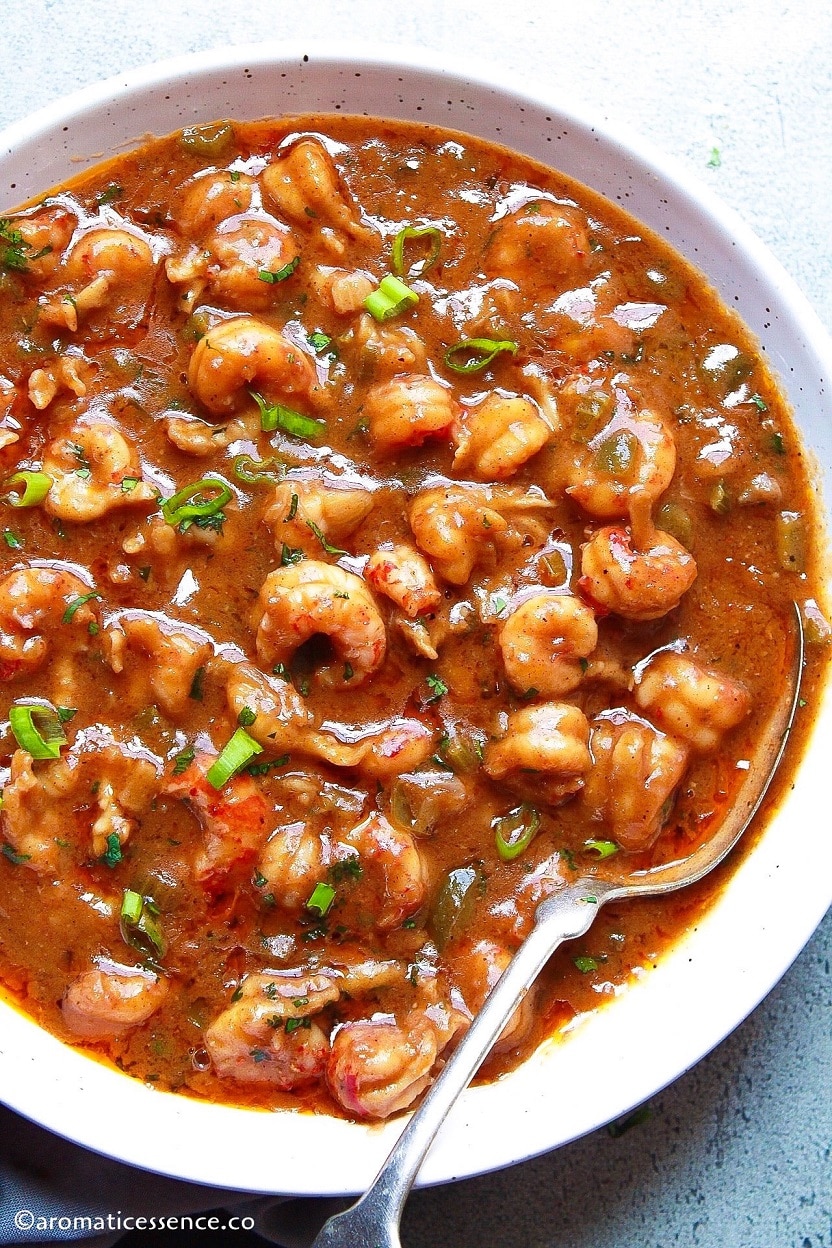
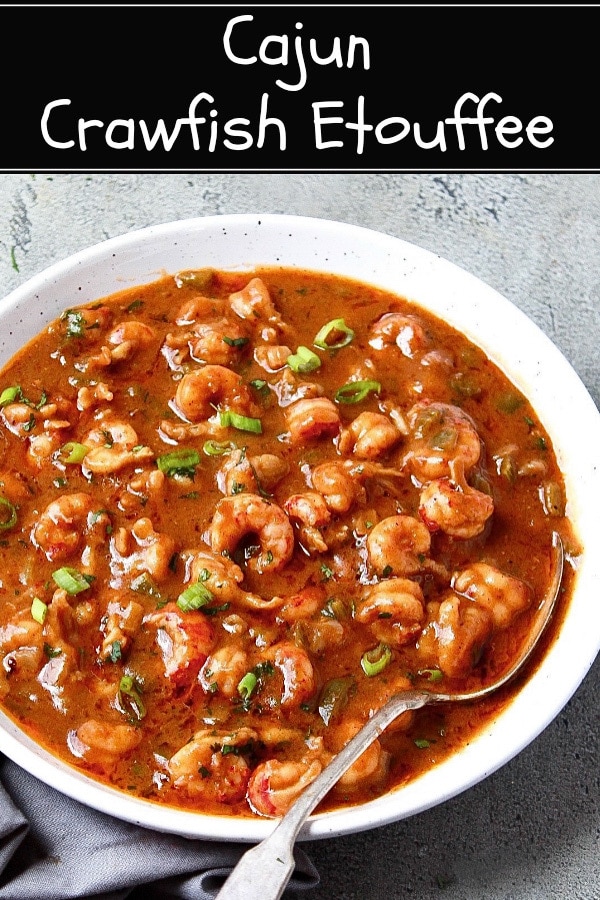
This crawfish etouffee is a classic Louisiana recipe packed with bold and robust flavors! Succulent crawfish tails are smothered in a rich and buttery gravy made with the holy trinity, dark nutty roux, and a hint of Creole spices.
You can make a Cajun or Creole version using this recipe, depending on your preference! Pair this crawfish etouffee with some steamed rice for the ultimate, Southern comfort food. Absolutely delicious & soul-satisfying!
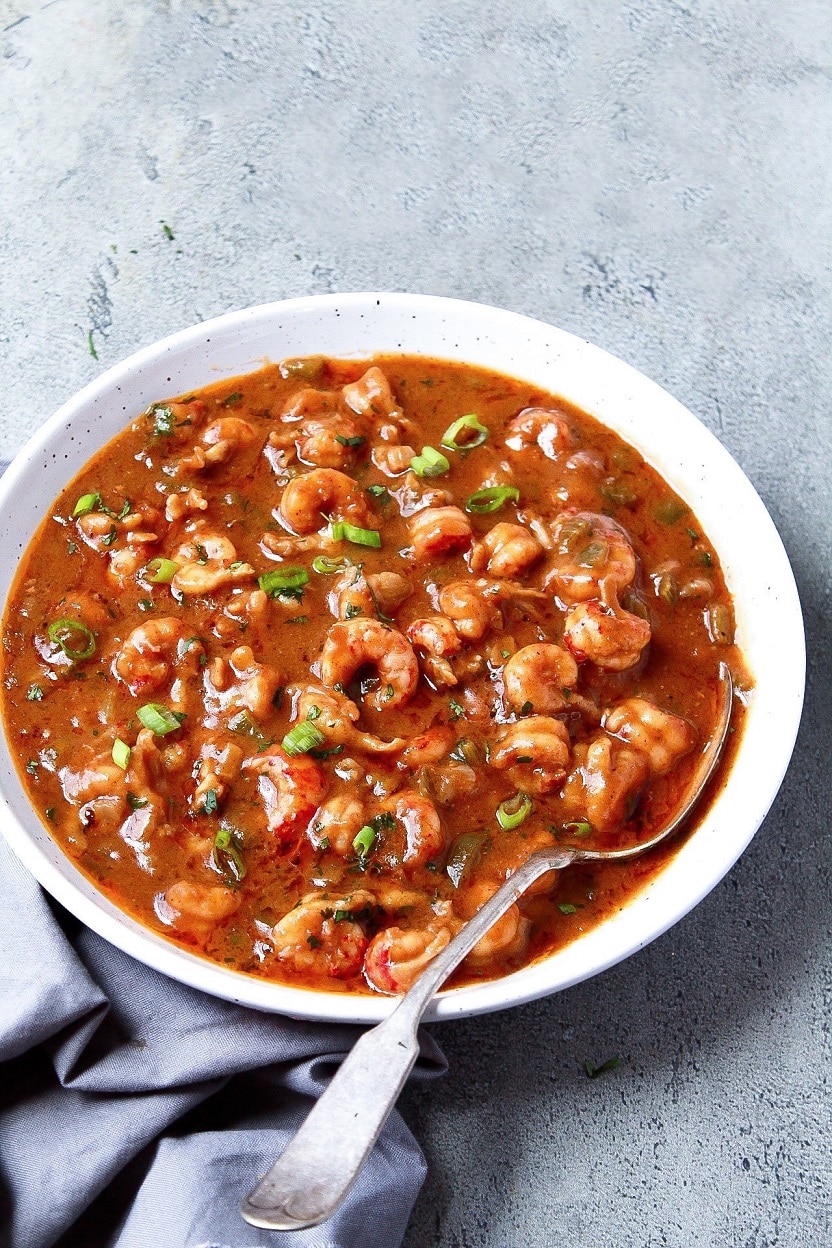
‘Etoufee’ pronounced as ‘ay-too-fay’ is a French word that means ‘smothered’ or ‘suffocated’. In this context, it refers to how that delicious crawfish tail meat is smothered in a rich, buttery, gravy made with a dark nutty roux, caramelized veggies, fragrant garlic, and seasonings all tied together with a flavorful stock.
Crawfish are also known by many names. They are called crayfish by the Northerners. Other terms like mudbugs, crawdads, mountain lobsters, etc. are also used to describe crawfish. The taste of crawfish is a cross between shrimp and crab, with a sweet and subtle flavor.
I fell in love with etouffee ever since we enjoyed it in New Orleans. Since then we have enjoyed it quite a few times at one of our local Cajun restaurants in Lafayette. I hadn’t thought of giving it a go at home, but when I had some leftover crawfish tails from a crawfish boil, I thought it was time I tried making crawfish etouffee.
I do miss Cajun food so much, I carried a lot of spices back home with me because it is quite difficult to source the authentic stuff here in Mumbai. Primarily, crawfish are not even available commercially. But, I will definitely be making this with shrimp because it is just as delicious and deserves to be made for an indulgent meal.
- Ingredients required for this recipe
- Tips for making crawfish etouffee
- How to make Cajun crawfish etouffee – Step by step instructions
- Serving suggestions
- How to store leftovers?
- Can you freeze crawfish etouffee?
- You may also enjoy these Louisiana classics
- Crawfish Etouffee Recipe
Ingredients required for this recipe
You will need the following ingredients to make this recipe. (Find all the quantities in the step-wise tutorial and recipe card below).
- Louisiana crawfish tail meat , which you will find in the freezer section of your grocery store, in 16 oz packets.
- Unsalted butter and flour: I’ve used butter to make the roux. You can use oil, Crisco, bacon grease, or lard instead.
- Holy trinity: Equal parts onions, celery, and green bell peppers.
- Freshly minced garlic: You can use store-bought minced garlic, but fresh is so much better.
- Seasoning: I used Tony Chachere’s salt-free Creole seasoning. I love that it is salt-free, and that gives me control over the sodium content of the dish. I also added some cayenne pepper for a kick.
- Stock: I used chicken stock made with better than bouillon base because that is what I had at home. I did the blunder of discarding the crawfish head and tails when, in fact, I should have made a stock with it. You could use seafood stock or crawfish stock for that authentic flavor. If you have none of these, simply use water.
- Green onions and chopped parsley
- Cooked rice: To serve
- Additional ingredients: You could add a dash of Worcestershire sauce along with the stock and lemon juice, in the end, to add some acidity to the dish and cut down the richness.
That’s about it. As you see, the ingredient list is not very long. You should definitely try making this restaurant-worthy dish at home.
Tips for making crawfish etouffee
Stay clear of Chinese crawfish: Please do not use this to make etouffee, they do not taste anything like Louisiana crawfish. For that authentic flavor, use Louisiana crawfish always. If you still go ahead with Chinese crawfish, drain and use it to get rid of that somewhat bitter flavor.
- Shrimp: Clean and devein 1 lb of shrimps. Sprinkle Creole seasoning, saute with a little butter until it turns pink, set aside. Add it instead of crawfish in the recipe. If using frozen shrimp, thaw them.
- Crabmeat: Add a pound of lump crabmeat in place of the crawfish.
- Chicken: Cut 1 pound of chicken breasts or thighs into 1.5 inch chunks. Season a cup of flour with a pinch of salt, pepper, and 1/2 teaspoon or more of Creole seasoning. Dredge the chicken pieces in flour and fry in hot oil until cooked through and golden brown on the outside. Set aside and add it instead of crawfish in this recipe.
Definitely use all the veggies included in the Holy Trinity: I’d not skip on the onions, bell peppers, or celery as it pretty much forms the base of every Cajun/Creole dish. The caramelized vegetables in butter along with garlic add a delicious layer of complex flavors, that cannot be missed in the final dish. Unless you are allergic or dislike one of these veggies strongly, I highly recommend you use the holy trinity to make this crawfish etouffee.
Pay attention to the roux: Roux is used in thickening gravies, sauces, stews, etc. It is made with equal parts of fat and flour.
For etouffee, you have to cook the roux until it is a shade darker than peanut-brown color. This adds a nice nutty, depth of the flavor to the dish.
Now here’s the deal! If you don’t cook the roux long enough, the entire dish will have a raw flour taste. A lighter-colored roux or blonde roux as it is known is not right for etouffee, it will just taste like a thick crawfish soup. On the other hand, if you leave the roux unattended, it might turn dark and even burn.
Please do not use a burnt roux, as it will make the etouffee bitter and inedible. You’d be wasting precious crawfish meat here. Just dump the entire thing, and start with a fresh roux.
I did burn my roux the first time, I simply tossed it out and started afresh. If you want to make it easier, simply buy the bottled roux and use that instead. Personally, I’ve not tried using a bottled roux, but I’m sure it would be great.
Seasoning: Since I used crawfish meat from a leftover boil, I reduced the seasoning because it was well seasoned. If you are not sure about how much to season, start off with as little as 1/2 teaspoon Cajun or Creole seasoning at a time, tasting as you go. I added about 1/2 tablespoon of Creole seasoning.
Make a Creole version: The cajun version does not include tomatoes, but if you like, you can make a Creole version by adding tomatoes. Add 1- (14.5 oz) can of diced tomatoes or tomato sauce if you don’t like the tomato chunks in step 3.

How to make Cajun crawfish etouffee – Step by step instructions
Step 1: Make the roux
Heat 1/4 cup unsalted butter in a heavy-bottomed skillet, dutch oven, or cast-iron skillet over medium heat. Once the butter melts, add 1/4 cup of all-purpose flour, and mix with a whisk or wooden spatula until smooth. Cook, stirring continuously until the roux reaches a peanut brown or caramel color. It took me about 11 minutes. Switch off the heat, and continue whisking until it turns a shade darker. Set it aside.

Step 2: Saute the holy trinity, garlic, and roux
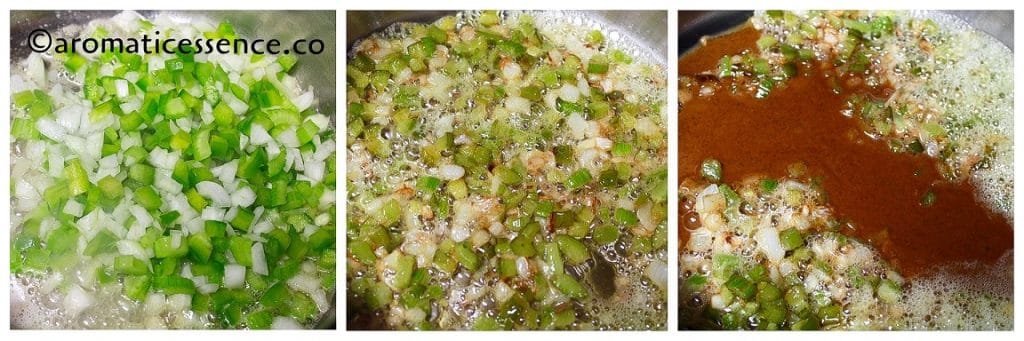
Heat another saute pan over medium-high heat, add 1/4 cup of unsalted butter, once it melts, add 1/2 cup each of diced onion, bell pepper, and celery along with 4 cloves of minced garlic (you can reduce the garlic as per your preference). Cook until the vegetables soften.
Add the prepared roux, mix well, and cook for another minute.
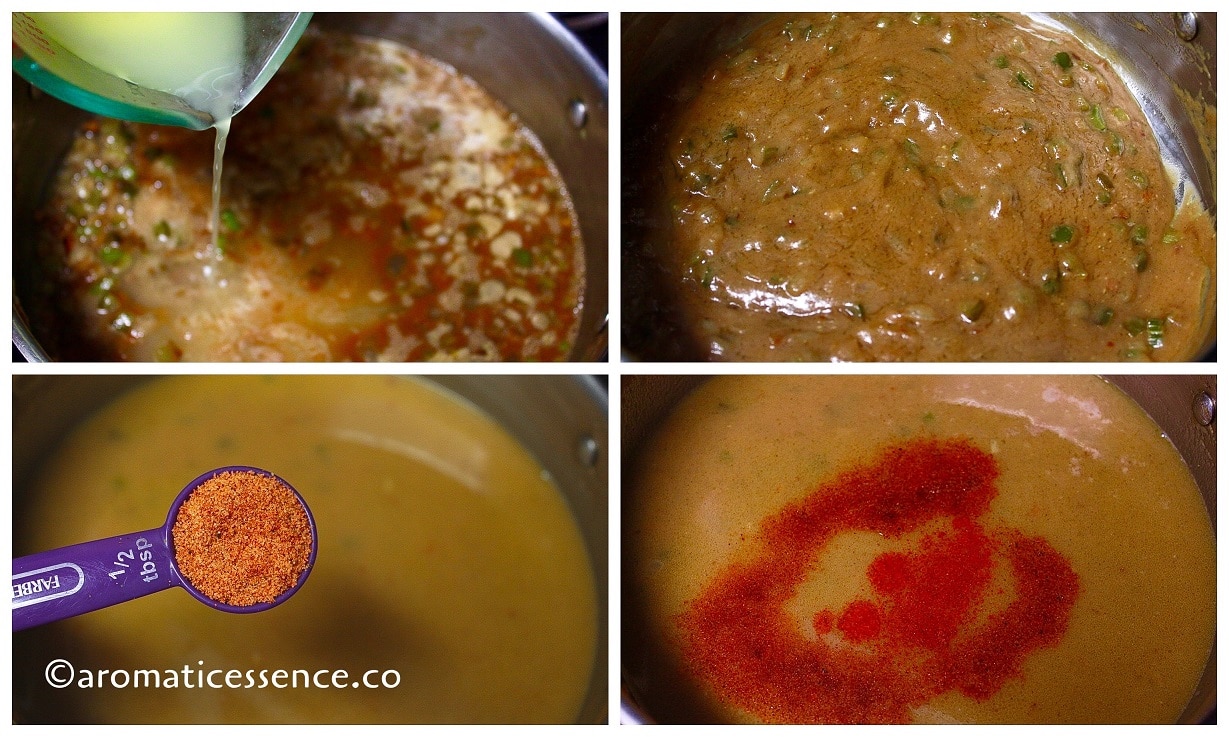
Step 3: Add the stock and seasonings
Add 1 cup of stock, and mix, and cook for 1-2 minutes, until the mixture thickens.
Then add the remaining 1 cup of stock and mix well. Add 1/2 tablespoon of salt-free Creole/Cajun seasoning along with 1/8 teaspoon of cayenne pepper, 1/4 teaspoon Kosher salt, 2 bay leaves (if using), and 1-(14.5) oz can of no-salt, diced tomatoes (only for a Creole version). Mix well, cover with a lid and simmer for 10-15 minutes, stirring occasionally in between.
Note: If using regular Cajun or Creole seasoning, hold off the salt, since these already contain salt, taste and adjust in the end.
Step 4: Add crawfish tail meat and simmer
Add 12 to 16 oz of crawfish tail meat, mix well, cover, and simmer over low heat for about 5 minutes. Do not overcook the crawfish.
I had about 12 oz of leftover crawfish meat, so that’s what I used. You can add the entire 16 oz packet of frozen and thawed crawfish tail meat.

Step 6: Serve
Check for seasonings, adjust with salt if required. If the etouffee is too thick, add the remaining 1/2 cup of stock, and heat it through. Sprinkle parsley and mix well.
Serve with steamed rice, sprinkle some more chopped parsley, and scallion greens. Add a few dashes of hot sauce. Enjoy!

Notes
- To make your own crawfish stock:
- Prep the crawfish. Use 1 pound of fresh boiled crawfish. Remove the tail of the crawfish, place the head in another bowl. Peel the shell off of the tail, and place it in the bowl containing the crawfish heads. Remove and discard the black string on the back of the tail meat and set the meat aside in another bowl. Repeat with the rest of the crawfish.
- Add 2 quarts of water in a large saucepan, add 1/2 teaspoon of creole seasoning and mix well. Add the crawfish heads and tails. Cover and simmer for 1 hour. Drain the stock through a fine-mesh strainer, taste for seasoning, and adjust if required. If using leftover crawfish from a crawfish boil, skip the seasonings as it already has a lot of flavor and spice.
- If you can’t find Cajun/Creole seasoning, use this spice blend : 1/4 to 1/2 teaspoon of kosher salt, 1/2 teaspoon each of freshly cracked black pepper, dried thyme, dried oregano, paprika, 2 teaspoons of dried parsley, and 1/8 teaspoon (or more) of cayenne pepper. Skip the additional salt in the recipe. Adjust with more salt if needed in the last step.
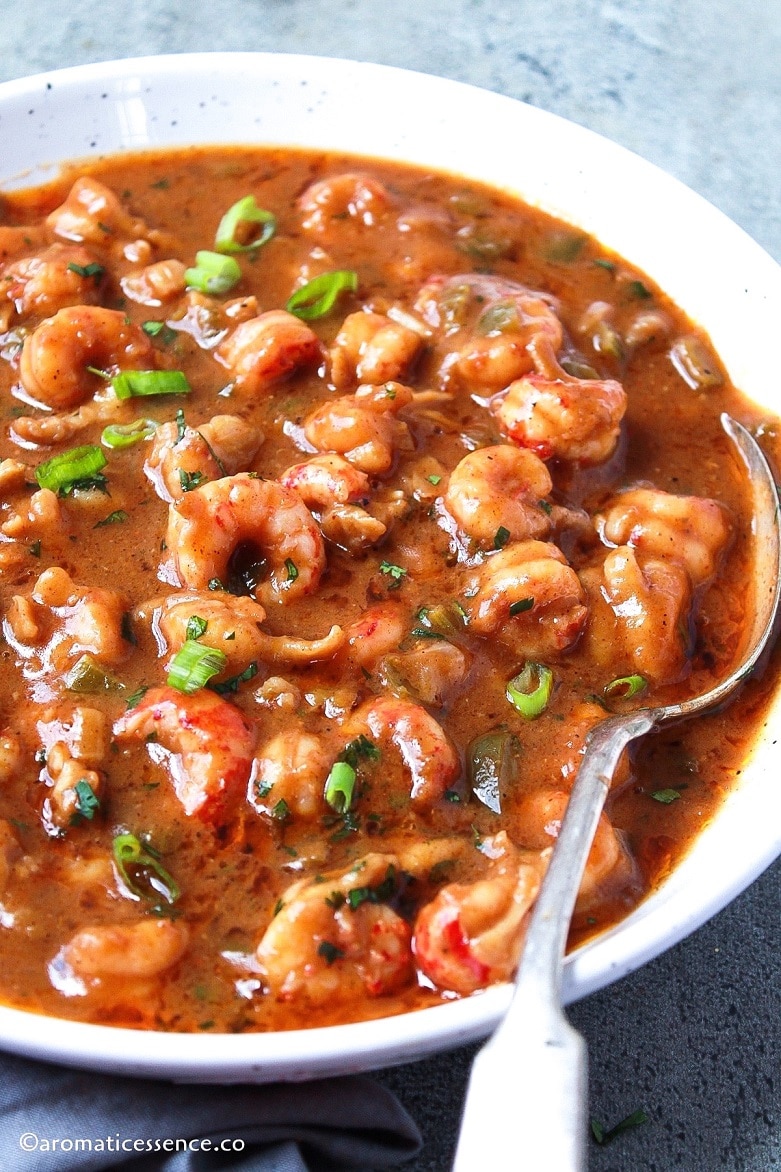
Serving suggestions
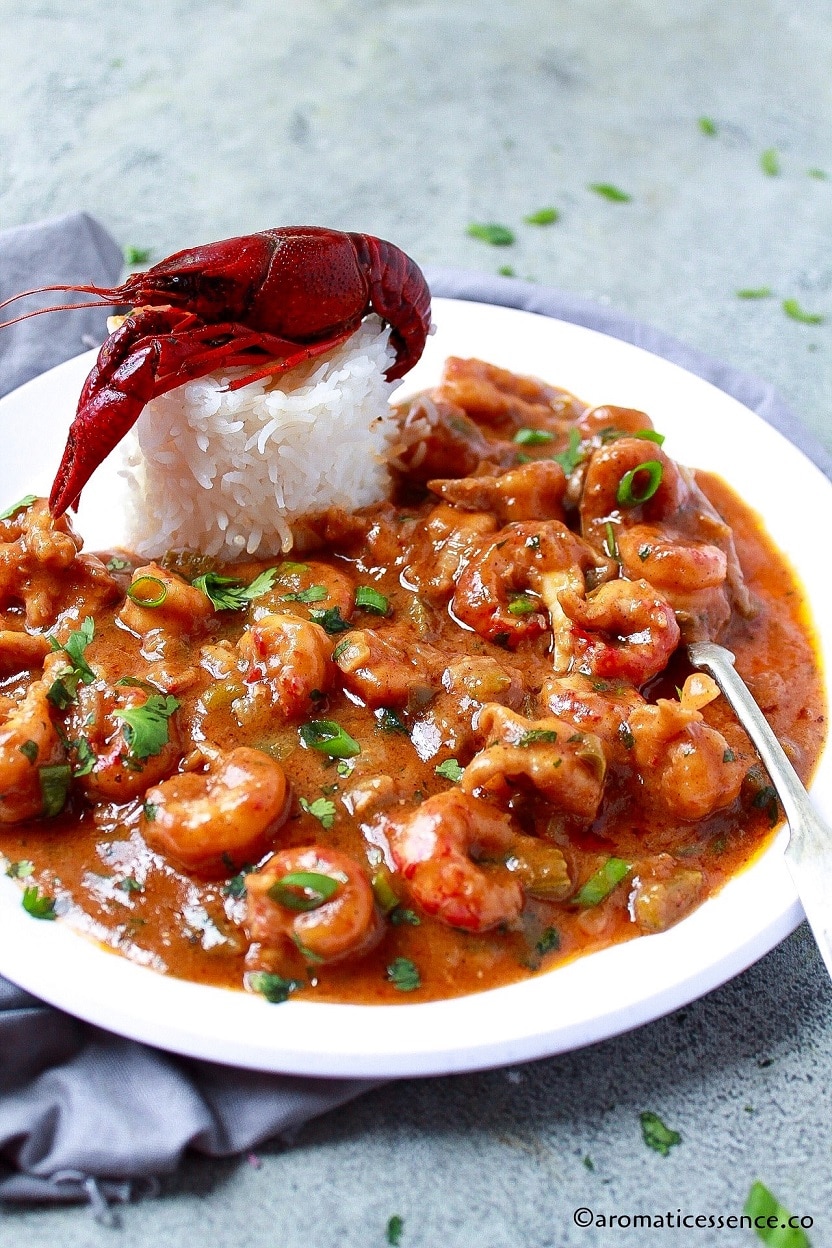
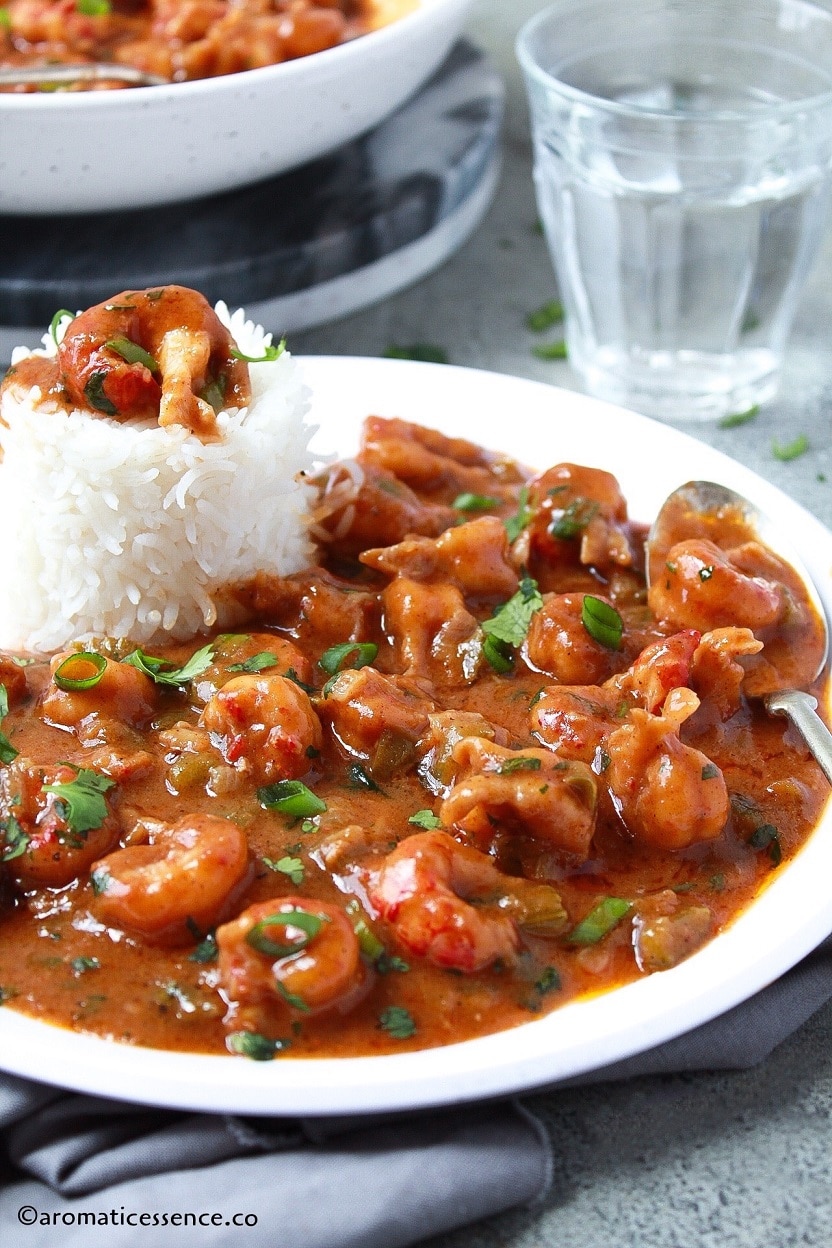
Traditionally, etouffee is served around a mound of steamed rice. The rice is tightly packed in a bowl and inverted onto a shallow bowl.
You can also serve it with brown rice, quinoa, riced cauliflower, or mashed potatoes.
Serve a fresh salad and some crusty bread, cornbread, or garlic bread on the side for a complete, wholesome, and hearty meal.
How to store leftovers?
Refrigerate leftovers in an airtight container for up to 3 days. To reheat, remove it from the fridge at least 30 minutes before serving. Transfer to a skillet, add a splash of stock if it looks too thick. Warm on low heat just until heated through.
Can you freeze crawfish etouffee?
Yes, you can freeze etouffee to enjoy it at a later time. Once the etouffee cools down completely, transfer it into a freezer-safe, airtight container, leaving an inch of headspace or into a freezer bag, and squeeze out all the air. Label and freeze up to 2-3 months.
Thaw overnight in the fridge, remove from the fridge at least 30 minutes before serving. Transfer to a skillet, if it is too thick, add a splash of stock and warm on low heat just until heated through.

You may also enjoy these Louisiana classics
- Instant Pot red beans
- Instant Pot Jambalaya
You can also follow me on Facebook , Pinterest, Instagram & Twitter

Crawfish Etouffee Recipe
Ingredients1x2x3x
For the roux
- 1/4 cup unsalted butter or oil
- 1/4 cup all-purpose flour
For the crawfish etouffee sauce
- 12 to 16 oz Louisiana crawfish tail meat, thaw if frozen
- 1/4 cup unsalted butter, you could use up to 1/2 cup of butter
- 1/2 cup diced onion
- 1/2 cup diced celery
- 1/2 cup diced green bell pepper
- 4 garlic cloves, finely minced
- 2 to 2.5 cups seafood or chicken stock, or homemade crawfish stock
- 1/2 tablespoon Tony Chachere’s salt-free Creole seasoning
- 1/8 teaspoon cayenne pepper, adjust as per desired heat
- 1/4 teaspoon Kosher salt, or to taste
Optional ingredients
- 1- 14.5 oz can of diced tomatoes, undrained, for a Creole version
- 2 Bay leaves
To serve
- Cooked rice, about 3 cups
- Hot sauce, as required, optional
Instructions
- Heat butter in a heavy-bottomed skillet, dutch oven, or cast-iron skillet over medium heat. Once the butter melts, add all-purpose flour, and mix with a whisk or wooden spatula until smooth.
- Cook, stirring continuously until the roux reaches a peanut brown or caramel color. Switch off the heat, and continue whisking until it turns a shade darker. Set it aside.
- Heat another saute pan over medium-high heat, add butter, once it melts, add diced onions, bell pepper, and celery along with minced garlic. Cook until the vegetables soften.
- Add the prepared roux, mix well, and cook for another minute.
- Add 1 cup of stock, and mix, and cook for 1-2 minutes, until the mixture thickens.
- Then add the remaining 1 cup of stock and mix well. Add Creole/Cajun seasoning along with cayenne pepper, Kosher salt, 2 bay leaves (if using), and 1-(14.5) oz can of no-salt, diced tomatoes (only for a Creole version). Mix well, cover with a lid and simmer for 10-15 minutes, stirring occasionally in between.
- If using regular Cajun or Creole seasoning, hold off the salt, since these already contain salt, taste and adjust in the end.
- Add crawfish tail meat, mix well, cover, and simmer over low heat for about 5 minutes. Do not overcook the crawfish.
- Check for seasonings, adjust with salt if required. If the etouffee is too thick, add the remaining 1/2 cup of stock, and heat it through. Sprinkle parsley and mix well.
- Serve with steamed rice, sprinkle some more chopped parsley, and scallion greens. Add a few dashes of hot sauce. Enjoy!
Notes
- Prep the crawfish. Use 1 pound of fresh boiled crawfish. Remove the tail of the crawfish, place the head in another bowl. Peel the shell off of the tail, and place it in the bowl containing the crawfish heads. Remove and discard the black string on the back of the tail meat and set the meat aside in another bowl. Repeat with the rest of the crawfish.
- Add 2 quarts of water in a large saucepan, add 1/2 teaspoon of creole seasoning and mix well. Add the crawfish heads and tails. Cover and simmer for 1 hour. Drain the stock through a fine-mesh strainer, taste for seasoning, and adjust with salt if required. If using leftover crawfish from a crawfish boil, skip the seasonings as it already has a lot of flavor and spice.

Crawfish Etouffee Recipe
Ingredients
For the roux
- 1/4 cup unsalted butter or oil
- 1/4 cup all-purpose flour
For the crawfish etouffee sauce
- 12 to 16 oz Louisiana crawfish tail meat, thaw if frozen
- 1/4 cup unsalted butter, you could use up to 1/2 cup of butter
- 1/2 cup diced onion
- 1/2 cup diced celery
- 1/2 cup diced green bell pepper
- 4 garlic cloves, finely minced
- 2 to 2.5 cups seafood or chicken stock, or homemade crawfish stock
- 1/2 tablespoon Tony Chachere’s salt-free Creole seasoning
- 1/8 teaspoon cayenne pepper, adjust as per desired heat
- 1/4 teaspoon Kosher salt, or to taste
Optional ingredients
- 1- 14.5 oz can of diced tomatoes, undrained, for a Creole version
- 2 Bay leaves
To serve
- Cooked rice, about 3 cups
- Hot sauce, as required, optional
Instructions
- Heat butter in a heavy-bottomed skillet, dutch oven, or cast-iron skillet over medium heat. Once the butter melts, add all-purpose flour, and mix with a whisk or wooden spatula until smooth.
- Cook, stirring continuously until the roux reaches a peanut brown or caramel color. Switch off the heat, and continue whisking until it turns a shade darker. Set it aside.
- Heat another saute pan over medium-high heat, add butter, once it melts, add diced onions, bell pepper, and celery along with minced garlic. Cook until the vegetables soften.
- Add the prepared roux, mix well, and cook for another minute.
- Add 1 cup of stock, and mix, and cook for 1-2 minutes, until the mixture thickens.
- Then add the remaining 1 cup of stock and mix well. Add Creole/Cajun seasoning along with cayenne pepper, Kosher salt, 2 bay leaves (if using), and 1-(14.5) oz can of no-salt, diced tomatoes (only for a Creole version). Mix well, cover with a lid and simmer for 10-15 minutes, stirring occasionally in between.
- If using regular Cajun or Creole seasoning, hold off the salt, since these already contain salt, taste and adjust in the end.
- Add crawfish tail meat, mix well, cover, and simmer over low heat for about 5 minutes. Do not overcook the crawfish.
- Check for seasonings, adjust with salt if required. If the etouffee is too thick, add the remaining 1/2 cup of stock, and heat it through. Sprinkle parsley and mix well.
- Serve with steamed rice, sprinkle some more chopped parsley, and scallion greens. Add a few dashes of hot sauce. Enjoy!
Notes
- Prep the crawfish. Use 1 pound of fresh boiled crawfish. Remove the tail of the crawfish, place the head in another bowl. Peel the shell off of the tail, and place it in the bowl containing the crawfish heads. Remove and discard the black string on the back of the tail meat and set the meat aside in another bowl. Repeat with the rest of the crawfish.
- Add 2 quarts of water in a large saucepan, add 1/2 teaspoon of creole seasoning and mix well. Add the crawfish heads and tails. Cover and simmer for 1 hour. Drain the stock through a fine-mesh strainer, taste for seasoning, and adjust with salt if required. If using leftover crawfish from a crawfish boil, skip the seasonings as it already has a lot of flavor and spice.
Tabouli salad also spelled as tabbouleh is a classic Middle Eastern salad. It is delicious and refreshing, made with lots of parsley, bulgar, mint, finely chopped vegetables, tossed with fresh lemon juice, and extra virgin olive oil! Tabbouleh is packed with zesty and herby notes with a subtle, nutty flavor from the bulgar wheat.
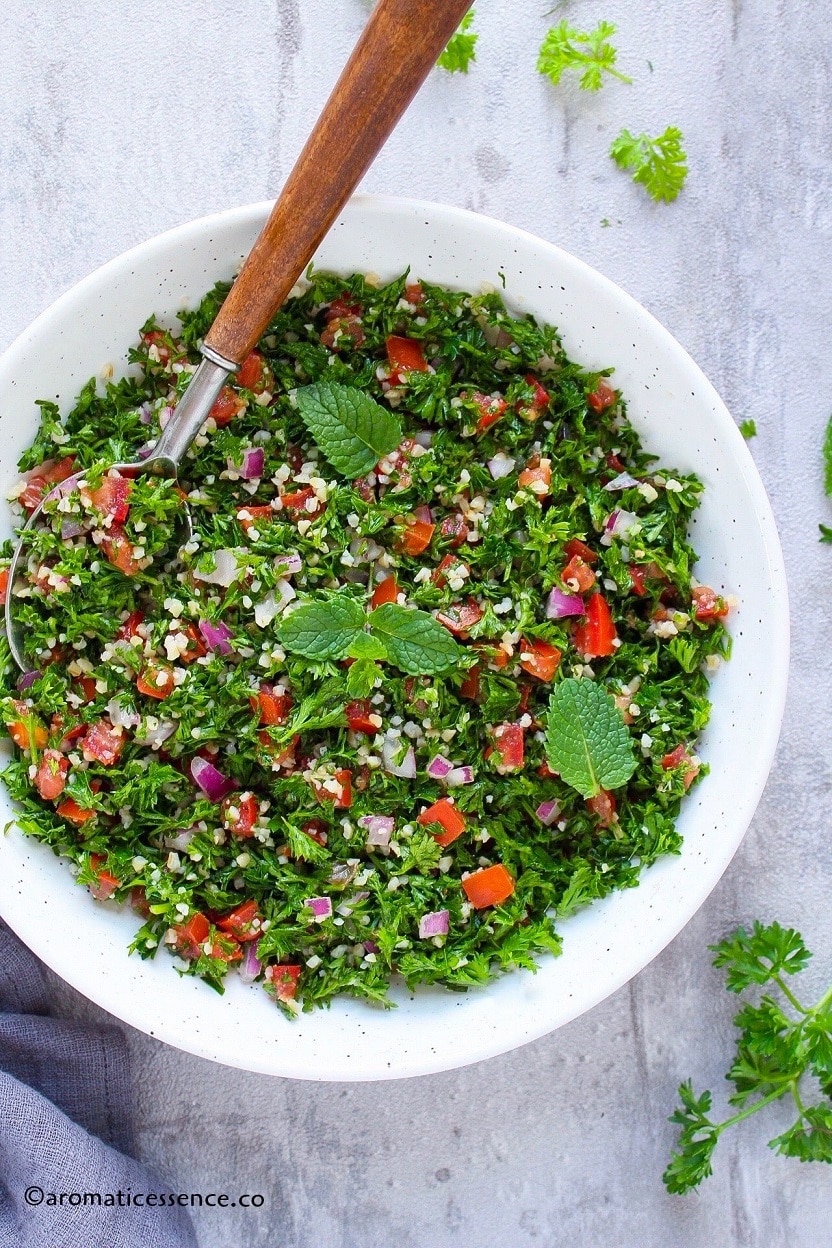
Whether it is hummus, falafel, baba ganoush , or pita bread, who doesn’t love Middle Eastern food? As much as I enjoy eating Arabic food, I also love recreating them in my kitchen. My husband worked for almost 5 years in the Middle East and he has so many wonderful stories to tell me about the food, be it how the shwarma was served up at one particular place, and how it was the best he’d eaten to numerous other delicious food stories.
- What is tabouli?
- Lebanese tabbouleh ingredients
- You will love this Lebanese tabbouleh salad recipe because
- How to make tabouli salad – Step by step instructions
- Serving suggestions
- Make-ahead
- Can you freeze this salad?
- Switch it up
- You may also enjoy these salad recipes
- Tabouli Salad {Lebanese Tabbouleh Salad}
What is tabouli?
The Levantine Arabic tabbūle is derived from the Arabic word tābil , meaning “seasoning” or more literally “dip”. (Source-Wiki)
Tabouli has many spellings and variations as each region or family has their own version of this salad. It really doesn’t matter whether you spell it as tabbouleh, tabouleh, tabouli, taboule, or any other spelling there is out there. This salad is really so refreshing and tasty! It is not only one of the most popular salads in the Middle Eastern countries but has gained popularity worldwide for quite a few years now.
At its core, tabouli is a delicious, vegan salad made with lots and lots of fresh parsley, bulgur wheat, mint, tomatoes, and onions. The herbs and vegetables are finely chopped and tossed with extra virgin olive oil and fresh lemon juice.
Tabouli is essentially a parsley salad and not a bulgar salad. Parsley, a herb that is used mainly as a garnish, is in fact, the star of this salad. The Americanized version of tabbouleh usually has more bulgar and less parsley, so people often think of tabbouleh as a bulgar salad. But the opposite is true!
There is a version in Turkey, known as kisir, where they add more bulgar and less parsley in the salad. However, in the Lebanese version, parsley dominates all the way.
If you really want to make the authentic version, use more of parsley and just enough of bulgar to dot the salad with little specks of grain. At least, the tabbouleh prepared by my favorite Lebanese restaurant back in Lafayette always had more parsley and very little of the bulgar.

Lebanese tabbouleh ingredients
Parsley
This is the most important ingredient in this salad. I’ve used flat-leaf parsley, but you can also use curly parsley if that is all you have.
Unfortunately, there is no substitute for parsley in tabbouleh salad because, in essence, it is called a parsley salad after all. Tabbouleh without parsley is just NOT tabbouleh.
Pro tip:
Prep the parsley a few hours in advance: Parsley needs to be washed thoroughly. Pat dry with a clean kitchen napkin or paper towel and then let it dry completely before storing it in the refrigerator. You could use a salad spinner to get rid of the excess water.
Use a sharp knife to chop the parsley: It is best to chop the parsley with a sharp knife, slicing through it gently. Using a dull knife will cause the parsley leaves to bruise easily.
It is time-consuming to chop up everything this fine, but hey, no pain no gain! Right?
Can you use a food processor? You can, but if you do, please make sure the parsley is absolutely dry. Or else, you will end up a watery, mushy parsley mixture not suitable to be used in the salad. This is where the first pointer of prepping the parsley in advance will also come in handy.
Bulgar
Also known as burghul or burgol, is a whole-grain made from cracked wheat that has been parboiled, dried, milled, and then sorted by size. It is a good source of dietary fiber, proteins, vitamins, and minerals. It has been used in Mediterranean and Middle Eastern cuisine for thousands of years.
Bulgar is commercially available in 4 grades, based on the color or size i.e fine, medium, coarse, and very coarse. #1 bulgar wheat, which is the fine variety, is used to make tabbouleh. It is quite fine and does not need any cooking. A quick soak for 5 minutes is more than enough.
I’ve used the medium variety of bulgar because that’s what I had in my pantry, and it needs a longer soaking time as compared to the fine variety. I prefer the texture of the medium variety as opposed to the fine one.
Many folks treat the fine variety of bulgar differently in this salad.
- Some soak it in lemon juice and then add it to the salad.
- Some just rinse and add it along with the rest of the ingredients, and let the bulgar soak up all the liquid in the salad.
- While some soak it in water for a few minutes, drain and use it.
If you use the coarse variety of bulgar, you may need to soak it for a longer time, about an hour.
Bulgar is cracked wheat grains, so it is not gluten-free. You can still enjoy a gluten-free version of this salad by swapping bulgar wheat with an equivalent quantity of quinoa (a favorite), brown rice, riced cauliflower, millet, or gluten-free orzo pasta. If gluten is not an issue, you could also try using couscous.
Mint leaves
I’ve used fresh mint leaves. In a pinch, you can also use dried mint leaves or a mix of both fresh and dried. You can make this salad without mint, it is not that important an ingredient. But, I love the pop of freshness it adds to the salad.
Tomatoes
Choose firm and ripe tomatoes. When tomatoes are not in season, you could use cherry tomatoes instead.
Pro tip:
De-seed the tomatoes: Scoop out the seeds to prevent excess liquid from making the salad soggy.
Onion
I prefer using red onions in my tabouli salad, for the flavor and the pop of color. A lot of versions use the white and green portion of green onion stalks. Some only use the green portion. Some folks also use white onion. You could also use shallots or chives for that onion flavor. As I’ve said, every household has their own version of this salad. So feel free to use whatever you prefer.
Lemon juice
Use fresh always! The bottled stuff is just not cut out for this salad.
Pro tip:
Be generous with the lemon juice: Tabouli salad should not be dry, it needs to have enough moisture but not be soggy. The bright flavor of the lemon complements the peppery flavor of the parsley and also softens the herbs. For an extra lemony flavor, you could also use the lemon zest.
Olive oil
Use a good quality extra-virgin olive oil!
Salt and freshly cracked pepper
To season!
Pro tip:
Hold off the salt if you intend to refrigerate it for a longer period of time: The salt will draw out excess moisture from the vegetables, and make the salad watery. You can add the salt an hour before you intend to serve it. Or check out this handy make-ahead tip if you want to make this a couple of days in advance.
Spices and other ingredients
Some versions of tabouli call for seven spices. You could also add a pinch of either of these spices: allspice, sumac, coriander, cloves, cinnamon, or baharat spice mix. Add a pinch of cayenne for some kick, if you like.
Some versions also call for pomegranate molasses or juice. I’ve skipped adding any of these. But if you have these ingredients lying around, you could probably try adding them.
I like to keep my tabouli salad simple because I mostly serve it with other dishes that are already packed with a lot of spices. So this salad adds a nice, refreshing element to the whole meal.

You will love this Lebanese tabbouleh salad recipe because
- Easy to make with a few ingredients that are available year-round
- A super refreshing salad with herby and zesty flavors
- It is healthy since it loaded with a chock full of highly nutritious ingredients that are good-for-you
- Vegan-friendly
- Can be easily customized to make it gluten-free
How to make tabouli salad – Step by step instructions
Step 1: Soaking bulgur for tabouli
Place 1/4 cup of fine bulgar in a bowl, add 1/4 cup of hot water, cover and soak for 5 minutes.
I used the medium variety and soaked it for 30 minutes. Drain, squeeze the bulgar well to remove excess moisture. While the bulgar is soaking, start chopping the other ingredients.

Soakedbulgur
Step 2: Prep the rest of the ingredients for the salad
Chop off the thick stems of 2 bunches of parsley. I like to leave some of the tender stalks because they are flavorful. But feel free to just use the leaves. Chop the parsley finely. Chop the mint leaves finely, do not use the stems. You should have about 3 cups of chopped parsley leaves and 1/4 cup of chopped mint leaves for this recipe.

Core 2 medium tomatoes, cut lengthwise into halves, de-seed, and dice into small pieces.

Also, dice 1/2 a red onion finely.

Step 3: Add all the ingredients in a bowl and mix
Place the chopped parsley in a big bowl, add mint leaves, diced tomatoes, red onions, and drained bulgar.
Add 4 tablespoons each of lemon juice and olive oil along with 1/2 teaspoon of kosher salt, and 1/4 teaspoon of freshly cracked black pepper. Toss to combine well. Taste and adjust with more salt or lemon juice, as needed.

Step 4: Refrigerate for at least an hour
Refrigerate the tabouli for at least an hour before serving. Check once again for salt and lemon juice, and adjust if needed right before serving. Tabouli salad is best served chilled or at room temperature, never warm.
Store leftovers in an airtight container in the fridge for up to 1-2 days, drain excess liquid if any as that will make the salad watery.

Notes
- You can substitute the red onion with 2-3 stalks of green onion, dice up the white and green portion finely.
- If you don’t care much for parsley, feel free to increase the quantity of the bulgar wheat.
Serving suggestions
You can enjoy Tabouli salad the way it served traditionally, by scooping in crisp, Romaine lettuce leaf and eaten with hands. You could also serve it as a part of mezze along with hummus, falafel, baba ganoush, etc. It is also great with baked pita chips.
Or serve it as a side along with kabobs, grilled meat, grilled halloumi, grape leaves, kibbeh, etc
Make-ahead
If you like to serve the salad after 2-3 days, it is best to prep up the components and then assemble it an hour before serving.
Soak the bulgar, drain and refrigerate it. Wash, dry, and chop all of the ingredients and place them in a dry bowl. Cover with a cling wrap or with a lid. When you are ready to serve, add the bulgar, salt, olive oil, and lemon juice, mix and refrigerate for an hour before serving.
Can you freeze this salad?
No, I do not recommend freezing this salad. The texture will change, the herbs and veggies will turn limp and wilt. It is best to enjoy this within 2 days or follow the make-ahead alternative mentioned above.
Switch it up
This beloved Levantine salad is great just as it is. But, like always, I’d like to list a few variations, which we also love. I know purists will disapprove of any of these, but if you are in an experimental mood, you could probably try one of these options.
- Lentils: Use green or brown lentils, about 1/4 to 1/2 cup of dry lentils, depending on the proportion of lentil to parsley you’d like. Cook until they are tender, yet firm to the bite, as per package instructions. Let it cool, add it to the rest of the ingredients.
- Farro: Use a 1/4 cup of farro instead of bulgar. The ratio of farro to water is 1:3. So combine 1/4 cup farro and 3/4 cup water in a saucepan, bring to boil, reduce the heat to low, cover and simmer until the farro is tender. Once it has cooled down completely, squeeze out excess moisture and add it to the rest of the ingredients. Farro is not gluten-free.
- Millet: This is yet another fantastic, grain-free alternative to bulgar in this salad. I like to use a 1:2 ratio to cook millet when it comes to pilaf or salad. I also suggest toasting the millet for a few minutes before cooking it. Again, you could use 1/4 cup or more of millet.
- Basil: Try substituting 1/2 of the parsley with finely chopped basil leaves.
- Cucumber: Though not part of the traditional Lebanese recipe, some of the Syrian and Egyptian versions include it, and I think it adds a nice crunch to this salad. If you do choose to add cucumber, use 2-3 Persian cucumbers or 1/2 of an English cucumber, these are seedless and have a thin skin. If using regular cucumbers, peel, remove the seeds, and dice it up.
- Chickpeas or other beans: Add a 15-oz can of rinsed and drained chickpeas or other beans like black beans, kidney beans, etc. This would make for a healthy and filling lunch to take to work.
- Pomegranate: You can throw in about a 1/4 cup of pomegranate arils to add some color and texture to the salad.
You may also enjoy these salad recipes
- Strawberry Spinach Salad
- Caprese Salad
- Watermelon Cucumber Feta Salad
- Mediterranean Quinoa and Chickpea Salad
- Blood Orange Salad with blood orange dressing
- Greek salad
You can also follow me on Facebook , Pinterest, Instagram & Twitter

Tabouli Salad {Lebanese Tabbouleh Salad}
Ingredients1x2x3x
- About 3 cups finely chopped parsley, 2 bunches of flat-leaf parsley
- 1/4 cup loosely packed chopped mint leaves, or 2 teaspoons of dried mint
- 1/4 cup bulgar wheat #1
- 2 medium tomatoes
- 1/2 cup finely chopped red onion
- 4 tablespoons lemon juice, or more to taste
- 4 tablespoons olive oil, or more to taste
- 1/2 teaspoon Kosher salt, or to taste
- 1/4 teaspoon freshly cracked black pepper, optional
Instructions
- Place 1/4 cup of fine bulgar in a bowl, add 1/4 cup of hot water, cover and soak for 5 minutes. I used the medium variety and soaked it for 30 minutes. Drain, squeeze the bulgar well to remove excess moisture. While the bulgar is soaking, start chopping the other ingredients.
- Chop off the thick stems of the parsley. I like to leave some of the tender stalks because they are flavorful. But feel free to just use the leaves. Chop the parsley finely. Chop the mint leaves finely, do not use the stems.
- Core the tomatoes, cut lengthwise into halves, deseed, and dice into small pieces.
- Also, dice the red onion finely.
- Place the chopped parsley in a big bowl, add mint leaves, diced tomatoes, red onions, and drained bulgar.
- Add lemon juice, olive oil, kosher salt, and black pepper. Toss to combine well gently. Taste and adjust with more salt or lemon juice, as needed.
- Refrigerate the tabouli for at least an hour before serving. Check once again for salt and lemon juice, and adjust if needed right before serving. Tabouli salad is best served chilled or at room temperature, never warm.
- Store leftovers in an airtight container in the fridge for up to 1-2 days, drain excess liquid if any as that will make the salad watery.
Notes
- You can substitute the red onion with 2-3 stalks of green onion, dice up the white and green portion finely.
- If you don’t care much for parsley, feel free to increase the quantity of the bulgar wheat.
- Nutrition Disclaimer: Nutrition values listed are estimates calculated using an online nutrition calculator. If you rely on them for your diet, please use your preferred nutrition calculator.
- Measuring cup used, 1 cup = 250 ml, 1 teaspoon = 5 ml
