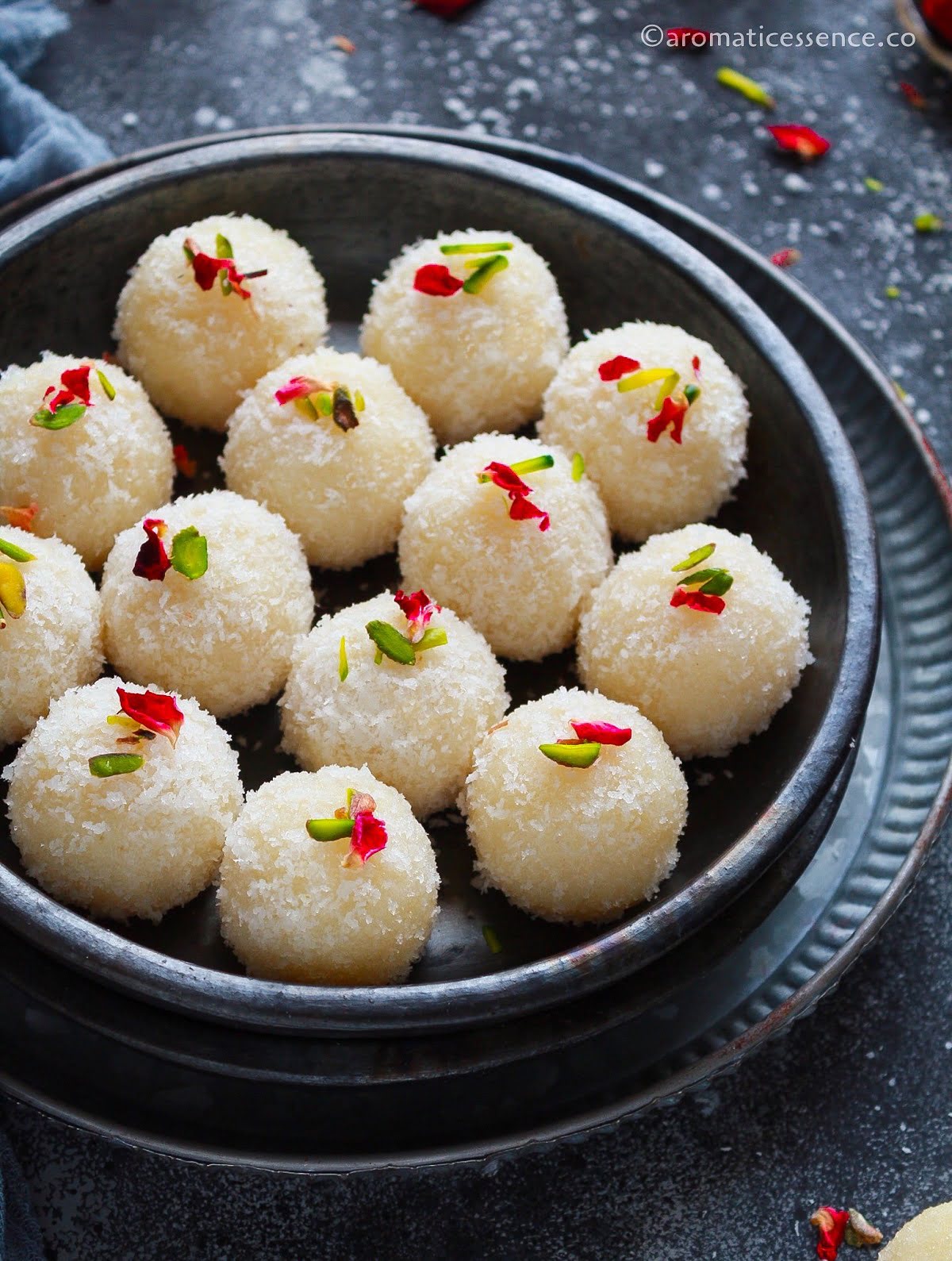
Coconut ladoo (nariyal ladoo) is a traditional Indian dessert prepared for festive occasions. Learn how to make the best coconut ladoo recipe using simple ingredients. These delicious nariyal ladoos are soft, moist, creamy, and melt-in-your-mouth!
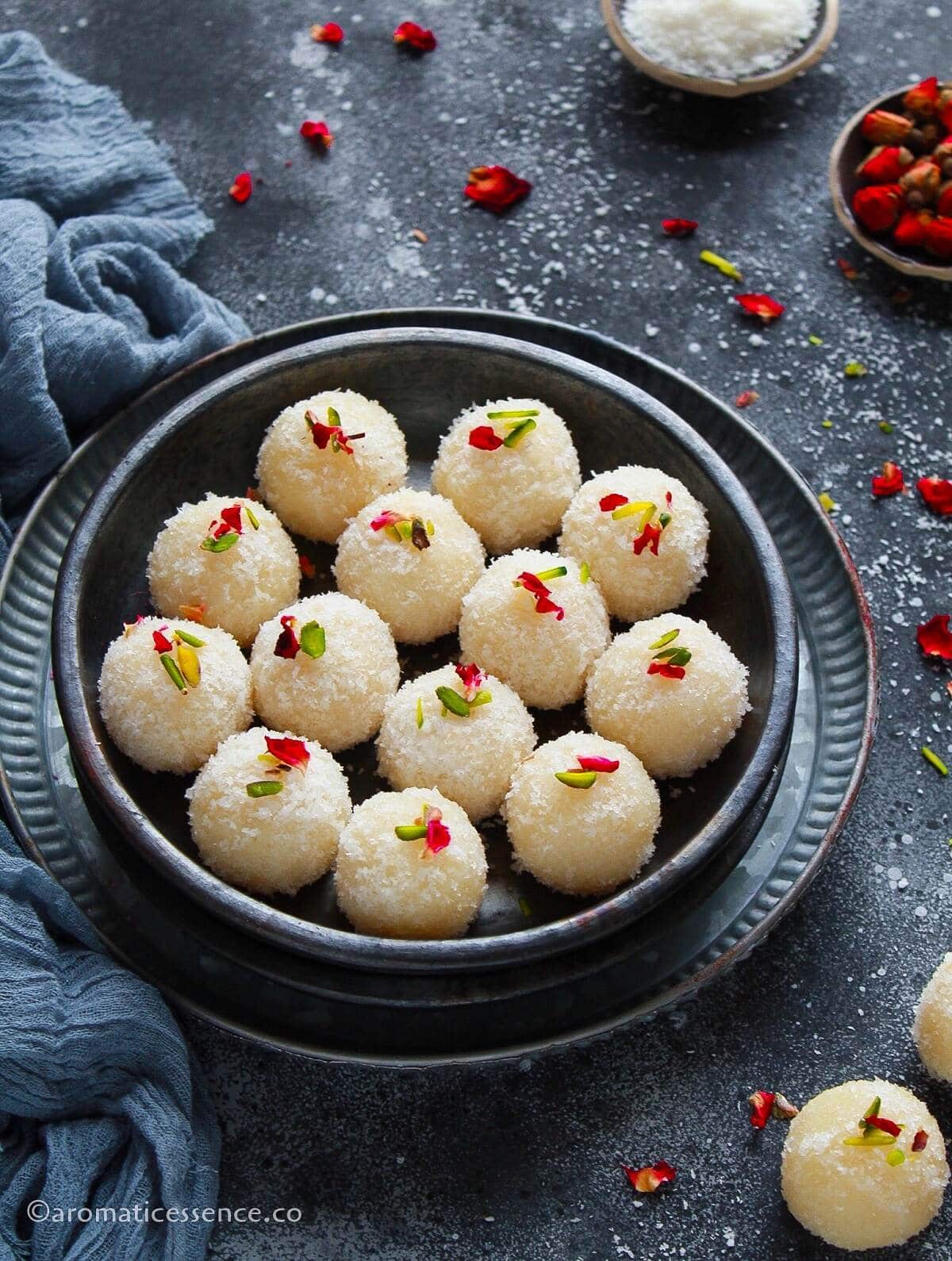
I have a weakness for coconut-based sweets because I’ve been enjoying them ever since I was a kid. These coconut ladoos are no exception! They are pretty easy, quick to prepare, and taste equally delicious. Soft, coconutty, and melt-in-your-mouth!
Coconut is also known as nariyal in Hindi, narkel in Bengali, and naral in Marathi.

There are numerous ways to make coconut laddu (nariyal ladoo);
- With milk and sugar
- With condensed milk
- Sugar syrup
- With jaggery
I will be showing you the first version, i.e. using milk and sugar as I personally prefer this way of preparing ladoos.
They taste insanely delicious and everyone really enjoys them way better than the ones made with condensed milk or sugar syrup.
My husband even suggested I should start selling them, so that definitely says something, now, doesn’t it?
The one made with jaggery is another favorite as coconut and jaggery is a very classic pairing for most desserts in Goa.
- You will love this nariyal ladoo recipe because it is
- Ingredients needed
- How to make coconut ladoo at home – Step by step
- Storage
- Recipe tips
- Variations of these Indian coconut fudge balls
- Frequently asked questions (FAQs)
- You may also enjoy these coconut recipes
- Coconut Ladoo Recipe | Nariyal Ladoo
You will love this nariyal ladoo recipe because it is
✔ A really simple recipe that uses few ingredients and yet yields delicious ladoos
✔ Great for sharing with friends and family
✔ Easily adaptable to make it vegan using either coconut milk or the jaggery version
✔ Perfect for preparing in advance.
✔ An awesome dessert to be served for a large gathering, potlucks, or parties

Ingredients needed
To make this super simple yet delicious coconut laddu, you will need the following ingredients;
- Coconut: I’ve used the fine variety of unsweetened desiccated coconut. It works the best to make these ladoos. However, freshly grated coconut will work equally well in this recipe.
- Milk: Use full-fat milk for best results. For those in the US, you can substitute milk with half and half or evaporated milk.
- Sugar: I’ve used regular granulated sugar. I’ve listed an alternative below to make coconut ladoo with jaggery if you refrain from sweets containing refined sugar.
- Ghee: To roast the desiccated coconut. You can also use an equal amount of coconut oil.
- Cream and milk powder: To increase the richness and creaminess.
- Cardamom powder: To flavor these ladoos. Though it is optional, I highly recommend you include it. Even grated nutmeg would be great. If you don’t like these spices, add vanilla extract.
- Pistachios and dried rose petals: These are optional as I’ve used them just to garnish the ladoos.

Don’t forget to bookmark this recipe to try in the coming weeks. Before you know it Raksha Bandhan will be here followed by all the other festivities. I hope you will give this coconut malai ladoo recipe a go, I’m so sure you will love it 🙂
How to make coconut ladoo at home – Step by step
Step 1: Roast the desiccated coconut
Heat 1 tablespoon ghee in a heavy-bottomed kadai over low heat. ( Photo 1 )
Add 175 grams (2 cups) of desiccated coconut. ( Photo 2 )
Roast over low heat for 2-3 minutes or until it gives out a nutty aroma. ( Photos 3 and 4 )

Step 2: Add milk and cream
Add 1 cup milk and 1/4 cup cream. ( Photos 5 and 6 )
Cook, stirring continuously until the milk is absorbed by the coconut. ( Photos 7 and 8 )

Step 3: Add sugar
Add 160 grams (2/3 cup) sugar. ( Photo 9 )
Mix well, the sugar will melt and release moisture. ( Photo 10 )
Cook, stirring continuously until the mixture releases most of the moisture. ( Photo 11 )

Step 4: Add the remaining ingredients
Add 3 to 4 tablespoons milk powder and 1/2 teaspoon cardamom powder. ( Photos 12 and 13 )
Mix and cook until the mixture comes together, forms a dough-like consistency, and starts leaving the sides of the kadai. ( Photos 14 and 15 )

Step 5: Cool down the mixture and form ladoos
Switch off the heat, and transfer the mixture to a plate or bowl. Allow it to cool down slightly, just warm enough to handle, about 10 minutes. ( Photos 16 and 17)

Grease your palms with little ghee, take about 2 tablespoons of the mixture, form a ball by rolling between your palms. ( Photos 18 to 20 )
Coat it with desiccated coconut and transfer it to a plate. ( Photo 21 )
Repeat with the rest of the mixture to form more ladoos. Garnish with slivered pistachios or other nuts of choice and dried rose petals. ( Photos 22 and 23)

Storage
These coconut laddus will keep well in an airtight container in the fridge for up to 5 days. Let it sit out for 5-10 minutes to take the chill off before serving.
You can also freeze them. To do that, place the ladoos in a single layer in a freezer-safe container.
If you have more ladoos to freeze, first refrigerate them until they firm up a bit and then stack them in single layers between parchment papers.
Coconut ladoo made with milk and sugar are a lot more delicate than the ones made with condensed milk, so refrigerating them for a little while before freezing will help hold their shape and prevent them from getting squished when stacked in the container.
Label the contents and freeze for up to a month. Thaw overnight in the fridge and let sit out for 5-10 minutes before serving.
Recipe tips
Coconut: Use finely desiccated coconut for best results. You may also use fresh or frozen coconut. If using frozen, thaw and use in the recipe. Also, since fresh coconut already has a lot of moisture, your can cut back on the quantity of milk by half.
Avoid over roasting the coconut: Over roasting will alter the taste of the laddoos, it may even taste bitter. Always roast on low heat.
Avoid overcooking the coconut mixture: Do not dry up the mixture completely. It needs to have some amount of moisture. If it is too dry, it will be difficult to shape the ladoos. They will turn dry, crumbly, and fall apart.
Scaling : You can easily halve, double or scale up the recipe depending on the number of ladoos you need. This recipe as such makes about 15 to 16 nariyal ladoos.
Variations of these Indian coconut fudge balls
This is one such recipe that gives you so many options to experiment with. While the plain ‘ol coconut laddus are delicious in their own way, you can always play around with things. Here are a few options to get you started.
Nariyal ladoo with khoya (milk solids): Instead of milk powder add about 1/4 cup of grated mawa or khoya and cook until the mixture leaves the sides of the pan.
Mango coconut ladoo: Include 1 cup of fresh or canned mango pulp for a delicious tropical flavored ladoo. After the milk has been absorbed by the roasted coconut, add the mango pulp, and cook until that is absorbed as well. Then follow the rest of the recipe as mentioned from thereon.
With condensed milk: For instant coconut ladoo, you can use condensed milk. But the texture will vary to a great extent. Expect it to be dense and chewy.
The proportions are 1:1 (by weight). So simply take equal quantities of desiccated coconut and condensed milk. You can go about this version in two ways;
- No-cook version: Simply mix everything in a bowl and make laddoos.
- Quick cooked version: Heat ghee in a heavy-bottomed kadai over medium-low heat. Add the coconut, roast well for 2-3 minutes. Pour in the condensed milk, cook stirring continuously, until the mixture comes together, leaving the sides of the kadai. Add cardamom powder, and mix well. Avoid overcooking the laddoo mixture or else it will turn hard. Switch off the heat, and transfer the mixture to a plate or bowl. Make ladoos as stated above.
Caramel: Use dulce de leche to add a delicious caramel flavor. Follow the same process as that mentioned with condensed milk above. Both the no-cook and cooked versions will work well with dulce de leche.
Rose flavored: Add 2 tablespoons of rose syrup along with the milk powder, and cardamom powder. Proceed with the recipe from thereon. The addition of rose syrup adds a pretty pink color and a lovely floral flavor to this nariyal ladoo. You can reduce the sugar by a few tablespoons as rose syrup is quite sweet.
Saffron-flavored: Dissolve a pinch of saffron in 1 tablespoon of hot milk and set aside for 10 minutes. Add this saffron-infused milk along with the milk and proceed with the recipe.
Chocolate coated: After shaping the ladoos, dip them in melted chocolate. Place them on a rack over a tray to dry completely. If you wish, you can sprinkle some desiccated coconut on top, but do so immediately before the chocolate sets.
Nuts: You can also throw in some ghee-roasted nuts along with the cardamom powder to add some crunch to these ladoos.

Why am I having a difficult time shaping the ladoos?
If you take the mixture off the heat earlier, the mixture will be too soft to roll or shape the ladoos. Have a look at the video to get a visual reference of the consistency. It should form a dough-like mass and leave the sides of the pan. You can test by pinching a small portion of the mixture to see if it can be rolled.
Let the mixture cool down a little (not completely cool, it should be slightly warm), and then try to make the ladoos. If it is still soft and you cannot make ladoos at this stage, then put the mixture back on the pan, and cook for another 4-5 minutes, stirring continuously. Then allow to cool for some time and try making the laddoos again.
Can I substitute desiccated coconut with freshly grated coconut in this recipe?
Yes, you can! Use the same amount of fresh coconut. You will just need to saute it longer until the moisture dries out. Be sure to do it over low heat to avoid browning the coconut too much.
Can I make coconut ladoo recipe with jaggery?
Yes, you can! Kobbari louz is a delicious version of coconut jaggery ladoo made in Andhra Pradesh. A similar recipe is made in Bengal, known as narkel naru.
The only thing is the color of these ladoos, they will be light to dark brown, depending upon the type of jaggery you use. You can use either sugarcane or palm jaggery.
For this version, skip the milk. Also, it’s best to use freshly grated coconut for this recipe.
Follow the same process of roasting 2 cups of fresh coconut, then add 1 cup of grated jaggery or jaggery powder. The jaggery will melt as it heats up and release moisture. Continue cooking on medium-low heat until the mixture thickens and leaves the sides of the pan, about 5-6 minutes. Then follow the same procedure as shown to make the ladoos.
Can I make this recipe vegan?
Yes, you definitely can. You can swap the dairy with coconut milk, ghee with coconut oil, and cream with coconut cream. Skip the milk powder.
Or simply make the jaggery version as jaggery is vegan and that recipe doesn’t need milk.
You may also enjoy these coconut recipes
- Eggless Coconut cookies
- Goan baath cake
- No-cook coconut ice
- 2 ingredient coconut macaroons
- Coconut toffee
You can also follow me on Facebook , Pinterest, Instagram & Twitter

Coconut Ladoo Recipe | Nariyal Ladoo
Ingredients1x2x3x
- 1 tablespoon ghee, 1/2 tablespoon more to grease your palms
- 175 grams desiccated coconut, 2 cups, plus 1/4 cup more for coating
- 1 cup full-fat milk
- 160 grams sugar, 2/3 cup
- 60 grams heavy cream or fresh malai, 1/4 cup
- 3 to 4 tablespoons milk powder, optional but recommended
- 1/2 teaspoon cardamom powder
Instructions
- Heat ghee in a heavy bottomed kadai over low heat.
- Add desiccated coconut and roast over low heat for 2-3 minutes or until it gives out a nutty aroma.
- Add milk and cream, cook, stirring continuously, until the milk is absorbed by the coconut.
- Add sugar and mix well. The sugar will melt and release moisture. Cook, stirring continuously, until the mixture releases most of the moisture.
- Add the milk powder and cardamom powder.
- Mix and cook until the mixture comes together, forms a dough-like consistency, and starts leaving the sides of the kadai.
- Switch off the heat, and transfer the mixture to a plate or bowl. Allow it to cool down slightly, just warm enough to handle, about 10 minutes.
- Grease your palms with little ghee, take about 2 tablespoons of the mixture, form a ball by rolling between your palms.
- Coat it with desiccated coconut and transfer it to a plate.
- Repeat with the rest of the mixture to form more ladoos. Garnish with slivered pistachios or other nuts of choice and dried rose petals.
Video
Notes
Nutrition

Coconut Ladoo Recipe | Nariyal Ladoo
Ingredients
- 1 tablespoon ghee, 1/2 tablespoon more to grease your palms
- 175 grams desiccated coconut, 2 cups, plus 1/4 cup more for coating
- 1 cup full-fat milk
- 160 grams sugar, 2/3 cup
- 60 grams heavy cream or fresh malai, 1/4 cup
- 3 to 4 tablespoons milk powder, optional but recommended
- 1/2 teaspoon cardamom powder
Instructions
- Heat ghee in a heavy bottomed kadai over low heat.
- Add desiccated coconut and roast over low heat for 2-3 minutes or until it gives out a nutty aroma.
- Add milk and cream, cook, stirring continuously, until the milk is absorbed by the coconut.
- Add sugar and mix well. The sugar will melt and release moisture. Cook, stirring continuously, until the mixture releases most of the moisture.
- Add the milk powder and cardamom powder.
- Mix and cook until the mixture comes together, forms a dough-like consistency, and starts leaving the sides of the kadai.
- Switch off the heat, and transfer the mixture to a plate or bowl. Allow it to cool down slightly, just warm enough to handle, about 10 minutes.
- Grease your palms with little ghee, take about 2 tablespoons of the mixture, form a ball by rolling between your palms.
- Coat it with desiccated coconut and transfer it to a plate.
- Repeat with the rest of the mixture to form more ladoos. Garnish with slivered pistachios or other nuts of choice and dried rose petals.
Video
Notes
Nutrition
Sitaphal Basundi is a delicious twist to the classic basundi recipe. Thickened and mildly sweetened milk is flavored with the sweet and luscious flavor of ripe custard apple.
You need a few ingredients to make this basundi, perfect to be enjoyed during the upcoming festive seasons!

It’s been a while since I’ve posted anything on the blog. I’ve been away due to some unforeseen issues, but now that I’m back, I hope I can continue sharing a lot of delicacies in the coming months.
Let me start off with this delicious sitaphal basundi recipe. The basic basundi recipe is made by reducing the milk to half, which is then sweetened with some sugar and flavored with cardamom. That’s about it!
Basundi is great as it is, but it is so much better when it’s infused with the sweet flavor of custard apple.
This dessert is popular in the states of Western India, especially in Gujarat and Maharashtra. Basundi is a lighter version of the North Indian Rabri. The difference between the two is in the texture and consistency.
Basundi is thinner in consistency as opposed to rabri which is quite thick. Rabri is usually lachchedar (layers of milk fat) that offers a bite, while basundi is usually smooth and creamy. Rabri is also more time-consuming because the milk is reduced to almost 1/3rd of 1/4th of its original quantity.

I happened to try this Sitaphal Basundi for the first time at a restaurant that serves Gujarati thali a couple of years ago. I was in love with this version of basundi. I knew I was going to try making it at home.
I realized that I’ve never posted any custard apple dessert on the blog. So, I’m glad I can finally share something related to it on this space. Custard apples lend themselves beautifully in most dessert recipes, be it kulfis, ice creams, rabri, or milkshakes.
Custard apple is also known as sitaphal, sharifa, sugar apple, bull’s heart, and cherimoya. Besides being delicious, they offer numerous health benefits.
The recipe for sitaphal basundi is really simple, but you need to be attentive as is the case with every milk-based dessert. It is delicious, quite addictive, and something that I’m sure you guys will enjoy.
So, let’s see how it’s made!
- Ingredients needed to make custard apple basundi
- Why must you try this recipe?
- How To Make Sitaphal Basundi- Step By Step process
- Storage Suggestions
- Recipe Tips
- Variations of this recipe
- Frequently Asked Questions (FAQ’s)
- You may also enjoy these Indian milk-based desserts
- Sitaphal Basundi | Custard Apple Basundi
Ingredients needed to make custard apple basundi
To make sitaphal basundi, you will need;
Milk: I’ve used full-fat milk and I suggest sticking to the same for best results.
Sugar: To sweeten the basundi. Adjust as per the sweetness of the custard apple.
Custard apple pulp: This is the star ingredient of this basundi that adds a lovely flavor to the basundi.
Other ingredients: Besides, these three ingredients, I’ve also used cardamom to elevate the taste of this basundi. I’ve also added some slivered almonds and pistachios for texture and crunch.

Why must you try this recipe?
✔ Custard apples are currently in season in India, and that is reason enough to whip up this sweet treat
✔ It is an easy dessert that is creamy, rich, and delicious
✔ Delicious dessert to serve at potlucks or gatherings
✔ Needs minimal ingredients
✔ Perfect to be served during the upcoming festivities such as Navratri, Diwali etc
✔ Can be had on days when you observe fasts
How To Make Sitaphal Basundi- Step By Step process
Step 1: Bring milk to a boil
Heat 1-litre full-fat milk in a heavy-bottomed pan or kadai over medium heat, stirring occasionally in between. Bring to a boil. ( Photos 1 to 3 )

Step 2: Reduce the milk until thickened
Reduce the heat to low, and continue cooking the milk. Scrape the sides of the pan and stir frequently to prevent it from sticking at the bottom of the pan. Cook until the milk reduces to half (2 cups). ( Photo 4 )

Step 3: Sweeten and flavor the milk
Now, add 1/4 cup sugar, mix well and cook further for 2-3 minutes, until the sugar dissolves. ( Photos 5 and 6 )

Add 1/4 teaspoon cardamom powder, and 1/2 tablespoon each of slivered almonds and pistachios. Mix well, and cook for another 1-2 minutes. ( Photos 7 to 10 )

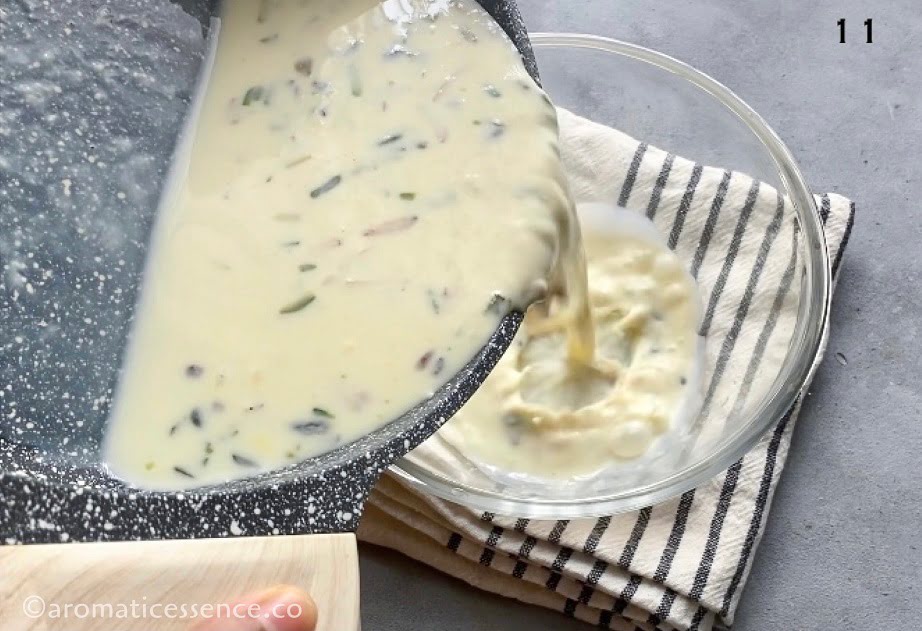
Switch off the heat, and transfer the basundi to a heat-proof bowl. Set aside to cool down completely. ( Photo 11 )
Step 4: Add custard apple pulp
Once the basundi reaches room temperature, add the custard apple pulp, and mix well. Cover the bowl, and refrigerate for 2-3 hours or until you are ready to serve. ( Photos 12 to 15 )
Transfer to serving bowls and garnish with the remaining 1/2 tablespoon each of slivered almonds and pistachios.

Storage Suggestions
Refrigerate custard apple basundi in an airtight container for up to 2 to 3 days. This tastes best when it is served chilled.

Recipe Tips
Full-fat milk: For creamy, milk-based desserts, always use full-fat milk. For a richer and creamier basundi, you can also use buffalo’s milk. If you are watching your calories, feel free to use low-fat milk.
Use a wide and thick bottomed vessel: Though not necessary, try and use a wide pan, as it has more surface area, which helps in reducing the milk faster. Whether you choose to use a kadai or a wide pan, make sure that it has a thick base, so that the milk does not scorch and brown at the bottom of the pan.
Remember to keep stirring: This is the most important point with milk-based sweets that need a long time to cook. If you walk away from the stovetop, chances are that the milk will stick to the bottom, and it may also boil, and spill over the pan. Pay attention to the milk, and keep stirring every 1 to 2 minutes.
Use ripe custard apple: Try and use fully ripe custard apples as the flesh tends to be soft and really sweet. It is also much easier to separate the seeds and pulp.
Do not add custard apple pulp to the hot basundi: Doing so might curdle the milk. Always add it once the basundi cools down completely. The pulp will also taste fresh and way better when added once the basundi cools down completely.
Adjust sugar as required: Feel free to adjust the quantity of sugar as per your desired sweetness. Taste the custard apple pulp and check for sweetness. If you end up adding too much sugar and the basundi becomes too sweet for your liking, salvage it by adding some thickened and reduced milk.
Variations of this recipe
With condensed milk: You can use condensed milk here instead of sugar for a richer, creamier, and thicker basundi. Start with 100 grams, taste, and adjust the sweetness as required. Remember to factor in the sweetness from the sitaphal pulp as well.
Saffron: You can add some saffron strands for a light golden-colored basundi. Add the strands after the milk comes to a boil, and follow the rest of the recipe as is. Do not add too much saffron as it can overpower the delicate flavor of the custard apple.
Nutmeg: You can use nutmeg in combination with cardamom, or else you can swap cardamom entirely with nutmeg powder.
Vegan: Use your favorite plant-based milk for a vegan version. If it doesn’t thicken to your liking, then add cornflour/cornstarch slurry (2 teaspoons of cornflour mixed with 1 tablespoon of plant-based milk).

How to remove the seeds from custard apple?
There are 3 ways in which you can deseed the custard apple;
- Manually: The most time-consuming process. Break apart the fruit in half lengthwise. You have to manually separate the seed from the flesh using your fingers.
- Using a fine-mesh sieve: Place a fine-mesh strainer over a bowl. Scoop the custard apple flesh using a spoon into the strainer. Use a spoon, spatula, or whisk to agitate the pulp vigorously to separate the seeds and flesh. Pick the seeds and transfer the flesh to the bowl. Refer recipe video.

- Using a food processor: This is similar to the method above. Transfer the pulp to the bowl of a food processor fitted with the blade. Pulse 1-2 times, until the seeds separate from the flesh. Do not overprocess, or you will end up with tiny bits of seeds scattered in the pulp, which is really unpleasant to eat.
Amongst the three methods mentioned above, I prefer using the bowl and strainer method.
Why is my custard apple basundi bitter?
Avoid scraping and scooping out the custard apple flesh that is closest to the skin as it will render a bitter taste and a grainy texture to the basundi.
Are Sitaphal Basundi and Sitaphal cream the same?
The two are not the same. Sitaphal cream is made by folding sitaphal pulp in sweetened whipped cream. It is similar to this mango cream recipe . If you’d like to make it, just swap the mango with sitaphal pulp.
You may also enjoy these Indian milk-based desserts
Rasmalai
Kalakand
Mango kheer
You can also follow me on Facebook , Pinterest, Instagram & Twitter

Sitaphal Basundi | Custard Apple Basundi
Ingredients1x2x3x
- 1 litre full-fat milk, 4 cups
- 50 grams sugar, approx 1/4 cup
- 200 grams custard apple pulp, about 3/4 cup
- 1/4 teaspoon cardamom powder
- 1 tablespoon slivered pistachios, divided
- 1 tablespoon slivered almonds, divided
- dried rose petals, as required for garnishing, optional
Instructions
- Heat milk in a heavy-bottomed pan or kadai over medium heat, stirring occasionally in between. Bring to a boil.
- Reduce the heat to low, and continue cooking the milk. Scrape the sides of the pan and stir frequently to prevent it from sticking at the bottom of the pan. Cook until the milk reduces to half (2 cups).
- Now, add sugar, mix well and cook further for 2-3 minutes, until the sugar dissolves.
- Add cardamom powder, and half of the slivered almonds and pistachios. Mix well, and cook for another 1-2 minutes.
- Switch off the heat, and transfer the basundi to a heat-proof bowl. Set aside to cool down completely.
- Once the basundi reaches room temperature, add the custard apple pulp, and mix well. Cover the bowl, and refrigerate for 2-3 hours or until you are ready to serve.
- Transfer to serving bowls and garnish with the remaining 1/2 tablespoon each of slivered almonds and pistachios.
